


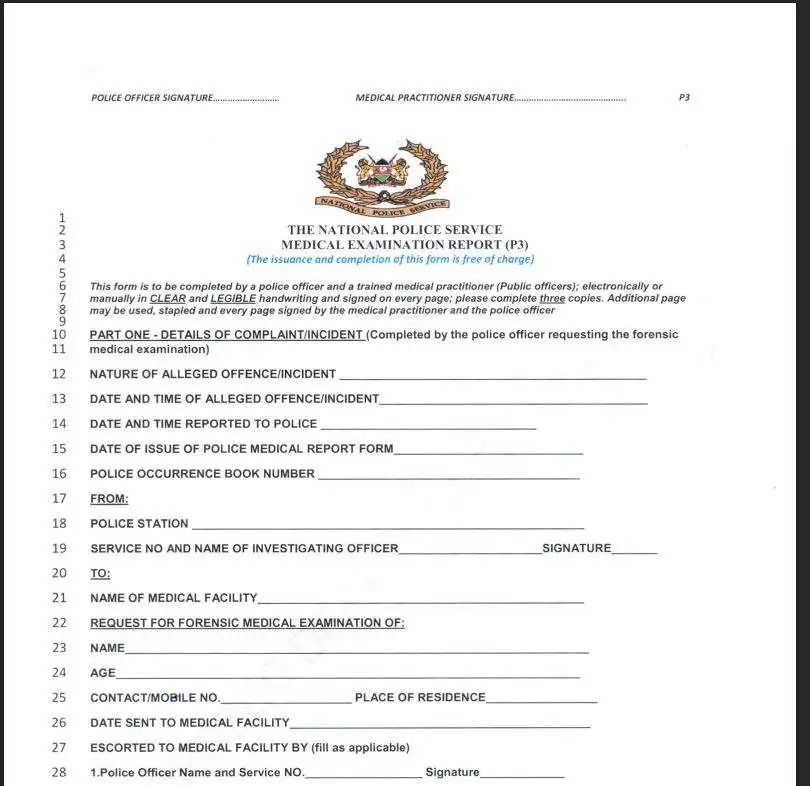
Sample of the official Kenya Police P3 Form – the key document for recording injuries in criminal cases.
The P3 Form, formally the National Police Service Medical Examination Report, is an essential legal document in Kenya used to record medical findings related to physical injuries from assaults, road accidents, sexual violence, or other offences. It provides crucial evidence that supports police investigations, prosecutions, and civil claims, such as insurance or compensation cases. The form is free and available at any police station or for download from official National Police Service sources.
What Is the P3 Form and When Do You Need It?
The P3 Form documents the extent of bodily harm, including details of injuries, their probable cause, age, and severity (harm, grievous harm, or maim). It is required in cases involving:
- Assault or battery
- Sexual offences (including rape or defilement)
- Road traffic accidents causing injury
- Domestic violence with physical harm
- Any incident where medical evidence is needed for legal action
Without a properly completed P3 Form, pursuing justice or compensation becomes significantly more difficult, as courts rely heavily on this objective medical record.
Requirements Before Filing a P3 Form
To initiate the process, prepare the following:
- A valid national ID, passport, or birth certificate (for minors)
- Report the incident to the nearest police station immediately or as soon as possible
- Obtain an Occurrence Book (OB) number or police reference number
- Have details of the alleged offence, including date, time, and location
- For minors or vulnerable persons, an authorized guardian or parent must accompany
The form itself requires no payment – any demand for fees contravenes court rulings and the Police Charter.
Step-by-Step Guide: How to File a P3 Form in Kenya
Visit your nearest police station to start the P3 Form process – reporting is the first essential step.
- Report the incident: Go to the nearest police station and report the offence. Provide a detailed statement. The officer will record it in the Occurrence Book and assign an OB number.
- Request the P3 Form: Ask the investigating officer (usually the Officer Commanding Station or designated officer) to issue and complete Part 1 of the P3 Form. This section includes complainant details, nature of the offence, and escort information if needed.
- Download if preferred: Alternatively, download the latest P3 Form from the official National Police Service website or forms section. Print three copies (as required for multiple records).
- Visit a medical facility: Take the partially completed form to a government hospital, dispensary, or approved medical practitioner. The doctor conducts a forensic medical examination and completes Parts 2 (general details), including sections A (clothing, history, general exam), B (injury details for assaults), C (sexual offences specifics), and others as applicable.
- Examination and documentation: The medical officer examines you thoroughly, notes injuries, collects specimens if necessary (e.g., for sexual offences), and assesses harm level. Both the police officer and doctor sign every page.
- Return to police: Submit the completed form back to the investigating officer. It becomes part of the case file for further investigation and potential court use.
- Keep copies: Ensure you receive a stamped copy for your records. The medical officer and police retain others.
Act quickly – delays can affect injury age assessment and evidence freshness.
Common Challenges and How to Overcome Them
Some victims face barriers like distance to facilities or reluctance from officers. If faced with demands for payment, politely reference the High Court ruling (Embu High Court, 2019) declaring the P3 Form free. For rural areas, seek assistance from local NGOs or legal aid organizations specializing in access to justice.
In sexual offence cases, request a Post-Rape Care (PRC) kit alongside the P3 to ensure immediate medical support and evidence preservation.
After Filing: What Happens Next?
Once filed, the P3 Form supports:
- Police investigations and suspect arrests
- Director of Public Prosecutions (DPP) review
- Court proceedings where the medical officer may testify
- Compensation claims or civil suits
The form remains a permanent record, strengthening your case significantly.
Frequently Asked Questions
Is the P3 Form free in Kenya?
Yes, the P3 Form is completely free of charge as per National Police Service regulations and court declarations. No fees should be charged for issuance, completion, or copies.
Who can fill the P3 Form?
Part 1 is completed by a police officer requesting the examination. Parts detailing medical findings are filled only by a qualified medical practitioner at a government or approved facility.
Can I download and print the P3 Form myself?
Yes, download the official form from nationalpolice.go.ke or npsc.go.ke. Print three copies, but Part 1 still requires police completion before medical examination.
How long does the P3 Form process take?
It varies by location and urgency. Reporting and police section can take hours to a day; medical examination usually same-day if you visit promptly. Aim to complete within days of the incident.
What if I’m a minor or unable to go alone?
Minors must be accompanied by a parent, guardian, or authorized person. The escort details are recorded on the form for legal protection.
Is the P3 Form required for insurance claims after an accident?
Yes, many insurers and courts require a completed P3 Form as proof of injuries sustained in road accidents or assaults.

The Kenyan flag symbolizes the official and accessible nature of public services such as obtaining a P3 Form.
Understanding how to file a P3 Form in Kenya empowers victims to preserve evidence and pursue justice effectively. Always report incidents promptly, insist on your rights to a free form, and seek professional support if challenges arise. Proper documentation through the P3 can make a decisive difference in legal outcomes.