Starting forex trading for beginners can feel overwhelming, yet thousands of people successfully place their first trade every month by following a clear plan. The currency market never sleeps and offers opportunities that stocks simply cannot match.
Did you know that the forex market moves more than $7 trillion every single day? This guide walks you through every practical step so you can move from complete beginner to placing your first live trade with confidence and proper risk control.

The global forex market offers 24-hour opportunities for those who understand the basics.
What Exactly Is Forex Trading?
Forex, short for foreign exchange, is the global marketplace where currencies are bought and sold. When you trade forex you are simply exchanging one currency for another, hoping the value of the currency you bought rises against the one you sold.
Unlike stock markets that close, the forex market runs 24 hours a day from Monday to Friday. This continuous trading creates constant opportunities. The truth many new traders miss is that you do not need large capital to start. Many brokers allow accounts with as little as $50 or $100.
Major currency pairs such as EUR/USD, GBP/USD, and USD/JPY dominate the volume. These pairs offer tight spreads and high liquidity, making them ideal for forex trading for beginners.
The Shocking Reality Most Beginners Face
Here is the untold truth: the majority of retail traders lose money in their first year. The reason is rarely the market itself. Poor risk management, emotional decisions, and lack of a simple plan destroy accounts faster than any chart pattern.
The hidden advantage successful beginners share is discipline. They treat trading like a skill that must be practiced on a demo account before risking real money. This single habit separates those who survive from those who quit within months.
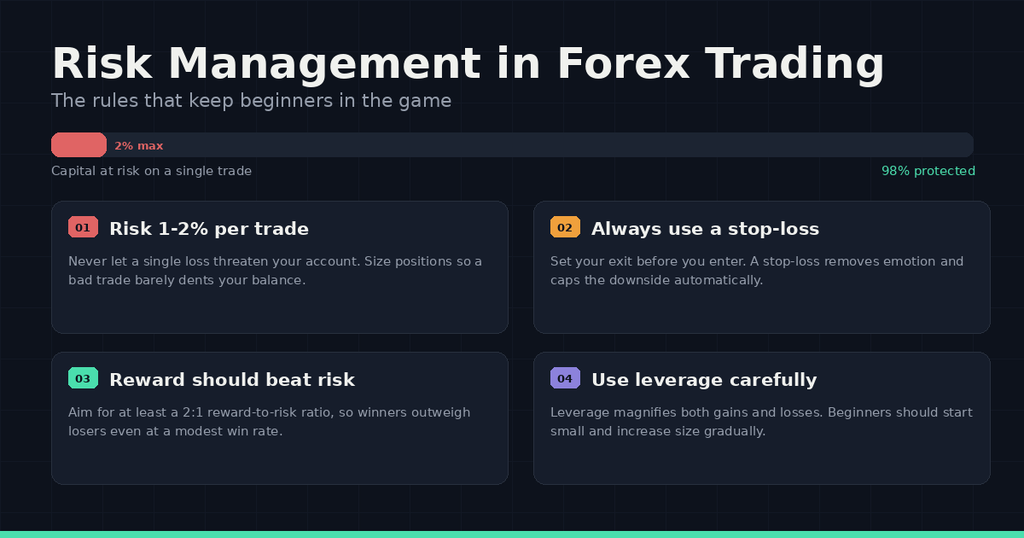
Proper risk management is the secret that protects beginner accounts.
Step 1: Learn the Core Concepts
Before opening any account you must understand a few essential terms.
- Currency Pair – Always quoted as Base/Quote (example: EUR/USD).
- Pip – The smallest price movement, usually the fourth decimal place.
- Lot Size – Standard lot = 100,000 units. Mini and micro lots exist for smaller accounts.
- Leverage – Borrowed capital that amplifies both gains and losses.
- Spread – The difference between the buy and sell price charged by the broker.
Mastering these terms takes only a few focused hours. Once they feel natural, the rest of forex trading for beginners becomes far clearer.
Step 2: Choose a Regulated Broker
Your broker is the gateway to the market. Choose carefully.
Look for regulation by trusted authorities such as the FCA (UK), ASIC (Australia), or CySEC (Europe). These licenses force brokers to keep client funds segregated and follow strict rules.
Key features beginners need:
- Low minimum deposit
- Free demo account with real market data
- MetaTrader 4 or MetaTrader 5 platform
- Transparent spreads and no hidden fees
- Fast withdrawals and responsive support
Never deposit money with an unregulated broker. The risk of losing funds permanently is simply too high.

A regulated broker is the foundation of safe forex trading for beginners.
Step 3: Open and Practice on a Demo Account
Every serious path into forex trading for beginners starts with a demo account. Most brokers give you virtual money that mirrors real market conditions.
Spend at least two to four weeks trading only on demo. Treat the virtual balance as if it were real money. Practice entering and exiting trades, setting stop-loss orders, and calculating position size.
This practice phase reveals the emotional side of trading without costing you a single dollar. Many traders discover their biggest weaknesses here and correct them before going live.
Step 4: Build a Simple First Strategy
You do not need complex indicators to place your first trade. A straightforward approach works best.
One reliable beginner method:
- Identify the overall trend using a 200-period moving average.
- Look for price to pull back toward the average.
- Enter in the direction of the trend when a clear candlestick signal appears.
- Place a stop-loss beyond the recent swing high or low.
- Aim for a risk-reward ratio of at least 1:2.
Keep the rules written down. The moment you start changing them mid-trade, emotion takes over.
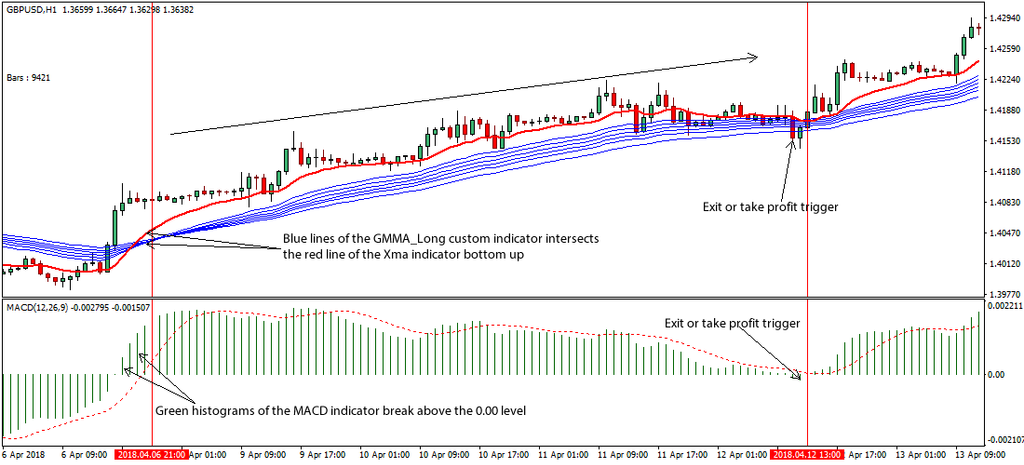
A clear, rules-based strategy removes guesswork from your first trades.
Step 5: Master Risk Management – The Real Secret
This is the single most important section in any guide to forex trading for beginners. Risk only 1% to 2% of your account on any single trade.
Example: With a $500 account, risk no more than $10 per trade. Calculate the distance to your stop-loss in pips, then size the position so that the dollar risk stays inside that limit.
Never increase position size after a winning streak. Never revenge-trade after a loss. These two rules alone protect more beginner accounts than any indicator ever will.
Step 6: Place Your First Live Trade
Once you have consistent results on demo and feel comfortable with the platform, fund a small live account.
Start with the smallest possible lot size (usually 0.01). Choose a major pair during the London or New York session for better liquidity. Follow your written plan exactly. Set the stop-loss and take-profit levels before you click buy or sell.
After the trade closes, review it honestly. What went right? What could improve? Journaling turns every trade into a lesson.
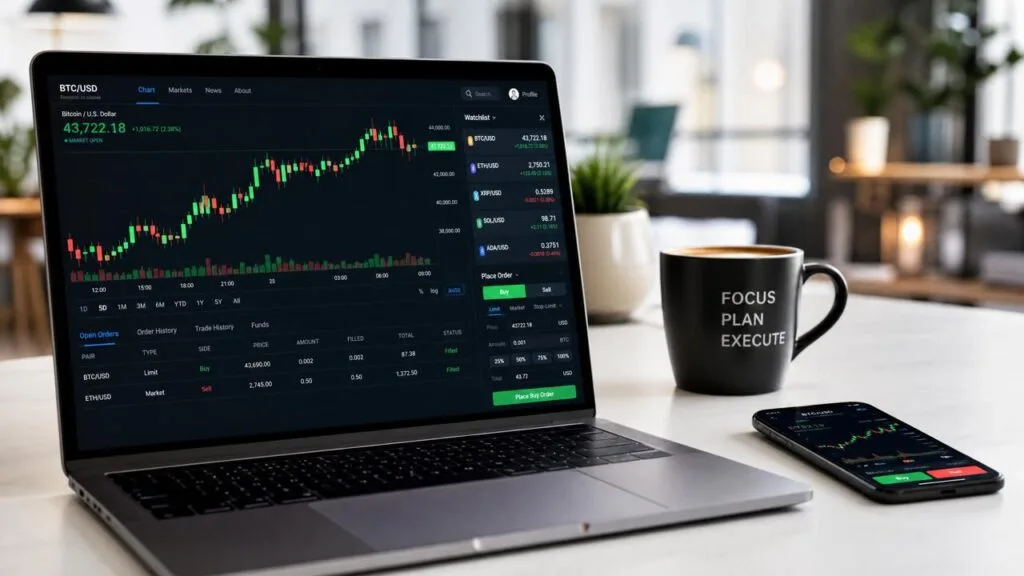
Your first live trade should feel calm and controlled, not exciting.
Step 7: Keep Learning and Stay Disciplined
Markets change. Successful traders never stop studying. Follow economic calendars for major news events such as interest rate decisions or employment data. These events can move pairs dramatically in minutes.
Continue using a trading journal. Review weekly. Adjust only when the data shows a clear improvement, never because of one bad day.
For more insights on global financial topics and education resources, explore related content on our about page.
Common Mistakes That Destroy Beginner Accounts
- Trading without a stop-loss
- Using maximum leverage from day one
- Overtrading out of boredom or excitement
- Ignoring the economic calendar
- Chasing losses with larger positions
Avoid these traps and your path becomes dramatically smoother.
Authoritative sources such as the Investopedia forex education section and the IG forex beginners guide provide additional depth on market mechanics and risk.

Recognizing these pitfalls early is half the battle won.
Ready to Take the Next Step?
You now hold a complete roadmap for forex trading for beginners. The market will still test your emotions, but you have the tools to respond with skill instead of panic. Open a demo account today, practice the steps outlined here, and move to a live account only when consistency appears.
Your first trade does not need to be perfect. It only needs to follow the plan. Start small, stay disciplined, and let experience compound over time.
Frequently Asked Questions
How much money do I need to start forex trading for beginners?
Many regulated brokers accept deposits as low as $50 or $100. Begin with an amount you can afford to lose completely while you learn.
Is forex trading for beginners actually profitable?
It can be, but only with strict risk management and continuous learning. Most new traders lose money because they skip the demo phase and risk too much too soon.
How long should I practice on a demo account?
A minimum of two to four weeks of consistent trading is recommended. Some traders stay on demo for several months until their strategy proves reliable.
What is the best currency pair for forex trading for beginners?
EUR/USD is the most popular choice because of its high liquidity, tight spreads, and relatively smooth price action during major sessions.
Can I trade forex while keeping a full-time job?
Yes. Many successful part-time traders focus on the London or New York sessions and use pending orders so they do not need to watch the screen constantly.
What leverage should beginners use?
Start with low leverage such as 1:10 or 1:20. Higher leverage amplifies losses as quickly as it amplifies gains and is the fastest way for new accounts to disappear.