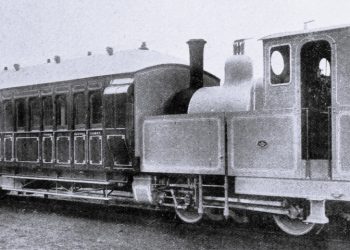



The 0-4-0 steam locomotive represents one of the simplest and most historically significant wheel arrangements in railway engineering. Under Whyte notation, it indicates no leading wheels, four powered and coupled driving wheels on two axles, and no trailing wheels. Compact yet powerful, this configuration became an enduring symbol of industrial shunting, early railway development, and locomotive evolution.
The earliest examples, such as Richard Trevithick’s Coalbrookedale locomotive (1802), pioneered the use of steam power for rail transport. Though initially limited by instability at high speeds, the 0-4-0 type thrived in yards, docks, mines, and tramways, where tight curves and short distances favored maneuverability over speed.
Design and Technical Characteristics
The defining feature of the 0-4-0 design is that all the locomotive’s weight rests on its driving wheels, maximizing tractive effort and adhesion. The arrangement was simple and easy to maintain, consisting of only two driven axles linked by coupling rods or, in early designs, gear wheels.
Two main types evolved:
- Tender engines, which hauled separate fuel and water cars.
- Tank engines, which carried fuel and water on board (denoted 0-4-0T).
The tank variants—including saddle tanks (ST), side tanks (T), and well tanks (WT)—became common from the 1850s onward. Their self-contained design made them ideal for industrial operations and short-haul freight.
In European UIC classification, the 0-4-0 corresponds to Class B; in French and Turkish notation, it is 020 and 22, respectively.
Historical Development
Early Pioneers (1802–1830)
The first 0-4-0 tender locomotives were built by Richard Trevithick between 1802 and 1805. His Coalbrookedale, Pen-y-Darren, and Newcastle engines used gear connections between axles rather than rods.
By 1825, Robert Stephenson’s Locomotion No. 1 introduced coupling rods, becoming the first operational 0-4-0 of its kind. Soon after, engines such as Lancashire Witch (1828) and Timothy Hackworth’s Sans Pareil (1829) expanded its utility.
Mid-19th Century Expansion
The design’s simplicity made it a staple for small railways and contractors. In Britain, Robert Sinclair of the Caledonian Railway designed six saddle-tank 0-4-0s around 1850, setting the standard for industrial use.
By 1860, Hudson, Barclay, and Hudswell Clarke were mass-producing 0-4-0 saddle tanks for factories, quarries, and harbors. Many remained in use into the mid-20th century, particularly as dockyard and works shunters.
Global Usage
United Kingdom
The United Kingdom saw widespread use of both tender and tank types.
- Edward Bury’s bar-framed locomotives (1840s) exemplified the 0-4-0 tender type.
- Manning Wardle and Hudswell Clarke supplied countless 0-4-0ST industrial locomotives.
- Aveling & Porter produced road traction engine-style locomotives, bridging agricultural and railway technology.
The last British Railways 0-4-0ST was built in 1955 and remained in service until 1966, marking over a century of use.
United States
America’s first locomotives—like the Best Friend of Charleston (1830) and John Bull (1831)—were 0-4-0s. The Baltimore & Ohio’s Atlantic No. 2 (1832), a vertical boiler “Grasshopper”, was another notable example.
The Pennsylvania Railroad’s A5s class (1920s) represented the ultimate development of the type, featuring superheating, power reverse, and piston valves. Although smaller than mainline locomotives, the A5s were exceptionally strong for yard work, demonstrating the enduring practicality of the 0-4-0 design.
South Africa
The Cape Government Railways (CGR) and Natal Harbours Department used numerous 0-4-0T locomotives for harbor shunting and construction from the 1860s onward.
- The Natal (1860) became the first locomotive to operate in South Africa.
- Later models such as Little Bess (1873) and Congella (1902) served in docks and ports.
- A few were later absorbed into South African Railways (SAR) after 1912.
Indonesia
The Samarang–Cheribon Stoomtram Maatschappij (SCS) operated 27 SCS Class 100 locomotives (1908–1911) built by Sächsische Maschinenfabrik. Renumbered as B52 class after independence, they worked on Central Java’s tramways and plantation lines. Two examples, B5210 and B5212, survive at Ambarawa and Taman Mini Indonesia Indah Museums.
New Zealand
The New Zealand Railways A Class (1873) included several 0-4-0 designs, British- and locally-built, used mainly on light branch lines and later preserved for heritage operations.
Philippines
The Manila Railway’s Manila Class (1885)—five light-duty 0-4-0 tank engines built by Hunslet Engine Company—served the Tranvía and later the Manila–Dagupan Railway. One unit, Manila, was later rebuilt into a tank-tender locomotive for sugarcane service.
Finland
The Vk4 class (1910), built by Borsig, featured two units for fortress service. One, nicknamed Leena, survives as Finland’s oldest working broad-gauge steam locomotive, preserved at the Finnish Railway Museum.
Austria and Angola
Austria’s Achenseebahn operates three 0-4-0 cog locomotives built by Wiener Lokomotivfabrik, still running on steep Tyrolean tourist lines.
In Angola, the Catumbela Sugar Estate converted a 1929 Rührthaler-built 0-4-0 to diesel power, extending its service life well into the 20th century.
Diesel and Electric Variants
The wheel arrangement persisted into the diesel and electric eras:
- 0-4-0DM (diesel-mechanical): compact industrial shunters by John Fowler & Co. and Andrew Barclay (1930s–1970s).
- 0-4-0DH (diesel-hydraulic): built between 1953 and 1960 for British Rail and private industry.
- 0-4-0DE (diesel-electric): smaller switchers like the EMD Model 40.
In Europe, similar designs were used by PKP (Polish Railways) as SM02 and SM03 classes, and narrow-gauge WLs40/50 locomotives.
Performance and Legacy
The 0-4-0 configuration combined simplicity, reliability, and compactness, making it indispensable for industrial railways, ports, and construction sites. Its design limitations—particularly instability at high speeds—prevented use on express services, but its rugged dependability ensured a service life spanning more than 150 years.
Preserved examples like Blackie in South Africa, Leena in Finland, and numerous Aveling & Porter locomotives in the UK demonstrate the durability and global reach of the 0-4-0.
Even in the diesel era, its practicality endured, making it one of the longest-lived wheel arrangements in locomotive history.