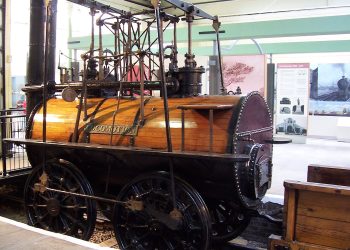
The 0-4-0+4 wheel arrangement represents one of the earliest attempts to integrate locomotive power and passenger accommodation into a single vehicle — a configuration known as a railmotor. Under Whyte notation, this classification describes a locomotive with no leading wheels, four coupled driving wheels on two axles, and four trailing wheels mounted on a bogie supporting the coach section.
This design was primarily intended for light passenger services on low-traffic routes. It was notably championed by William Bridges Adams in the United Kingdom around 1848, marking one of the earliest efforts to simplify and economize rail travel for rural and suburban lines.
Design and Configuration
In a 0-4-0+4 arrangement, the front portion of the vehicle functions as a self-contained 0-4-0 tank locomotive, housing the boiler, cylinders, and fuel compartments. The rear section comprises a single passenger coach, usually supported by a four-wheel bogie.
This allowed the entire vehicle to operate as one unit, eliminating the need for a separate locomotive. Many designs also included a secondary driving station at the rear, enabling the railmotor to reverse direction without turning around.
The equivalent international classifications were:
- UIC: B2′
- French: 020+2
- Turkish: 2/4
- Swiss: 24
- Russian: 0-2-0+2
Historical Background
The 0-4-0+4 railmotor concept emerged in the mid-19th century, coinciding with experiments in light railway transport. William Bridges Adams, a British engineer known for his work on locomotive suspension and portable railways, built several small railmotors beginning around 1848.
His goal was to create a cost-effective and flexible railway vehicle suitable for routes with limited passenger demand, where operating a full locomotive and coach would have been uneconomical.
Use in South Africa
Cape of Good Hope (1906)
The Cape Government Railways (CGR) introduced a single railmotor in 1906 for rural passenger routes. Built by North British Locomotive Company, it featured a 0-4-0 side-tank engine integrated with a Metropolitan Amalgamated Railway Carriage & Wagon-built coach.
The locomotive and coach were joined as a single frame, with the engine section at the front and a bogie-mounted passenger compartment at the rear. A rear driver’s cab allowed the train to be operated in reverse without turning.
This self-contained design was well-suited to isolated lines with light passenger traffic but was soon replaced by more conventional locomotive-hauled trains as passenger numbers grew.
Transvaal Colony (1907)
In 1907, the Central South African Railways (CSAR) acquired a similar self-contained railmotor, built by Kitson & Company (engine unit) and Metropolitan Amalgamated Railway Carriage & Wagon (coach body).
This railmotor, 46 feet 11 inches (14.3 meters) in length, carried 56 passengers and featured a pivoting power unit that acted like a bogie, improving maneuverability on tight curves and complex track layouts.
It was assembled at the Cape Government Railways’ Salt River workshops and entered service on 10 August 1907, demonstrating the practical potential of early railmotor technology in southern Africa.
Performance and Legacy
The 0-4-0+4 railmotor was a precursor to later self-propelled railcars and multiple-unit trains. Its compact design reduced operational costs and allowed smaller railway companies to offer passenger services on low-density routes.
However, limitations in power output, maintenance complexity, and passenger comfort meant that few were built, and even fewer survived beyond the early 20th century.
By the 1920s, improved automobile engines and diesel-mechanical systems rendered steam railmotors obsolete, paving the way for modern diesel and electric multiple units (DMUs and EMUs).
Significance
While the 0-4-0+4 configuration never became widespread, it remains a key milestone in railway evolution. It represented the transition from traditional locomotive-hauled trains to self-contained passenger vehicles, influencing later designs for railcars, steam railmotors, and early diesel units across Europe and the Commonwealth.
Today, the few surviving examples of such early railmotors — preserved in museums or detailed in archival records — stand as a testament to the innovation and experimentation of 19th-century railway engineering.