Quantum computing is emerging as one of the most transformative technologies of the 21st century. As organizations push the boundaries of artificial intelligence, cybersecurity, and scientific discovery, quantum computing stands out as the next frontier of exponential computing power. This article explores advancements in quantum hardware, breakthroughs in cryptography and drug discovery, and how quantum integrates with AI to revolutionize industries.
The growing interest in quantum computing the next frontier comes from rapid progress in qubit stability, photonic processors, and hybrid quantum–classical algorithms. These technologies are paving the way for quantum-enabled breakthroughs that will redefine computing, medicine, finance, and beyond.
What Makes Quantum Computing Different?
Traditional computers rely on bits—either 0 or 1. Quantum computers use qubits, which can exist in multiple states at once thanks to superposition. Qubits can also be entangled, allowing them to share information instantly across distances.
- Perform parallel computations
- Model molecular and physical systems
- Explore massive solution spaces instantly
- Break cryptographic systems once considered secure
Quantum computers scale exponentially, making them powerful for tasks that are impossible for classical systems.
Latest Advancements in Quantum Hardware
Superconducting Qubits
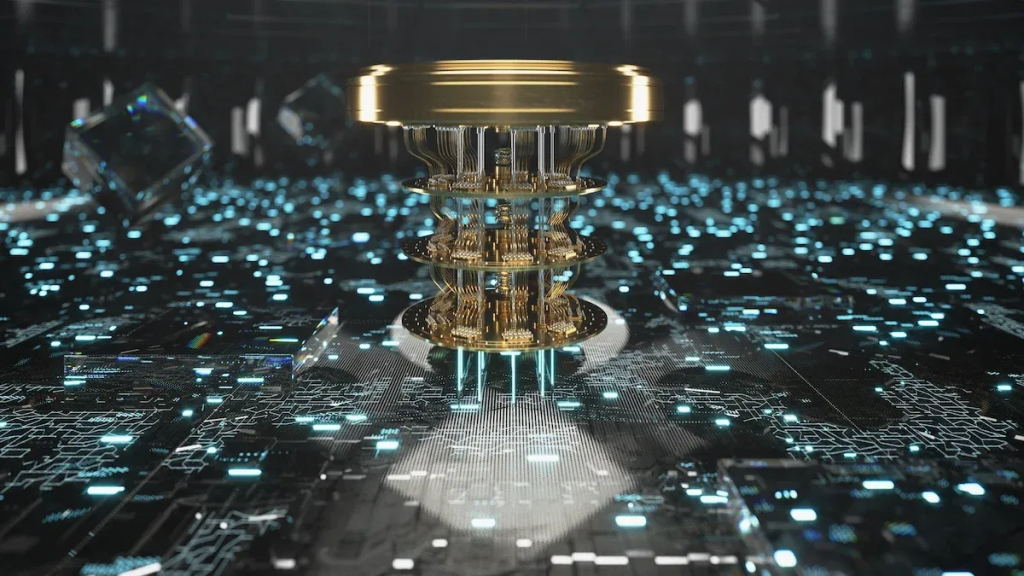
Tech leaders like IBM and Google use superconducting qubits cooled to near absolute zero. Recent improvements in gate fidelity and error correction have enabled systems with hundreds of qubits.
Photonic Quantum Chips
Photonic processors use light rather than electrons, allowing room-temperature operation. These chips offer scalability and lower energy consumption, making them a promising solution for quantum data centers.
Trapped Ions
Trapped-ion quantum computers use charged atoms held in electromagnetic traps. They offer long coherence times and high precision, making them ideal for research and optimization tasks.
Topological Qubits
An experimental but promising approach, topological qubits could drastically reduce error rates and simplify quantum error correction.
Quantum Computing in Cryptography
One of the most talked-about impacts of quantum computing is cryptography. With algorithms like Shor’s algorithm, quantum computers can break RSA and ECC encryption, which secure most of today’s digital infrastructure.
Quantum Threats to Modern Encryption
- Classical encryption may become obsolete
- Cybersecurity frameworks will need major updates
- Critical infrastructures must prepare for post-quantum risks
The Rise of Post-Quantum Cryptography
To counter quantum threats, researchers are developing quantum-resistant algorithms. Governments and tech companies are transitioning to post-quantum cryptography (PQC) to secure long-term data.
Quantum Key Distribution (QKD)
Quantum communications offer unbreakable encryption through QKD, where any attempt to intercept a message is instantly detected. This is especially important for defense, finance, and national security.
Quantum Computing in Drug Discovery
Quantum computing has enormous potential in healthcare. Traditional computers struggle to simulate complex molecular structures. Quantum systems can model them accurately, enabling breakthroughs in medicine.
- Accelerated drug discovery
- New vaccine development
- Genomic analysis
- Protein folding solutions
Pharmaceutical companies are partnering with quantum developers to create targeted therapies faster and at lower cost.
Quantum Computing for Materials Science
Beyond healthcare, quantum computing helps design new materials:
- Next-generation batteries
- Stronger and lighter materials
- High-temperature superconductors
- Energy-efficient semiconductors
These materials could drive advancements in electric vehicles, aerospace, and renewable energy.
Integrating Quantum Computing with AI
The pairing of quantum computing with artificial intelligence is one of the most transformative developments in modern technology.
Quantum-Accelerated AI Training
Quantum algorithms can dramatically reduce the time required to train large machine learning models.
Quantum Machine Learning (QML)
QML enables new forms of pattern recognition that classical machines cannot achieve, unlocking new use cases in finance, healthcare, and cybersecurity.
Agentic AI Optimization
Agentic AI systems, which autonomously reason and execute tasks, can benefit from quantum-powered optimization for planning, scheduling, and simulation.
Quantum-Enhanced Generative AI
Quantum computers could help generative AI models scale to trillions of parameters and handle more complex datasets, unlocking new creative and scientific potential.
Industries That Will Be Transformed
Finance
Quantum computing enhances risk modeling, fraud detection, and portfolio optimization.
Healthcare
AI and quantum systems accelerate diagnosis, drug discovery, and personalized medicine.
Logistics
Quantum optimization improves supply chain planning and reduces operational costs.
Cybersecurity
Quantum-safe encryption and QKD create secure communication channels for critical industries.
Challenges and Limitations
Despite progress, quantum computing still faces challenges:
- High error rates
- Complex maintenance and cooling
- Expensive hardware
- A shortage of quantum talent
- Limited software and programming tools
However, hybrid quantum-classical systems allow companies to benefit from quantum power even before fully fault-tolerant systems arrive.
Quantum computing represents the next frontier in global technological advancement. With its ability to break current encryption, accelerate drug discovery, transform materials science, and integrate with AI for exponential computing power, it is set to redefine the future of multiple industries.
Organizations that begin preparing today—learning, experimenting, and adopting hybrid quantum systems—will lead in tomorrow’s quantum-driven world.