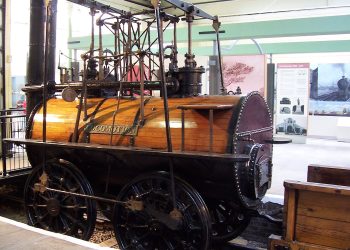
The 0–10–0 steam locomotive—also called a ten-coupled or Decapod in the United Kingdom—is a type of locomotive under the Whyte notation featuring no leading wheels, ten powered and coupled driving wheels on five axles, and no trailing wheels. This powerful arrangement maximized traction by dedicating all of the locomotive’s weight to adhesion, making it particularly suitable for heavy freight, steep gradients, and low-speed haulage.
In the United States, the term ten-coupled is standard, while the name Decapod typically applies to 2–10–0 locomotives. Despite its strength, the 0–10–0 configuration was known for instability at high speeds due to the absence of guiding wheels, restricting its use to shunting yards, industrial lines, and mountainous routes.
Equivalent Classifications
| System | Classification |
|---|---|
| UIC | E |
| French | 050 |
| Turkish | 55 |
| Swiss | 5/5 |
| Russian | 0–5–0 |
Overview
The first recorded tank engine version of the 0–10–0 was the Reuben Wells, built in 1868 for the Jeffersonville, Madison & Indianapolis Railroad in the United States. Designed by Reuben Wells himself, it successfully climbed Madison Hill—the steepest standard-gauge grade in America (5.89%).
The first tender engine version appeared in 1899 in Austria, designed by Karl Gölsdorf for the Imperial Royal Austrian State Railways (kkStB). This version introduced the Gölsdorf axle system, allowing lateral motion on certain axles to ease curve negotiation.
Advantages: maximum adhesive weight for heavy loads.
Drawbacks: poor stability and limited top speed.
Usage by Country
Austria
Engineer Karl Gölsdorf designed the renowned 180.00 class 0–10–0 in 1899 for mountain service. With a low axle load and drive on the fourth axle, it worked across Yugoslavia, Czechoslovakia, Romania, and France.
Canada
The Canadian Pacific Railway owned three 0–10–0 locomotives, mainly for switching and heavy yard operations.
China
Between 1924 and 1929, the Baldwin Locomotive Works built sixteen 600 mm (1 ft 11 ⅝ in) narrow-gauge 0–10–0 locomotives for the Yunnan–Kopei Railway. They remained in service until 1990, a testament to their durability.
Finland
The VR Class Vr3 0–10–0T, nicknamed Rooster, consisted of five locomotives (Nos. 752–756) ordered from Hanomag in 1924. One example, No. 755, is preserved at the Finnish Railway Museum.
Germany
Germany built several 0–10–0 freight engines between 1905 and 1915, later replaced by the 2–10–0 type for greater stability. Tank versions, such as BR 82, BR 87, and BR 94, continued to be developed for shunting work.
Indonesia
The Staatspoorwegen ter Sumatara’s Westkust railway operated the E10 rack tank locomotives between 1921 and 1928 for steep coal routes in West Sumatra. Built by Esslingen and SLM, they tackled 8% gradients and later included models from Nippon Sharyo (1967)—the last steam engines ever built by that firm.
Japan
Japan imported four 4100 Class 0–10–0T locomotives from Krauss-Maffei in 1912, inspiring domestic production of 39 4110 Class engines (1914–1917). The final units were retired from Japanese National Railways service in 1950, with some lasting in private use until 1971.
Russia
Russia’s E Class (Э) became the most numerous 0–10–0 series in the world, with over 11,000 units built. Sub-classes included E, Em, Eg, Esh, Eu, and Er. These engines handled massive freight demands across the USSR and other nations including Czechoslovakia, Germany, Sweden, Hungary, and Poland.
Variants like the Emk and Egk added condensing tenders for arid regions, though they remained experimental. The design influenced later Soviet locomotives such as the SO Class 2–10–0 and FD Class 2–10–2.
South West Africa
In 1911, the Lüderitzbucht Eisenbahn of German South West Africa purchased six 0–10–0 Decapods from Henschel & Son. Originally built for a French colony, they were repurposed for desert service with protective motion shields against sand. None survived World War I.
Taiwan
An 0–10–0 locomotive served the steep grade at Shengxing Station, assisting passenger trains to the island’s highest rail point.
Thailand
Two Hanomag 0–10–0s (Nos. 401 and 402) arrived in 1913, regauged from standard to metre gauge in 1924 for continued service on the Royal State Railways of Siam.
United Kingdom
Only two 0–10–0s ever worked in Britain:
- The Holden Decapod (1902) – a suburban tank prototype for the Great Eastern Railway.
- The Midland Railway No. 2290 (1919) – a banking engine for the Lickey Incline, later nicknamed The Lickey Banker.
United States
The 0–10–0 type was rare in America—fewer than 70 units were built. For switching, railroads favored the 0–8–0, while mainlines preferred 2–10–0s or articulated 0–6–6–0 Mallets.
The first U.S. example, the Reuben Wells (1868), hauled trains up Madison Hill and is preserved at the Children’s Museum of Indianapolis. Later models served the St. Clair Tunnel Company, New York Central, Illinois Central, Chesapeake & Ohio, Baltimore & Ohio, and Duluth Missabe & Iron Range railways.
Technical Characteristics
- Configuration: 0–10–0 (five driving axles)
- Primary Use: Heavy freight and banking service
- Typical Builder: Henschel, Hanomag, Baldwin, Esslingen, SLM, Nippon Sharyo
- Advantages: Maximum traction, simplicity, durability
- Disadvantages: Poor high-speed stability, limited flexibility on tight curves
Legacy
The 0–10–0 steam locomotive symbolizes an era of brute-force rail power. Its role in conquering gradients, moving wartime freight, and pioneering rack railways demonstrates its engineering importance. From Gölsdorf’s Austrian mountains to Russia’s endless plains, the ten-coupled machine remains a benchmark in locomotive design history.