As dusk descended on December 30, 2007, the Kenyatta International Conference Centre (KICC) became the heart of confusion and tension. What was meant to be a transparent electoral tallying process turned into a scene of disbelief. Returning officers went missing, figures failed to reconcile, and the entire process teetered on the edge of collapse. Inside the dimly lit hall, Samuel Kivuitu, chairman of the Electoral Commission of Kenya (ECK), appeared defeated. His haunting words echoed through the room, “I do not know where some of my returning officers are.” That single confession deepened the growing suspicion that the election had been hijacked.
Outside KICC, a heavy deployment of General Service Unit (GSU) and riot police sealed the perimeter. Journalists were shoved aside, opposition agents expelled, and communication lines disrupted. In a charged atmosphere, Kivuitu read out the declaration that would alter Kenya’s course: “I, Samuel Kivuitu, declare Mwai Kibaki duly elected President of the Republic of Kenya.” His shaky voice contrasted sharply with the gravity of his announcement. Within moments, state television went dark, only to return to a live feed from State House Nairobi — an image that would forever symbolize betrayal for millions of Kenyans.
The Oath in the Night
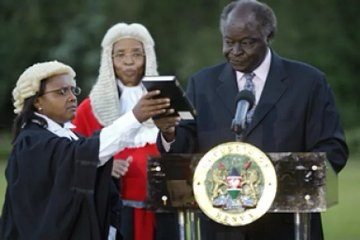
Under the floodlights on the State House lawn, the country watched as Mwai Kibaki was hastily sworn in for his second term. The event, hastily arranged and shrouded in secrecy, was attended by a handful of ministers, military officials, and close allies. Among them stood Martha Karua, then Minister of Justice, who reportedly insisted that the ceremony proceed immediately to avoid “constitutional vacuum.”
When Kibaki raised his hand to take the oath, a strange moment occurred — a slip of the tongue that would become a symbol of the unease gripping the nation. He began, “Nitafanya kazi zangu za uhalifu…” (I will perform my duties of crime), before quickly correcting himself to “Urais” (Presidency). Though brief, that linguistic stumble felt prophetic to millions watching in disbelief. The laughter that followed was nervous, not joyful. Cameras clicked; the ceremony ended. Kenya had a president sworn in under the cover of darkness — a metaphor that would define the tragedy that followed.
The Eruption of Violence
Until that night, much of Kenya remained tense but hopeful that fairness would prevail. Yet when the image of Kibaki taking the oath aired, it was perceived not as a peaceful transition but as an act of defiance — the “theft of democracy.” In Kisumu, protests erupted immediately; police responded with live bullets. In Nairobi’s Mathare and Kibera slums, crowds clashed with security forces, and entire neighborhoods burned.
The Rift Valley became the epicenter of revenge attacks. Historical land grievances and ethnic divisions flared violently. One of the darkest moments came in Eldoret, where a church sheltering families seeking refuge was set ablaze. Dozens of innocent lives — mostly women and children — were lost in the inferno. The air was thick with smoke and sorrow, and Kenya, once seen as an island of stability in East Africa, was bleeding from within.
By the end of the chaos, over 2,000 people were dead, and more than 600,000 were displaced. Villages were divided along ethnic lines, friendships shattered, and communities scarred. The manicured lawns of State House remained untouched, but the nation outside its gates descended into one of its darkest chapters.
The Legacy of the Kibaki Night Swearing
The Kibaki Night Swearing became a defining moment in Kenya’s political history — a night when the nation’s fragile democracy cracked under pressure. What was intended as a swift, administrative act turned into a symbol of illegitimacy and betrayal. The violence that followed forced Kenya to confront its deep-seated issues of ethnicity, inequality, and electoral malpractice.
International mediators, led by Kofi Annan, brokered a power-sharing agreement that ended the bloodshed, birthing the Grand Coalition Government. Yet the wounds left by that night have not fully healed. For many Kenyans, the floodlit image of Kibaki taking the oath under heavy security remains the haunting embodiment of how power, when pursued without restraint, can devastate a nation.
The Kibaki Night Swearing was more than a ceremony — it was a fracture in Kenya’s democratic promise. It serves as a reminder that when institutions falter and truth is obscured, the cost is paid not in politics but in human lives.