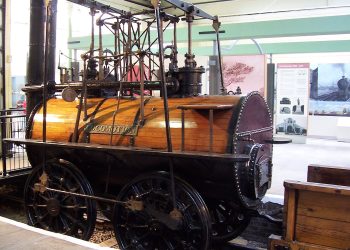



Under the Whyte notation system used to classify steam locomotives by their wheel arrangement, the 0–12–0 configuration describes engines with no leading wheels, twelve powered and coupled driving wheels on six axles, and no trailing wheels. This made the 0–12–0 among the most powerful and heavy-duty freight locomotives ever built, designed for extreme tractive effort rather than speed.
Equivalent Classifications
In other international systems, the 0–12–0 steam locomotive corresponds to the following classifications:
- UIC classification: F (also used in German and Italian systems)
- French classification: 060
- Turkish classification: 66
- Swiss classification: 6/6
These equivalences indicate the locomotive’s six coupled driving axles, emphasizing its suitability for hauling exceptionally heavy loads.
The Pennsylvania (1863)
The first known example of the 0–12–0 configuration was a locomotive named Pennsylvania, designed by Jame Milholland for the Philadelphia and Reading Railroad in 1863.
Built in the company’s own workshops, it weighed an impressive 50 tons, making it the heaviest steam locomotive in the world at that time. The Pennsylvania was intended as a pusher engine to assist coal trains climbing the steep Falls Grades near Philadelphia.
The locomotive’s immense traction and rigid frame design allowed it to handle the steep gradients, though its lack of guiding or trailing wheels limited maneuverability on tight curves.
Tank Engines (0–12–0T Types)
Only two notable classes of 0–12–0T tank locomotives were ever constructed, both designed for demanding mountain or freight operations.
Austrian Class 269 – Erzberg Railway (1912)
In 1912, Lokomotivfabrik Floridsdorf built three rack locomotives for the Erzberg Railway (Erzbergbahn) in Austria.
Originally designated Class 269 under the kkStB (Imperial Royal Austrian State Railways), these engines later served under:
- BBÖ (Austrian Federal Railways) after World War I,
- Deutsche Reichsbahn during the 1939 annexation period, and
- ÖBB (Austrian Federal Railways) after World War II.
Remarkably durable, all three locomotives remained in active service until the 1970s, a testament to their robust engineering and suitability for rack railway gradients.
Bulgarian Class 45 – Hanomag (1922)
The Bulgarian State Railways (BDŽ) ordered ten 0–12–0T locomotives from Hanomag in 1922.
Initially numbered 4001–4010, they were renumbered 45.01–45.10 between 1935 and 1936.
These locomotives were two-cylinder compound engines with the following specifications:
- Boiler pressure: 15 kg/cm² (1.47 MPa or 213 psi)
- High-pressure cylinder: 620 × 700 mm (24.4 × 27.6 in)
- Low-pressure cylinder: 900 × 700 mm (35.4 × 27.6 in)
- Driving wheel diameter: 1,340 mm (52.8 in)
- Total weight: 101 tonnes (111 short tons)
Built for mountainous freight work, these locomotives combined high power with relatively low speed, demonstrating the practicality of the 0–12–0 configuration for hauling heavy loads on challenging gradients.
Engineering Significance
The 0–12–0 design prioritized adhesive weight — the total mass resting on driving wheels — to maximize traction. However, the absence of leading or trailing trucks reduced stability at higher speeds, confining such locomotives to low-speed freight, pusher, or rack railway operations.
While rare compared to other large freight types like 2–10–0 or 2–10–2, the 0–12–0 remains a notable engineering experiment in maximizing tractive power through simplicity and raw mechanical strength.