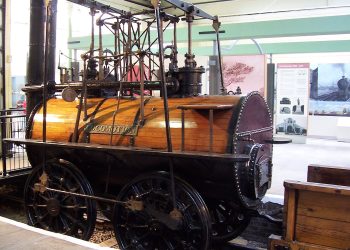
The 0-4-0 locomotive is a steam engine with four coupled driving wheels and no leading or trailing axles. Under Whyte notation, the first “0” indicates no leading wheels, the “4” represents four driving wheels on two axles, and the final “0” means no trailing wheels. It is one of the simplest and earliest locomotive types, valued for its compact design and high traction in confined spaces such as docks, yards, and industrial plants.
In the UIC classification, the 0-4-0 is represented as B (German or Italian) when the axles are connected by coupling rods or gearing, or 020 in the French system. In the Bo classification for electric or diesel-electric locomotives, it means each axle is independently motored.
Historical Overview
The earliest 0-4-0 locomotives appeared in Great Britain around 1802, with Richard Trevithick’s Coalbrookedale engine considered one of the first examples. Later, Robert Stephenson’s Locomotion No. 1 (1825) became the first 0-4-0 locomotive to use coupling rods instead of gears, marking a milestone in steam locomotive development.
The configuration was later used in Timothy Hackworth’s Sans Pareil (1829) and Lancashire Witch (1828). Despite its simplicity and strong traction, the design was unstable at high speeds, limiting its mainline use. It became ideal for shunting duties and short-haul operations in yards, mines, and industrial sites.
By the late 19th century, 0-4-0 locomotives had spread worldwide, adapted into tank, tender, and fireless versions. The arrangement allowed builders to place the engine’s entire weight on the driving wheels, maximizing adhesion.
Design and Advantages
The 0-4-0 design used all engine weight for traction, giving it excellent pulling power at low speeds. The tank locomotive variant (0-4-0T) carried water and coal onboard, eliminating the need for a tender. This made it shorter and easier to operate in tight spaces like dockyards or factory tracks.
However, due to the lack of leading and trailing wheels, these locomotives were prone to instability at high speed, limiting them to slow industrial or shunting work. Despite this, their durability and compactness ensured their production well into the 20th century.
Global Usage
United Kingdom
The first significant class of 0-4-0 tank engines was introduced by Robert Sinclair for the Caledonian Railway in the 1850s. By 1860, this wheel arrangement had become widespread in both mainline and industrial service.
Manufacturers like Hudswell Clarke, Barclay, and Robert Stephenson & Hawthorns produced these locomotives until the mid-20th century. The last British Railways 0-4-0 saddle tanks, built at Horwich Works in 1955, remained operational until 1966.
United States
The 0-4-0 configuration gained popularity in America for both tender and tank locomotives. Early examples include the Best Friend of Charleston (1830) and John Bull (1831).
The Pennsylvania Railroad continued developing the type long after most railroads moved on, producing the A5s Class into the 1920s—larger and more advanced than typical 0-4-0s, featuring superheating and piston valves.
The type was used extensively in industrial switching and harbor shunting, where maneuverability mattered more than speed.
South Africa
South Africa’s first locomotives, including Blackie (1859) and Natal (1860), were 0-4-0 designs used for harbor construction and short-haul transport. Many variations appeared across Cape, Natal, and Transvaal railways, including saddle-tank, well-tank, and narrow-gauge versions.
Builders such as Hudswell Clarke, Manning Wardle, and Neilson & Company supplied these engines well into the early 20th century, with several preserved today as part of the South African Railways (SAR) heritage fleet.
Australia and New Zealand
In New South Wales, the Dorrigo Steam Railway Museum preserved twelve 0-4-0 steam locomotives and eight diesels.
In New Zealand, the NZR A class (1873) featured multiple 0-4-0 designs, some locally built. A few have survived in museums and tourist lines.
Asia
In Indonesia, the Samarang-Cheribon Stoomtram Maatschappij imported 27 0-4-0T locomotives from Germany between 1908 and 1911, known for their superheated boilers.
In the Philippines, five Manila class 0-4-0 tank engines built by Hunslet served in tram and sugar operations.
Japan and India also employed 0-4-0 types in industrial sectors during the colonial and postcolonial railway expansions.
Diesel and Electric 0-4-0 Variants
The wheel arrangement persisted into the diesel and electric eras, mainly for shunting locomotives. Builders such as John Fowler & Co., Hudswell Clarke, and Andrew Barclay created 0-4-0 diesel-mechanical (DM), diesel-hydraulic (DH), and diesel-electric (DE) models between the 1930s and 1970s.
Examples include the EMD Model 40 in the United States and PKP SM02 and SM03 in Poland. These small locomotives offered the same compact maneuverability as their steam predecessors, ideal for factories, ports, and industrial yards.
Legacy and Preservation
Despite their limitations, 0-4-0 locomotives are celebrated for their engineering simplicity and historical importance. Their enduring presence in museums and heritage railways worldwide demonstrates their influence on early steam and diesel design.
They symbolize an era when railway innovation was guided by practicality, compactness, and reliability. From Trevithick’s pioneering designs to industrial shunters of the 20th century, the 0-4-0 remains a cornerstone of railway history.