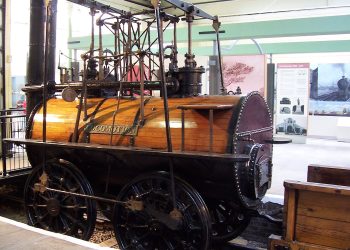



The 0-2-2 locomotive is a steam engine wheel arrangement with no leading wheels, two coupled driving wheels, and two trailing wheels. Under Whyte notation, this configuration was among the earliest used in steam railway history. It became famous for its role in the Rainhill Trials of 1829, through Stephenson’s Rocket, one of the most iconic locomotives ever built.
Equivalent classification systems describe it as A1 under the UIC system, 011 in French notation, and 1/2 in Swiss classification. The type was briefly produced by Robert Stephenson and Company for the Liverpool and Manchester Railway, where it helped establish the foundation of modern locomotive engineering.
Stephenson’s Rocket
The 0-2-2 layout gained fame through George and Robert Stephenson’s Rocket, built in 1829 for the Rainhill Trials—a competition to select the best locomotive for the Liverpool and Manchester Railway. Unlike previous heavy, four-coupled engines, Rocket was light, fast, and purpose-built for passenger service.
Stephenson realized that the competition favored speed and efficiency over raw power. To reduce weight and mechanical complexity, he designed Rocket with a single driving axle instead of two. The boiler was placed forward over the driving axle to improve traction, while the trailing wheels supported the firebox and crew platform.
Rocket’s cylinders were angled over the firebox, a departure from the vertical orientation of earlier locomotives. Both the driver and fireman shared a single rear footplate, which simplified operation. The locomotive’s superior balance of power and weight led it to win the Rainhill Trials, securing Stephenson’s company as the chief supplier for the railway.
Novelty and Rival Designs
Another competitor at Rainhill, Ericsson and Braithwaite’s Novelty, also featured an 0-2-2 configuration but in a well-tank form. Both the driving and trailing wheels were of equal size. Some sources describe Novelty as a 2-2-0WT, as its design lacked a defined front or rear end. Despite its mechanical innovation, Novelty was less reliable than Rocket and failed to complete the trials successfully.
Northumbrian Type and Later Variants
After Rocket’s success, Robert Stephenson and Company built eight additional 0-2-2 locomotives for the Liverpool and Manchester Railway, including Meteor, Comet, Dart, Arrow, Phoenix, North Star, Northumbrian, and Majestic. These designs were known collectively as the Northumbrian type and featured near-horizontal cylinders mounted low between the wheels, improving stability and efficiency.
The Northumbrian locomotives marked a transitional phase in steam technology, bridging early vertical-cylinder engines and later inside-cylinder models. Their performance inspired further developments but revealed the limitations of the 0-2-2 configuration for heavy hauling.
Supersession by Planet and 2-2-2 Designs
By 1830, the 0-2-2 wheel arrangement was replaced by the 2-2-0 Planet type, which reversed the layout—placing the driving wheels behind a leading pair. The inside-cylinder design of the Planet improved balance, reduced yawing oscillations, and increased efficiency through shorter steam pipes and a more compact boiler arrangement.
Soon after, the 2-2-2 configuration became the standard for passenger locomotives, offering smoother riding at higher speeds through an additional leading axle. The 0-2-2 locomotives thus became an important but short-lived step in the evolution of steam engineering.
Later Use in Railmotors and Tank Engines
In the early 20th century, the 0-2-2 layout reappeared in railmotors—steam engines permanently coupled with passenger coaches. These compact locomotives provided economical service on low-traffic branch lines.
The London and South Western Railway (LSWR) C14 class used a reversed form of this layout, designated 2-2-0T. However, their low adhesive weight limited traction, leading to many being rebuilt as 0-4-0T S14 class engines.
Significance and Legacy
Although short-lived, the 0-2-2 locomotive played a pivotal role in the development of early passenger railway technology. Stephenson’s Rocket set benchmarks for boiler design, cylinder placement, and overall locomotive efficiency.
The lessons learned from the 0-2-2 configuration guided the rapid evolution of steam locomotives in the 1830s, influencing later designs that would dominate the Victorian railway era. Today, replicas of Rocket continue to operate in museums, symbolizing the dawn of the railway age.