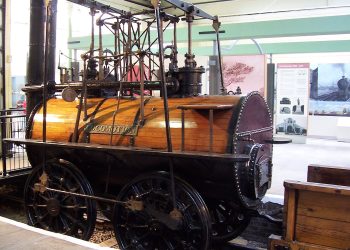
The 0-2-4 locomotive is an extremely rare steam engine wheel arrangement classified under the Whyte notation as having no leading wheels, two powered driving wheels on one axle, and four trailing wheels on two axles. This design was primarily used in early British railway experiments and represents one of the most unusual configurations of the early steam era.
Because only a few examples were ever built, the 0-2-4 locomotive occupies a distinctive place in locomotive history as an example of early mechanical experimentation before the dominance of standard designs such as the 0-4-0 and 2-2-0.
Historical Background
The only known locomotives with the 0-2-4 configuration were three engines built by J. and C. Carmichael of Dundee in 1833 for the Dundee and Newtyle Railway in Scotland. These locomotives were constructed to operate on the line’s 4 ft 6 in (1,372 mm) gauge, which was narrower than the later-adopted British standard gauge.
These early steam engines were characterized by a single powered axle providing traction and two trailing axles that carried the weight of the firebox and water tanks. The configuration aimed to improve stability on rough or lightly laid track, but the limited traction from only one driving axle made them less efficient for heavy work.
The three Carmichael-built 0-2-4 locomotives remained in service until around 1847. When the line was converted to standard gauge in 1849, they were likely withdrawn and scrapped, marking the end of the 0-2-4 type in British mainline use.
Bristol and Exeter Railway Example
A later and equally unusual example of a 0-2-4 locomotive was the Fairfield steam carriage, built in 1848 for the Bristol and Exeter Railway. This experimental vehicle functioned as a combined locomotive and passenger carriage, intended to provide self-propelled service on short branch lines.
The Fairfield steam carriage featured four trailing wheels under the coach section and two powered driving wheels at the front. However, its hybrid design proved impractical. The locomotive section was eventually separated from the coach body, and the machine was converted into an 0-2-2 configuration for use in shunting duties. This adaptation demonstrated how early railway engineers experimented with wheel arrangements before settling on more standardized, efficient layouts.
Design Characteristics
The 0-2-4 layout offered better weight distribution compared to earlier single-axle or 0-2-0 engines. The trailing wheels helped to carry additional weight—such as water tanks, the firebox, or passenger accommodation—making it more stable on uneven or curved track.
However, with only one driving axle, the design lacked sufficient traction for steep gradients or heavy loads. This limitation prevented its wider adoption in industrial or mainline service.
The design’s unusual balance between powered and unpowered axles made it a transitional step between early multi-purpose steam carriages and the later, more effective tank locomotive types that dominated 19th-century passenger railways.
Rarity and Legacy
The 0-2-4 locomotive remains one of the rarest wheel arrangements in railway history. Only a handful were ever constructed, and none are known to have survived. Its short-lived presence reflects the experimental spirit of early British railway engineering, a period marked by constant innovation in search of the ideal balance between stability, speed, and traction.
Although the 0-2-4 design itself was abandoned, the lessons learned from these locomotives contributed to later refinements in locomotive balance and trailing-axle stability—features that became central to future steam designs such as the 2-4-0 and 0-4-2 types.