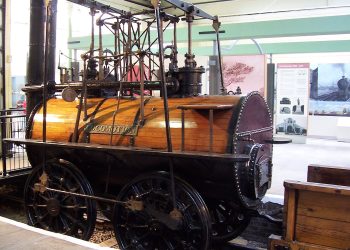
The 0-4-4T locomotive is a steam tank engine configuration classified under the Whyte notation system as having no leading wheels, four coupled driving wheels on two axles, and four trailing wheels on two axles. The “T” denotes that it is a tank locomotive, carrying its own water and fuel instead of hauling a tender.
This wheel arrangement became one of the most successful suburban passenger engine types of the late 19th century. In the United Kingdom, the 0-4-4T design became the standard passenger tank configuration for many railway companies. In the United States, it evolved into the famous Forney locomotive, widely used on narrow-gauge and elevated railways.
Equivalent Classifications
Equivalent notations of the 0-4-4T locomotive in other systems include:
- UIC classification: B2 (German and Italian)
- French classification: 022
- Turkish classification: 24
- Swiss classification: 2/4
- Russian classification: 0-2-2
Each designation describes two pairs of powered and trailing axles, emphasizing the locomotive’s balanced traction and stable handling.
Historical Development
The first 0-4-4 locomotives appeared in Britain in 1866. These early versions were well tanks, built by John Chester Craven for the London, Brighton and South Coast Railway, and by James Cudworth for the South Eastern Railway.
Later developments included side-tank versions, which soon became more common. The Great Eastern Railway’s Samuel Waite Johnson introduced this improvement in 1872, marking the beginning of a widespread shift toward more efficient tank designs.
By the late 19th century, almost every major British railway company had adopted the 0-4-4T type for commuter and branch line services. These locomotives offered a balance of power, stability, and compactness, ideal for frequent stops and tight track curves typical of suburban routes.
United Kingdom: Key Classes and Usage
In the UK, the 0-4-4T locomotive dominated suburban and rural passenger operations from the 1870s through the early 20th century. Among the most notable examples were:
- Midland Railway 690 and 780 Classes (1869–1870)
- Great Northern Railway 48 Class (1873–1881)
- LSWR O2 Class and M7 Class, both designed for local and branch line service
- Caledonian Railway 439 Class, famed for its versatility in Scotland
- Midland Railway 2228 Class, which inspired later LMS designs
The last British design to employ this wheel arrangement was the LMS Stanier Class 2 0-4-4T, introduced in 1932, effectively bringing the era of the 0-4-4T locomotive to a close.
Several examples survive today in working order, including:
- SECR H Class No. 263 on the Bluebell Railway
- LSWR O2 Class No. W24 “Calbourne” on the Isle of Wight Steam Railway
- Metropolitan Railway E Class No. 1 at the Buckinghamshire Railway Centre
- Caledonian Railway No. 419, maintained by the Scottish Railway Preservation Society
- Duke of Sutherland’s “Dunrobin”, repatriated from Canada by the Beamish Museum
Finland: Class F1 Locomotives
In Finland, the Class F1 0-4-4T locomotives were introduced in 1885 for the Finnish State Railways (SVR). Built by the Swiss Locomotive and Machine Works (SLM) of Winterthur, these engines operated until 1935.
They were well-suited for Finland’s shorter regional routes and moderate gradients. One preserved example, No. 132, remains on display at the Finnish Railway Museum, complete with its original builder’s plate from 1886.
United States: The Forney Locomotive
In America, the 0-4-4 wheel arrangement evolved into the Forney locomotive, patented by Matthias N. Forney between 1861 and 1864. Unlike British tank engines, Forneys were built on a single rigid frame, with the rear truck supporting the coal bunker and water tank.
These locomotives were designed to run cab-first, providing greater stability and visibility on tight urban curves. They became synonymous with elevated and commuter rail systems in major U.S. cities, including New York, Chicago, and Boston.
The Forney type was also used on narrow-gauge railways, such as the Sandy River and Rangeley Lakes Railroad, where its compact size and powerful traction made it an ideal choice for light, winding lines.
Design Characteristics
The 0-4-4T design placed the driving wheels under the boiler, with a rear bogie (truck) to support the weight of the bunker and tank. This gave the locomotive better stability in reverse operation and a smooth ride even on poorly laid suburban tracks.
While its tractive effort was moderate, its fuel efficiency and maneuverability made it highly economical for passenger services. The design’s adaptability also led to its use in several continental European and colonial rail systems, where it served light mixed-traffic roles.
Legacy
The 0-4-4T locomotive represents one of the most enduring designs in the evolution of steam motive power. Its dual legacy — as the standard British suburban engine and the American Forney — highlights its versatility and influence across continents.
Though replaced by larger tank and tender locomotives in the 20th century, many preserved examples continue to operate on heritage lines today. The 0-4-4T remains a symbol of the golden age of local passenger steam transport, bridging the gap between industrial efficiency and early commuter convenience.