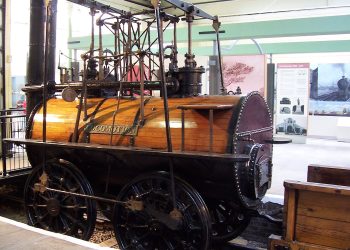
The 0-3-0 wheel arrangement represents one of the rarest configurations in railway history, designed specifically for monorail steam locomotives rather than conventional railways. Unlike standard locomotives that run on dual tracks, the 0-3-0 design was intended for single-rail balancing systems, featuring three driving wheels arranged along a single line.
This unusual layout found limited use on two notable experimental railways: the Listowel and Ballybunion Railway in Ireland and the Patiala State Monorail Trainways in India.
Design and Functionality
In traditional Whyte notation, the 0-3-0 classification indicates:
- No leading wheels,
- Three powered driving wheels, and
- No trailing wheels.
However, in the context of monorail systems, these locomotives required balancing or outrigger wheels on either side to maintain stability. The driving wheels carried the locomotive’s weight on the single rail, while the outrigger wheels—sometimes guided by beams or ground rollers—prevented tipping.
Listowel and Ballybunion Railway
One of the earliest and most famous uses of the 0-3-0 wheel arrangement was on the Lartigue Monorail of the Listowel and Ballybunion Railway in County Kerry, Ireland. Constructed in 1888 by the Hunslet Engine Company of Leeds, the Lartigue system ran on an elevated central rail supported by A-shaped trestles.
The locomotives had three central driving wheels mounted on the monorail beam and were balanced by small, non-load-bearing guide wheels running on parallel side rails. The configuration provided sufficient traction while keeping the vehicle stable as it carried passengers and goods across the rural Irish countryside.
Despite its ingenuity, the Lartigue system was mechanically complex and operationally cumbersome, leading to its closure in 1924.
Patiala State Monorail Trainways
A similar but ground-level monorail system, the Patiala State Monorail Trainways (PSMT), was established in 1907 in Patiala, India. Built by Orenstein & Koppel of Berlin, this line used locomotives that also followed the 0-3-0 configuration.
Each locomotive had double-flanged driving wheels riding on the single central rail, with a ground-contact outrigger wheel on one side for balance. This arrangement allowed the trains to operate on inexpensive and narrow rights-of-way.
Four of these locomotives were produced, and remarkably, one has been preserved in working condition at the National Rail Museum in New Delhi, where it remains one of the world’s oldest operational monorail locomotives.
Relation to Russian Classification
In Russian locomotive notation, which counts axles instead of wheels, the 0-3-0 configuration is equivalent to a 0-6-0 under the Whyte system. This reflects three powered axles, though in the case of the monorails, the mechanical and operational context differs substantially from standard dual-rail locomotives.
Legacy and Significance
Though the 0-3-0 monorail design was never widely adopted, it represents a fascinating chapter in railway innovation. These locomotives demonstrated the potential of monorail transport long before modern suspended and magnetic systems emerged.
The preserved examples in Ireland and India remain unique testaments to early engineering creativity, showcasing how inventors adapted steam technology to explore alternative rail systems in the late 19th and early 20th centuries.