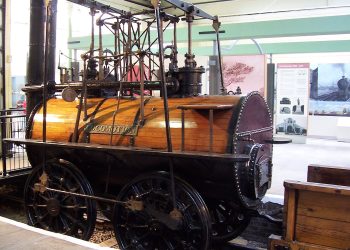



The 0-4-0+0-4-0 configuration describes an articulated steam locomotive of the Garratt type, consisting of two 0-4-0 power units placed back-to-back or face-to-face, with the boiler and cab suspended between them. This arrangement, under the Whyte notation system, indicates that each power unit had no leading or trailing wheels and four coupled driving wheels on two axles.
Although mechanically innovative, the 0-4-0+0-4-0 design was less common than later Garratt configurations with more driving wheels, as those provided greater stability and tractive effort for heavy railway operations.
Overview and Development
The first locomotive of this type was built in 1909 for the Tasmanian Government Railways (TGR) by Beyer, Peacock & Company, marking the birth of the Garratt concept. The prototype, known as K1, was part of the TGR K class, a 2 ft (610 mm) gauge locomotive that became the foundation for future Garratt development worldwide.
In the UIC classification, this wheel arrangement is written as B+B, and in other systems as follows:
- French: 020+020
- Turkish: 22+22
- Swiss: 2/2+2/2 (or 4/4 after the 1920s)
- Russian: 0-2-0+0-2-0
The 0-4-0+0-4-0 design allowed all locomotive mass to contribute to adhesion, increasing pulling power on light or steeply graded lines. However, the absence of leading and trailing wheels made the design less stable at higher speeds, limiting its practical application to industrial and narrow-gauge lines.
Design Characteristics
The Garratt design placed the boiler and cab on a central frame, while two independent power bogies (each with two driving axles) supported it at either end. Steam was fed to both engine units through flexible steam pipes, allowing articulation and smooth curve negotiation.
Most Garratts used the back-to-back cylinder arrangement, meaning that both sets of driving cylinders faced outward. However, in the original Tasmanian K class, the engines were arranged face-to-face, with the cylinders positioned toward the center of the locomotive. This experimental setup, combined with compound steam operation, made the K class a distinctive engineering milestone.
Tasmanian Government Railways K Class
The K1 and K2 locomotives, built for the Tasmanian Government Railways, were the world’s first Garratt locomotives.
Key features included:
- Compound steam expansion, with high-pressure cylinders on the rear engine and low-pressure cylinders on the front.
- Face-to-face cylinder orientation, unlike later Garratts, which were arranged back-to-back.
- Operation on 2 ft gauge mountain lines, where their flexibility and traction were advantageous.
K1 has been restored to full working condition and is preserved at the Welsh Highland Railway in Wales, serving as a landmark of early 20th-century locomotive innovation.
Use in Africa and Industry
The C.F. Vicinaux du Mayumbe railway in the Belgian Congo (now DR Congo) became the largest user of the 0-4-0+0-4-0 type. Between 1911 and 1927, St. Leonard of Belgium built 20 narrow-gauge Garratts for the line, serving on 600 mm track. Their compact yet powerful design suited the lightweight rails and sharp curves of tropical plantation and forestry operations.
Similar locomotives were later exported to Algeria, Brazil, and Belgium, primarily for mining and sugar operations.
Modern Examples in Argentina
In the 1990s, the Southern Fuegian Railway (F.C.A.F.) in Argentina revived the 0-4-0+0-4-0 concept for modern steam use.
Two locomotives were introduced:
- Engineer Porta (1994) — designed based on Livio Dante Porta’s thermodynamic principles, featuring improved boiler insulation and fuel efficiency.
- Engineer Zubieta (2006) — constructed in South Africa by Girdlestone Rail, with added superheating and enhanced performance.
Both locomotives used face-to-face arranged engine units and remain operational, serving as examples of modernized steam technology adapted to tourist service.
Preserved Examples in the United Kingdom
Apart from K1 in Wales, the industrial Beyer-Garratt “William Francis”, built in 1937, is preserved at the Bressingham Steam Museum in Norfolk, England. Unlike K1, it used a standard gauge (4 ft 8½ in) layout and featured the more common back-to-back cylinder orientation.
Technical Summary
| Feature | Specification |
|---|---|
| Type | Garratt articulated steam locomotive |
| Wheel Arrangement | 0-4-0+0-4-0 |
| Builder | Beyer, Peacock & Company |
| First Built | 1909 |
| Gauge Range | 500 mm – standard gauge |
| Primary Users | Tasmania, Belgian Congo, Argentina |
| Advantages | High tractive effort, flexibility on sharp curves |
| Drawbacks | Instability at speed, limited hauling power for heavy loads |
Legacy
The 0-4-0+0-4-0 Garratt design holds historical significance as the prototype configuration that gave rise to one of the most successful articulated locomotive families in the world. Its conceptual simplicity—combining two small power units under one boiler—laid the groundwork for larger Garratt models such as the 2-6-0+0-6-2 and 4-8-2+2-8-4, which dominated heavy-haul operations across Africa, Australia, and India throughout the 20th century.
Today, preserved examples like K1 and Engineer Porta keep the legacy of this pioneering design alive, symbolizing the evolution of steam locomotive engineering from experimental innovation to global standard.