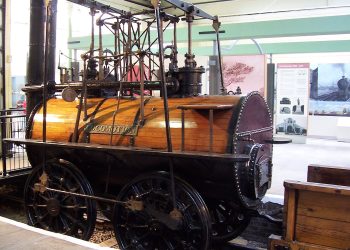



The 0-6-0 steam locomotive represents one of the most iconic and widely used wheel arrangements in railway history. Under Whyte notation, it designates a locomotive with no leading wheels, six powered and coupled driving wheels on three axles, and no trailing wheels. Known as the “six-coupled” configuration, it became the backbone of both freight and shunting operations from the early 19th to mid-20th centuries.
Because all the engine’s weight rests directly on the driving wheels, the 0-6-0 provided maximum adhesion and high tractive effort, making it ideal for heavy freight work and yard shunting. However, the lack of leading or trailing wheels reduced stability at high speeds, restricting its use to low and medium-speed services.
Historical Development
The earliest recorded 0-6-0 tender engine was Hackworth’s Royal George, built in 1827 for the Stockton and Darlington Railway in England. It was designed by Timothy Hackworth, one of the pioneering engineers of the railway age.
The first tank engine versions emerged in the 1850s, as compact locomotives for local passenger and freight services. Their simplicity, power, and ease of maintenance made them favorites among railway operators worldwide.
In Whyte notation, variants included:
- 0-6-0T – Side tank
- 0-6-0ST – Saddle tank
- 0-6-0PT – Pannier tank
- 0-6-0WT – Well tank
- 0-6-0VB – Vertical boiler
- 0-6-0F – Fireless
- 0-6-0G – Geared steam locomotive
For diesel versions, the suffixes changed to reflect transmission type:
- 0-6-0DM – Diesel-mechanical
- 0-6-0DH – Diesel-hydraulic
- 0-6-0DE – Diesel-electric
Design and Advantages
The key strength of the 0-6-0 design was that all the engine’s weight contributed to traction, allowing even small locomotives to haul relatively heavy loads. This made it invaluable in industrial yards, docks, mines, and branch lines.
The design’s simplicity also reduced costs of construction and maintenance. Inside-cylinder versions became particularly common in the United Kingdom, providing stability and compactness.
However, the absence of guiding wheels meant poor tracking on curves at higher speeds, so these locomotives were best suited for freight work, short-distance haulage, and shunting duties.
Early Examples
Among the first notable 0-6-0s were:
- Royal George (1827) – Timothy Hackworth’s pioneering tender engine.
- Vulcan (1835) – The first inside-cylinder 0-6-0, built by Charles Tayleur & Co. for the Leicester and Swannington Railway.
- Hector (1845) – A “long boiler” 0-6-0 by Kitson & Co. for the York and North Midland Railway.
- Derwent (1845) – Built by William and Alfred Kitching, preserved today at the Darlington Railway Museum.
Global Usage
United Kingdom
The 0-6-0 was the most common locomotive type in Britain for over a century. Between 1858 and 1872, over 900 units of the LNWR DX Goods Class were built by John Ramsbottom, representing early mass production. By 1900, more than one-third of Britain’s 20,000 locomotives were 0-6-0s.
The pinnacle of British development came with the Southern Railway Q1 Austerity Class (1942)—Europe’s most powerful 0-6-0. Designed during wartime for efficiency and strength, it exemplified the type’s evolution from humble freight hauler to industrial workhorse.
Australia
In New South Wales, the Z19 class became a mainstay for goods services. In Victoria, various classes like the O, P, Q, and Z-class dominated from the 19th century onward, later replaced by 0-6-0 diesel shunters such as the F, M, and W classes.
Finland
Finland’s VR Class Vr1 and Vr4 tank engines were vital for shunting and short-line freight operations. The C-series tender locomotives (C1–C6) served from the 1860s to 1930s, with preserved examples like C1 No. 21 at the Finnish Railway Museum.
Indonesia
The Dutch colonial Nederlands-Indische Spoorweg Maatschappij (NIS) and other tramway operators extensively used 0-6-0T and 0-6-0WT locomotives for sugarcane and mixed freight transport.
Classes like NIS Class 250 and SJS Class 100 were imported from German and Dutch builders, with several preserved at Indonesia’s Ambarawa Railway Museum.
New Zealand
The F class, built between 1872 and 1888, became New Zealand’s most successful 0-6-0 tank engine, with 88 units built. Many survived until the end of the steam era, with eight preserved.
Philippines
Introduced in 1905, 0-6-0 locomotives powered sugarcane plantations, sawmills, and coal mines. The Cabanatuan Class (Nos. 777 and 778) served the Manila Railway, while the Hawaiian-Philippine Company continues to operate preserved examples such as No. 2 Peter Francis Davies and No. 7 Isabella Curran for heritage tours.
South Africa
South Africa saw both Cape gauge and narrow gauge 0-6-0s. The Natal Harbours Department’s John Milne (1879) and the Pretoria-Pietersburg Railway’s 26 Tonners (1896–97) exemplify early use. Dozens of Zwillinge twin locomotives operated in German South West Africa, coupled back-to-back for double power output.
United States
The 0-6-0 became the standard switcher locomotive in American yards. The USRA 0-6-0 (World War I) and USATC S100 Class (World War II) were among the most widely produced. Over 500 S100 units were built for the U.S. Army Transportation Corps and exported worldwide, with many continuing service in Europe, the Middle East, and Asia.
Performance and Variants
The 0-6-0’s mechanical balance made it reliable, powerful, and easy to maintain. Its versatility led to countless adaptations, from industrial shunters to branch line haulers and military logistics locomotives.
However, its instability at high speeds and limited ride comfort eventually led designers to adopt 2-6-0 or 4-6-0 configurations for mainline duties.
In the diesel era, the legacy continued with classes such as British Rail’s Class 08, which became the most numerous diesel shunter ever built in the UK.
Legacy and Preservation
The 0-6-0 steam locomotive symbolizes industrial strength and simplicity. Thousands were built across five continents, from Hackworth’s Royal George (1827) to wartime Q1 and S100 types.
Dozens remain preserved in museums and heritage railways, operating as living symbols of the golden age of steam engineering. Their robust design and adaptability ensured the 0-6-0 would remain one of the most enduring and influential wheel arrangements in locomotive history.