The global race to build faster, more efficient AI hardware has reached a turning point with the China photonic quantum chip, a breakthrough that promises up to 1000× performance for specialized AI and data center workloads. Unlike traditional processors that rely on electrons, this new class of chips uses photons, or particles of light, to perform computation. This change in the fundamental building block of computing has massive implications for speed, power consumption, and scalability.
In 2025, Chinese researchers and photonics companies demonstrated prototypes of photonic quantum chips integrating thousands of optical components onto a single six-inch wafer. These chips are designed to accelerate AI inference, scientific simulation, and optimization tasks that currently require huge server farms packed with power-hungry GPUs. If the technology reaches mass deployment, it could transform the architecture of cloud platforms, edge devices, and high-performance computing (HPC) systems around the world.
What Is China’s Photonic Quantum Chip?
The China photonic quantum chip is a hybrid processor that blends integrated photonics with quantum-inspired computation. Instead of moving electrical charges through transistors, it manipulates light inside microscopic waveguides carved into a chip. Information can be encoded in different properties of photons, such as phase, polarization, and wavelength.
Inside the chip, light travels through a network of interferometers, splitters, phase shifters, and modulators. By carefully designing these optical pathways, engineers can build circuits that naturally carry out complex linear algebra operations. These operations are the foundation of many AI workloads, including deep neural networks, recommendation systems, and generative models.
Because photons do not suffer from electrical resistance, the chip generates far less heat than traditional electronics. This allows designers to pack more computing elements into a smaller area without melting the device or requiring extreme cooling systems. The result is a processor that is not only fast but also highly energy efficient.
How Photonic Computing Differs from Traditional Chips
Traditional CPUs and GPUs are based on CMOS (complementary metal–oxide–semiconductor) technology. Billions of transistors switch on and off to represent binary values. As engineers shrink these transistors, they can fit more of them into the same area, increasing performance. However, this scaling trend, often called Moore’s Law, has slowed. Further shrinking produces more heat, more noise, and diminishing returns.
Photonic computing takes a different path. Rather than pushing more electrons through smaller wires, it uses light moving through waveguides. Several key differences stand out:
- Speed of propagation: Photons move at or near the speed of light in the material, far faster than electron drift in copper.
- Parallel channels: Multiple wavelengths of light can carry different streams of data through the same waveguide at once, a technique known as wavelength-division multiplexing.
- Low heat: Light produces minimal joule heating, reducing the thermal limits that currently constrain CPU and GPU clocks.
- Native math operations: Optical interference patterns naturally implement matrix operations and transforms, the core of linear algebra.
Because of these features, a well-designed photonic circuit can perform certain operations in a single physical step that would require billions of digital operations on a GPU. That is where the claimed 1000× improvement comes from: not from doing the same electronic operations faster, but from replacing them with a fundamentally different physical process.
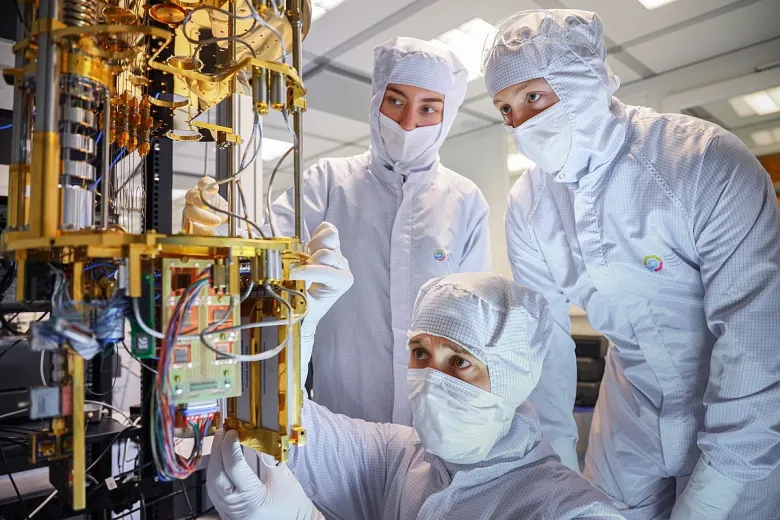
Why the China Photonic Quantum Chip Is Claimed to Be 1000× Faster
The headline figure of “1000× faster” refers to specific classes of workloads, not every task a GPU performs. In particular, the chip excels at:
- Large matrix–vector and matrix–matrix multiplications
- Fourier and other spectral transforms
- Quantum-inspired optimization and simulation routines
- Fixed AI inference pipelines where models do not change frequently
In these scenarios, the China photonic quantum chip uses the physical behavior of light to compute results. Instead of iterating through loops of multiply-add operations, it configures the optical circuit once and then passes light through it. The interference pattern at the output encodes the result of the mathematical operation. Measuring that pattern is far faster than performing the same calculation in digital logic.
It is important to emphasize that this speedup is highly workload dependent. Tasks that involve complex branching, symbolic reasoning, or general-purpose logic do not map as cleanly to photonic hardware and may still be better served by CPUs and GPUs.
Impact on AI Model Training and Inference
Modern AI systems, especially large language models and image generators, rely heavily on matrix multiplication. Each layer of a neural network multiplies large matrices and vectors to produce new activations. This is why GPUs, with their massive parallel floating-point units, became the standard hardware for AI development.
By offloading these matrix operations to a China photonic quantum chip, AI systems could achieve:
- Faster inference: Responses from chatbots, recommendations, and scoring systems could be generated with much lower latency, enabling smoother real-time experiences.
- Higher throughput: Data centers could serve more queries per second with the same or lower power budget.
- Lower energy per operation: Cutting power usage per inference run would reduce operating costs and environmental impact.
- New AI applications: Compute-intensive features that are currently too expensive may become viable when costs drop.
For training, the gains might be more modest in the short term, because training is more dynamic and requires frequent weight updates. However, specialized training phases or precomputed components of models could still benefit from photonic acceleration.
Reinventing Data Center Architecture
Data centers today are designed around racks of servers filled with CPUs, GPUs, and network switches. Power delivery, cooling, and cabling are major design constraints. As AI workloads grow, some large data centers already consume more electricity than small cities.
Integrating the China photonic quantum chip into data centers could trigger a shift in how these facilities are built and operated:
- Higher compute density: Less heat per operation allows more compute per rack.
- Reduced cooling requirements: Lower thermal output means smaller cooling systems and lower electricity bills.
- Optical networking integration: Photonic compute can be combined with optical interconnects, reducing conversion losses between electrical and optical signals.
- Smaller physical footprint: The same amount of AI work can be done with fewer servers and less space.
In the long term, cloud providers might deploy hybrid nodes that combine traditional CPUs for control logic, GPUs for general-purpose acceleration, and photonic chips for the most demanding linear algebra and optimization tasks. This heterogeneous model would optimize performance and cost across many workload types.
Comparison with Current Technologies
Versus GPUs
GPUs from companies like Nvidia and AMD are highly programmable, with rich software ecosystems and strong support for training and inference. They are flexible, but they are also energy-hungry and increasingly limited by memory bandwidth and heat.
The China photonic quantum chip is not a direct drop-in replacement for a GPU. Instead, it acts as a specialized accelerator focused on a subset of operations where photonics shines. In those niches, it may outperform GPUs by orders of magnitude, but GPUs will still be essential for many tasks.
Versus Superconducting Quantum Chips
Superconducting quantum computers, such as those from IBM or Google, operate at millikelvin temperatures and require bulky cryogenic systems. They are powerful for certain quantum algorithms but difficult to scale in a data-center environment.
Photonic quantum chips, by contrast, can operate at or near room temperature, use more familiar semiconductor fabrication techniques, and integrate more easily into existing infrastructure. However, full fault-tolerant quantum computing with photons remains an open research challenge.
Versus Analog and Neuromorphic Chips
Analog and neuromorphic processors also seek to break free from the limitations of digital logic. They mimic brain-like structures or continuous dynamics to improve efficiency. However, they still rely on electrons and face similar scaling and thermal issues. Photonic systems avoid many of these problems by using light as the carrier of information.
Challenges and Limitations
While the media focus on the impressive performance claims, several practical limitations must be considered before the China photonic quantum chip becomes mainstream:
- Verification of benchmarks: Independent testing is needed to confirm 1000× gains across realistic workloads.
- Manufacturing yield: Integrated photonics is still a young technology. Producing high-yield wafers with complex optical circuits is difficult.
- Programming model: Developers need new tools, compilers, and frameworks to map algorithms onto photonic hardware.
- Integration complexity: Systems must coordinate classical control, digital logic, and photonic computation in a stable, synchronized way.
- Quantum error and noise: If quantum states are used, noise and losses can degrade performance and accuracy.
These challenges do not negate the promise of the technology, but they suggest that adoption will be gradual, starting with niche applications and expanding as the ecosystem matures.
Global Implications of China’s Photonic Quantum Push
The development of the China photonic quantum chip is not only a technical story but also a strategic one. Control over advanced compute has become a key dimension of geopolitical competition. Countries with access to cheaper, faster, and more efficient AI hardware gain advantages in research, defense, finance, and industry.
If China can scale photonic quantum hardware faster than other nations, it may reduce its dependence on imported GPUs and legacy semiconductor technologies. This could reshape global supply chains, shift market power, and spur accelerated investment in alternative computing paradigms in other regions.
The China photonic quantum chip represents a bold step toward a new era of computing. By harnessing the unique properties of light, it promises dramatic improvements in speed and efficiency for AI and data center workloads. While significant technical and practical challenges remain, the direction is clear: the future of high-performance computing may rely less on packing more transistors onto silicon and more on exploring entirely new physical foundations for computation.
For now, developers, researchers, and businesses should watch this space closely. As photonic and quantum technologies mature, they will open new possibilities for AI applications, reshape data-center economics, and redefine what is possible in large-scale computation.