Official December 2025 Inflation Data Released
The Kenya National Bureau of Statistics (KNBS) published its Consumer Price Indices (CPI) and Inflation Report on December 31, 2025, confirming that annual consumer price inflation stood at 4.5% in December 2025. This year-on-year rate — unchanged from November 2025 — compares prices in December 2025 to December 2024 and keeps inflation firmly within the Central Bank of Kenya’s (CBK) preferred target range of 5% ± 2.5%.
Month-on-month, the overall CPI increased from 147.08 in November to 148.02 in December, reflecting a modest 0.6% rise. While this indicates some end-of-year price pressure, the stable annual rate signals improved price stability after earlier volatility in 2025.
Main Drivers Behind the 4.5% Rate
Food and non-alcoholic beverages remained the dominant upward force, with the category index rising 7.8% year-on-year. The sharpest increases hit fresh produce: tomatoes surged 30.3%, sukuma wiki rose 23.4%, and mangoes climbed 23.1%. These jumps reflect seasonal supply constraints, weather impacts on farming, and transport logistics to urban markets.
Other notable movements included:
- Electricity tariffs fell 2.8% (50 kWh band) and 2.6% (200 kWh band) between November and December, providing relief on power bills.
- Fresh packaged cow milk dropped 1.3% year-on-year.
- Sugar prices eased 1.5%, cooking oil (salad) fell 0.7%, and white bread declined slightly.
- Transport and housing/utilities added moderate pressure, while gas/LPG rose only 0.4% month-on-month.
These offsetting declines in energy and some processed foods helped cap the headline rate despite persistent food cost challenges.
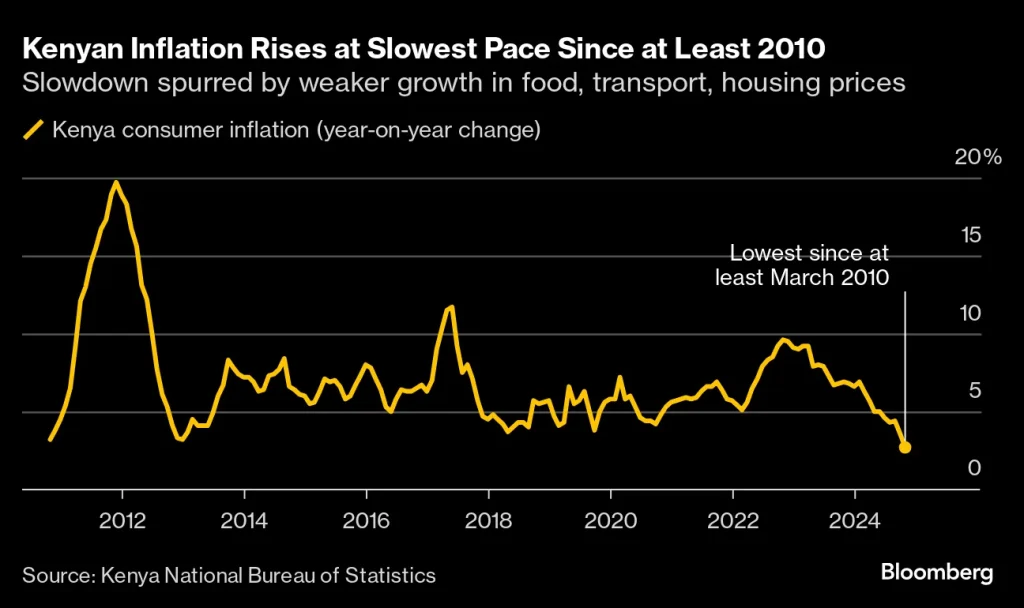
Illustrative chart of Kenya’s CPI trend through 2025, highlighting food as the primary inflation driver and energy declines offering partial relief (Source: based on official KNBS December 2025 report).
What the 4.5% Inflation Means for Households in 2026
An annual inflation rate of 4.5% indicates that, on average, the cost of the typical Kenyan household basket rose by 4.5% over the past 12 months — a relatively moderate pace compared to higher spikes in previous years. This stability preserves more purchasing power and supports economic planning as Kenyans enter 2026.
Key positive implications include:
- Preserved real incomes: Wages and fixed incomes lose less value to price rises, making it easier to cover rent, school fees, and daily needs.
- Room for lower interest rates: With inflation below the 5% midpoint, the CBK is likely to maintain or extend its accommodative monetary policy, keeping loan and mortgage rates reasonable for households and SMEs.
- Stable import costs: A stronger Kenyan shilling in late 2025 helped curb imported inflation on fuel, fertilizer, and manufactured goods.
However, challenges remain — especially for lower- and middle-income families:
- Food inflation at 7.8% hits hardest on staples, meaning vegetables, fruits, and cereals consume a larger share of budgets.
- Weather risks (droughts/floods), global oil price swings, or fiscal spending could push inflation higher in 2026.
- Many Kenyans report feeling squeezed because headline figures average out extremes — food and transport spikes outweigh declines elsewhere, and wage growth often lags.
2026 Price Outlook by Sector
Food & Non-Alcoholic Beverages: Volatility likely persists in fresh vegetables and fruits due to climate and supply-chain factors, though processed staples (milk, oil, sugar) may stabilize or ease further with steady imports.
Energy, Transport & Utilities: Electricity and fuel prices could remain subdued if global crude stays range-bound and the shilling holds firm — potentially lowering matatu fares, boda boda costs, and household power bills.
Housing, Rent & Related Costs: Modest upward pressure expected from urban demand and construction material costs, though not likely to outpace overall inflation.
Consensus forecasts (World Bank, IMF, market analysts) project 2026 headline inflation around 5.0–5.2%, assuming continued policy discipline, agricultural recovery, and no major external shocks.
How to Protect Your Budget in 2026
Even with stable inflation, smart habits can help counter food and service price swings:
- Use budgeting apps or simple spreadsheets to track spending and spot rising categories early.
- Buy seasonal vegetables and fruits in bulk during low-price periods; preserve (dry, freeze) where feasible.
- Compare electricity providers, switch to energy-saving bulbs/appliances, and monitor usage to benefit from lower tariffs.
- Maintain an emergency savings fund equivalent to 3–6 months of core expenses to cushion unexpected hikes.
- Check eligibility for government relief programs, subsidies, or cash transfers aimed at vulnerable households.
Small business owners and traders should watch input costs (fuel, raw materials) closely and adjust pricing gradually to stay competitive without adding to broader inflation pressures.
Frequently Asked Questions
What exactly caused the 4.5% inflation rate in December 2025?
KNBS data shows the main push came from food prices — especially tomatoes (+30.3%), sukuma wiki (+23.4%), and mangoes (+23.1%). Declines in electricity tariffs, fresh milk (-1.3%), sugar, and cooking oil partially offset the rise, keeping the annual rate stable at 4.5% compared to December 2024.
Is a 4.5% inflation rate good news for Kenya?
Yes — it sits comfortably inside the CBK’s 2.5–7.5% target band and reflects better price control than earlier in 2025. This supports economic growth, borrowing, and investment without triggering aggressive rate hikes.
How much will my cost of living rise in 2026?
If inflation averages ~5% as forecasted, KSh 100 of goods and services in early 2026 would buy roughly what KSh 95 bought in early 2025. Food and transport may feel more expensive; energy and some processed items could ease.
Will CBK continue cutting interest rates in 2026?
Very likely, provided inflation remains anchored near 5%. Recent rate reductions have already supported credit growth; stable or slightly higher inflation still allows room for gradual easing to boost economic activity.
Why do many Kenyans say life feels more expensive despite the 4.5% figure?
Headline inflation averages the entire basket, but food (a large share of most budgets) rose 7.8%. Specific spikes in vegetables, transport fares, and school-related costs hit harder than declines in electricity or milk, and many wages have not kept pace.
What is the expected inflation rate for the whole of 2026?
World Bank and market consensus point to around 5.0%, while the IMF projects 5.2%. Both assume steady global conditions, agricultural output recovery, and continued CBK policy support.