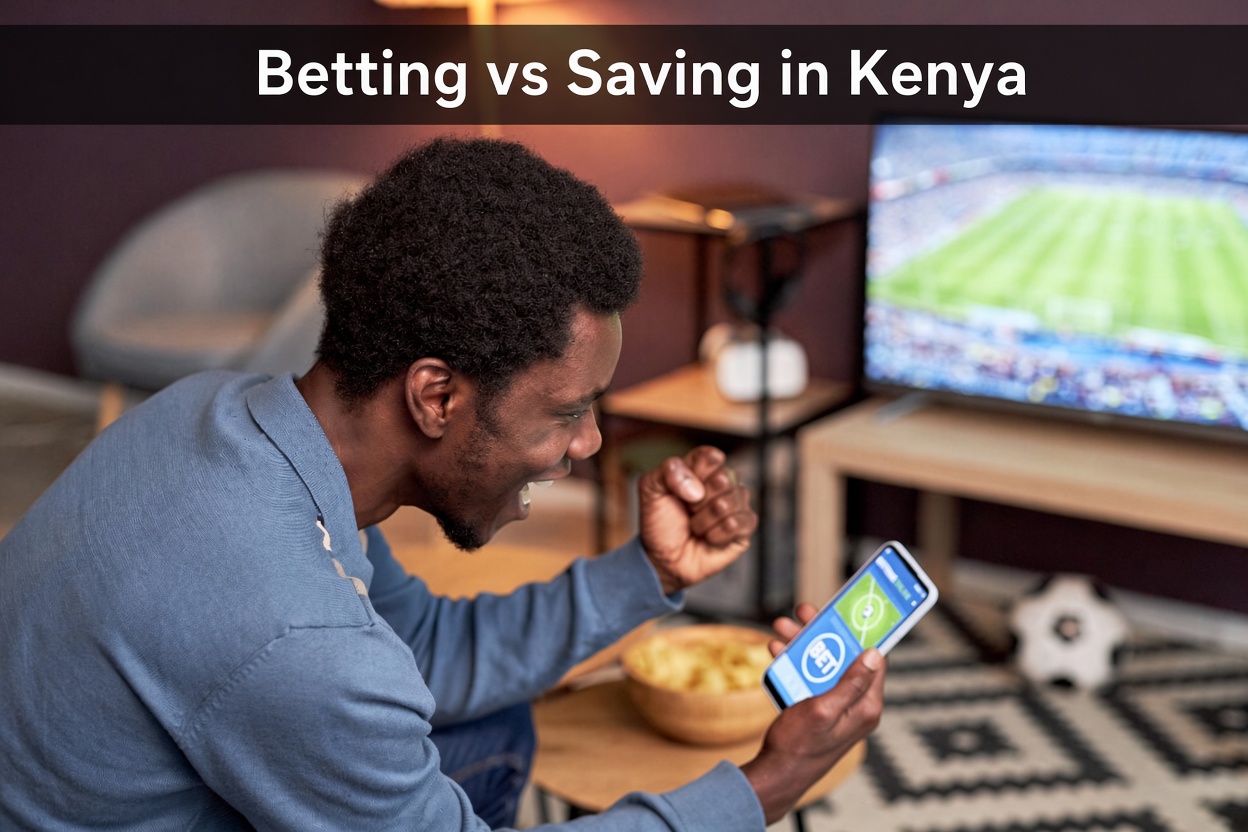
Betting vs Saving in Kenya,the biggest threat to a young Kenyan’s financial future is not a low salary—but what happens to the salary after it arrives?
That question is becoming increasingly important as new financial-wellness findings reveal a fascinating contradiction among young working Kenyans: optimism is rising, incomes are improving for many, entrepreneurship is expanding, yet debt, weak emergency savings and betting remain significant financial pressures.
The latest findings from the Old Mutual Financial Wellness Monitor 2025, released ahead of International Youth Day, show that Kenyans aged 20–29 were the most optimistic age group surveyed, with 83% expressing a positive financial outlook. Financial satisfaction among this group rose from 34% in 2024 to 45% in 2025, while 42% said they were earning more than the previous year.
But optimism is not the same thing as financial security.
And that is where the betting-versus-saving debate becomes important.

Young Kenyans are increasingly diversifying their income, but financial resilience depends on how that income is managed.
The New Survey Reveals a Financial Contradiction
The Old Mutual findings paint a picture of a young workforce that is trying to adapt to difficult economic conditions rather than simply waiting for formal employment to solve everything.
Nearly 24% of young people surveyed earn income from multiple sources, while 39% own or part-own a business. Another 27% report receiving financial support from family, friends or local and international networks.
Those numbers tell an important story.
Young Kenyans are not necessarily depending on one monthly salary anymore. Side businesses, freelance work, entrepreneurship, family support and additional income streams are becoming part of household financial survival.
Yet having several sources of income does not automatically create wealth.
If additional income is immediately consumed, used to repay previous debt or redirected into high-risk activities such as betting, the person can remain financially vulnerable despite earning more.
Did You Know? Financial satisfaction among young people improved significantly in the latest survey, but the same generation still faces gaps in emergency savings, insurance, retirement planning and debt management.
Why Betting Is So Attractive to Young Workers
Betting offers something saving cannot promise: immediate excitement and the possibility of a sudden financial transformation.
A worker earning KSh30,000 a month may understand that putting KSh2,000 aside every month is sensible. But saving KSh2,000 produces a relatively small visible result in the short term.
A KSh2,000 bet, on the other hand, can appear to offer the possibility of turning that money into a much larger amount within hours.
That psychological difference matters.
Saving rewards patience. Betting creates the illusion of acceleration.
For someone facing rent, school fees, food costs, family obligations, debt and limited opportunities for rapid income growth, the promise of quick money can become particularly powerful.
Kenya has had a long-running betting culture among young people. Historical GeoPoll research found high levels of gambling participation among young Kenyan respondents, although the often-repeated claim that “76% of young Kenyans are gamblers” requires important qualification because the survey measured whether respondents had gambled in the past rather than proving that 76% were currently betting.
The lesson is important: good financial journalism should distinguish between people who have ever gambled and people who gamble frequently or problematically.
The Debt Connection Makes the Problem More Serious
Betting becomes considerably more dangerous when it is financed with borrowed money.
A person using their own discretionary income to place an occasional recreational bet is facing one type of risk. Someone borrowing money to recover previous gambling losses is facing a much more serious financial spiral.
The pattern can look like this:
- Salary arrives.
- A portion is spent on betting.
- The person loses.
- They borrow money to recover the loss.
- The next salary is partly used to repay the loan.
- Disposable income becomes smaller.
- The person bets again hoping to solve the shortfall.
- Debt increases when the next bet fails.
At that point, betting is no longer simply entertainment.
It has become part of the person’s financial decision-making.
And that is where the hidden cost appears.
Saving Has One Major Advantage Betting Does Not
Saving compounds.
Consider a worker who puts KSh5,000 aside every month instead of spending it on speculative activities.
After one year, the contributions alone amount to KSh60,000, before considering any interest or investment returns.
After five years, the contributions reach KSh300,000.
The important point is not that saving produces spectacular overnight results. It is precisely the opposite.
Saving works because repeated small decisions eventually create a meaningful financial asset.
Betting generally works in the opposite direction for the participant: the expected financial outcome is determined by the odds, and repeated wagering does not turn into a reliable wealth-building strategy.
The shocking truth: a person can be winning occasionally while still losing financially over time.
Why a Big Win Can Actually Make Things Worse
This is one of the least understood aspects of gambling behaviour.
A large early win can reinforce the belief that betting is a viable source of income.
Instead of withdrawing the money and stopping, the bettor may increase their stakes because the previous success creates confidence.
A KSh1,000 bet that produces KSh10,000 can quickly become a KSh5,000 bet followed by another KSh10,000 bet.
The problem is that the brain remembers the exciting win more vividly than dozens of smaller losses.
That can produce the dangerous belief that a person is “due” for another big win.
But previous outcomes do not create a mathematical obligation for the next bet to succeed.
Young Kenyans Are Actually Doing Some Things Right
The survey should not be interpreted as a story of financial failure.
There are encouraging signs.
Young Kenyans are increasingly experimenting with entrepreneurship and multiple income sources. According to the Old Mutual findings, 39% of young people surveyed own or part-own a business, while nearly one-quarter have multiple income sources.
That is significant because income diversification can improve resilience.
If one source temporarily disappears, another may continue generating money.
The challenge is converting that resilience into actual wealth.
That requires a system for managing income—not simply increasing it.

Regular saving can turn irregular or multiple income streams into a stronger financial safety net.
The Emergency Fund Problem
One of the most important findings is the continuing weakness around emergency savings.
This is where the difference between looking financially successful and being financially resilient becomes obvious.
A person can own an expensive smartphone, wear fashionable clothes, run a side business and still have no money available for an unexpected medical bill or job loss.
An emergency fund provides something betting cannot: certainty.
If you have KSh50,000 saved for emergencies, that money remains available when your car breaks down, your child needs medical attention or your income suddenly stops.
A KSh50,000 betting balance does not exist.
There is only the possibility of winning—and the possibility of losing.
Betting vs Saving: A Simple Comparison
| Factor | Saving | Betting |
|---|---|---|
| Primary purpose | Build financial reserves | Risk money for a potential payout |
| Predictability | Contributions accumulate predictably | Outcome is uncertain |
| Long-term wealth building | Can support wealth accumulation | Not a reliable wealth-building strategy |
| Emergency usefulness | High if funds remain accessible | None if money is lost |
| Debt risk | Can reduce dependence on borrowing | Can worsen debt if borrowed money is used |
| Psychological reward | Usually delayed | Immediate excitement and potential reward |
The Real Cost of Betting Is Not Just the Lost Stake
Suppose a worker spends KSh200 every day on betting.
That is KSh6,000 in a 30-day month.
Over a year, the total becomes KSh72,000.
Now imagine that instead of betting, the person saved KSh200 every day.
After one year, they would have contributed KSh72,000.
After five years, the contributions would total KSh360,000.
This does not mean every person who bets would definitely save the exact amount they would otherwise have bet. It illustrates the opportunity cost: money spent chasing uncertain returns cannot simultaneously be building a financial reserve.
And the opportunity cost can be even larger if the person borrows money to fund the betting.
Why Optimism Can Become Dangerous Without a Financial Plan
The 83% optimism figure among 20–29-year-olds is encouraging. But optimism needs structure.
Believing your finances will improve can motivate you to start a business, pursue a better job, learn a skill or invest.
But optimism without a plan can also encourage excessive risk-taking.
A young worker may think:
- “My salary will increase next year.”
- “My business will take off soon.”
- “I will get another job.”
- “The next bet will recover the losses.”
- “I can repay the loan after payday.”
The first three can represent legitimate optimism.
The last two can become dangerous assumptions.
The secret is to build your financial plan around what you know—not around the money you hope will arrive.
Young Workers Need a Different Definition of Success
Social media has made visible consumption a powerful measure of success.
Someone posts a new phone, a car, a holiday or a night out. The person viewing the post does not see the bank balance, loan repayment schedule or unpaid bills behind the image.
That can create pressure to spend money as soon as it arrives.
Financial success should instead be measured by questions such as:
- How many months could I survive without income?
- How much high-interest debt do I have?
- Do I have health or other essential insurance?
- Am I saving for retirement?
- Do I have investments outside my primary income source?
- Can an unexpected KSh30,000 expense destroy my finances?
If the answers are uncomfortable, the problem is not necessarily income alone.
It may be financial structure.
How to Stop Betting From Eating Into Your Savings
For people who want to reduce betting, the first step is to make saving automatic and betting difficult.
Try a simple system:
- Save immediately after payday. Do not wait until the end of the month.
- Separate savings from spending money. A different account can create a useful psychological barrier.
- Set a fixed entertainment budget. Know exactly how much you can afford to lose before spending anything.
- Never borrow to bet. Debt-funded betting can turn a temporary loss into a long-term financial problem.
- Do not chase losses. A previous loss does not create a reason to increase the next stake.
- Track every betting transaction. Seeing the cumulative amount can be more revealing than looking at individual bets.
- Redirect the money. Move the amount you would have bet into savings, debt repayment or an investment account.
If betting is becoming compulsive or is causing serious financial, relationship or emotional problems, financial budgeting alone may not be enough. Seeking professional support can be an important step.
What About Investing Instead of Saving?
Saving and investing should not be treated as identical.
An emergency fund is primarily about liquidity and stability. Investments are designed for longer-term goals and can rise or fall in value.
A sensible financial progression for many young workers is therefore:
- Control essential spending.
- Reduce expensive debt.
- Build an emergency reserve.
- Protect yourself through appropriate insurance.
- Begin long-term investing.
- Increase investment contributions as income grows.
This approach is less exciting than betting.
But financial independence rarely comes from excitement.
It comes from consistency.
Digital Loans and Betting Can Create a Dangerous Combination
Kenya’s mobile financial ecosystem makes both borrowing and betting extremely accessible.
A person can move from receiving a mobile-money loan to placing a bet within minutes.
That convenience removes some of the friction that previously forced people to think carefully before borrowing or spending.
Research on Kenyan youth involved in sports betting has also examined the relationship between financial technology and investment decisions, finding that digital and mobile services influence financial decisions among young bettors.
The technology itself is not necessarily the problem.
Mobile finance can help people save, invest, transfer money and run businesses.
The issue is what behaviour the technology makes easier.
The same smartphone that can build your financial future can also make losing money remarkably easy.
Why Saving Feels Too Slow
One reason betting competes successfully with saving is that humans tend to value immediate rewards more heavily than future rewards.
Saving KSh5,000 today means giving up something now for a future benefit.
Betting KSh5,000 offers an immediate emotional experience, even before the result is known.
This is particularly difficult for workers whose financial goals appear far away.
Buying land may take years.
Building a house may take years.
Retirement may be decades away.
A betting result takes minutes.
That difference in time horizon is one reason financial discipline can be difficult.
The Better Challenge for Young Kenyans
Instead of asking, “How can I make KSh100,000 quickly?”, a young worker could ask:
“How can I make sure that five years from now I own assets worth significantly more than I owe?”
That question changes everything.
It encourages saving.
It encourages investment.
It encourages entrepreneurship.
It encourages skills development.
And it discourages treating gambling as an income strategy.

Digital savings tools can help young workers automate contributions and build financial discipline
The Bigger Economic Picture
Young Kenyans are operating in an economy where traditional career paths are changing.
Formal employment is not the only route to income. Side hustles, entrepreneurship, digital work and small businesses are increasingly important.
The Old Mutual survey’s finding that 24% of young people earn from multiple sources reflects this adaptation.
At the same time, the African Youth Survey 2026 found that economic sentiment among Africa’s young people has improved, even as Kenya has faced particularly weak confidence around jobs and the economy compared with other countries surveyed.
This creates a complicated environment.
Young people are ambitious enough to believe they can improve their circumstances, but economic uncertainty can make quick-money opportunities appear more attractive.
The challenge for the next generation is therefore not simply to become more optimistic.
It is to turn optimism into assets.
Five Money Rules Every Young Worker Should Consider
If you earn a salary or income from a business, these five rules can provide a simple starting point:
- Pay yourself first: Save before discretionary spending.
- Do not finance lifestyle with debt: Borrowing should have a clear purpose and repayment plan.
- Never count a potential betting win as income: Only guaranteed or reasonably predictable income belongs in your budget.
- Build an emergency fund: Aim for progressively larger reserves rather than trying to create the perfect fund immediately.
- Invest for the long term: Use regulated investment products that match your goals and risk tolerance.
Frequently Asked Questions
1. Is betting worse than saving in Kenya?
They serve fundamentally different purposes. Saving is designed to preserve and accumulate money, while betting involves risking money for an uncertain outcome. Betting can be particularly damaging when it replaces saving or is funded through debt.
2. Why are young Kenyans still betting despite financial difficulties?
Betting offers the psychological attraction of a quick potential payout, while saving produces benefits gradually. Easy access through smartphones and mobile payments also reduces the friction involved in placing bets. Historical Kenyan research has documented high participation in gambling among young people, although individual surveys have important methodological limitations.
3. What did the latest Old Mutual survey say about young Kenyans?
The Old Mutual Financial Wellness Monitor 2025 reported that 83% of surveyed Kenyans aged 20–29 had a positive financial outlook. It also found that 42% reported earning more than the previous year, while 24% had multiple income sources and 39% owned or part-owned businesses.
4. How much should a young Kenyan save every month?
There is no single percentage suitable for everyone because income, debt, family obligations and living costs differ. A practical approach is to choose a sustainable amount, automate it after payday and increase the contribution as income grows.
5. Can betting be considered an investment?
No. Betting involves wagering money on uncertain outcomes and should not be treated as a substitute for diversified long-term investing. An investment is normally assessed based on its expected return, risk, time horizon, liquidity and underlying economic value.
6. What should I do if betting has already put me into debt?
Stop using additional borrowing to recover losses, calculate the full amount owed, prioritise essential expenses and create a repayment plan. If betting feels difficult to control or is causing serious financial or personal harm, consider seeking professional support rather than attempting to recover losses through more gambling.
Turning Optimism Into Wealth
The latest financial-wellness findings offer an encouraging message: young Kenyans are not giving up. Many are earning from multiple sources, starting businesses and becoming more optimistic about their financial future.
But optimism alone does not create financial security.
A worker can earn more and still remain broke. A business owner can increase revenue and still have no emergency fund. Someone can win a large bet and still lose money over the long term.
The difference comes down to what happens after the money arrives.
Saving may look boring. Investing may look slow. Debt repayment may feel unrewarding. But those are the behaviours that can turn today’s income into tomorrow’s assets.
Betting can remain entertainment for people who choose to participate and can genuinely afford the loss. It should not become a financial plan.
The biggest financial win for a young Kenyan may not be hitting a huge jackpot. It may be reaching the point where an unexpected bill no longer requires a loan.
If this article made you rethink how you handle your salary, share it with a young worker, friend or family member who is trying to build a better financial future.
This article is for educational and informational purposes only and is not personalised financial advice. Investment and savings decisions should be based on individual circumstances, financial goals and risk tolerance.