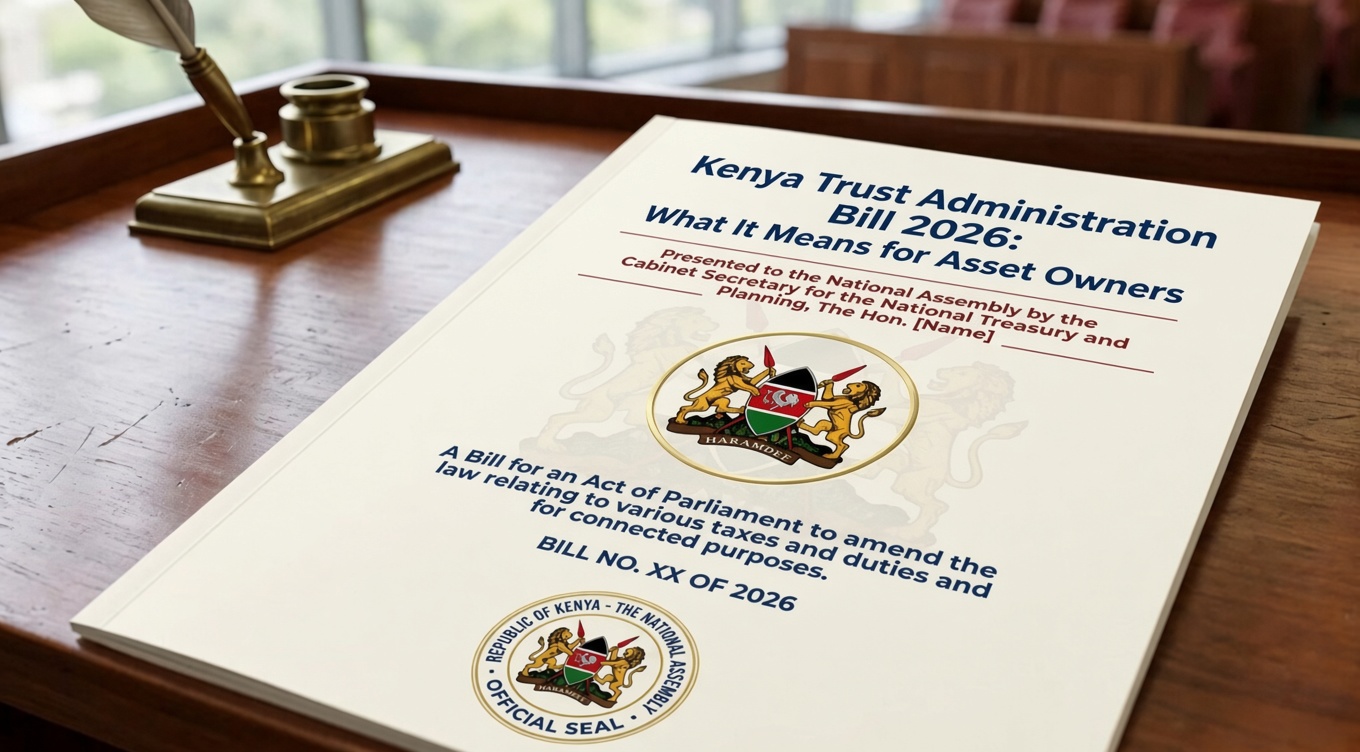
A new law could make it much harder to keep the people behind Kenyan trusts hidden.
The Kenya Trust Administration Bill 2026 is now before the National Assembly and proposes a major overhaul of the country’s legal framework governing trusts. The Bill is National Assembly Bill No. 29 of 2026 and was first read on June 16, 2026. Parliament has also invited members of the public to submit memoranda on the proposed legislation.
At the centre of the proposed reforms is a simple but powerful question: Who ultimately owns, controls or benefits from assets placed in a trust?
For ordinary families, this could mean more formal compliance when using trusts for estate planning and wealth management. For investigators and regulators, it could provide a clearer ownership trail when trusts are suspected of being used to conceal proceeds of crime.
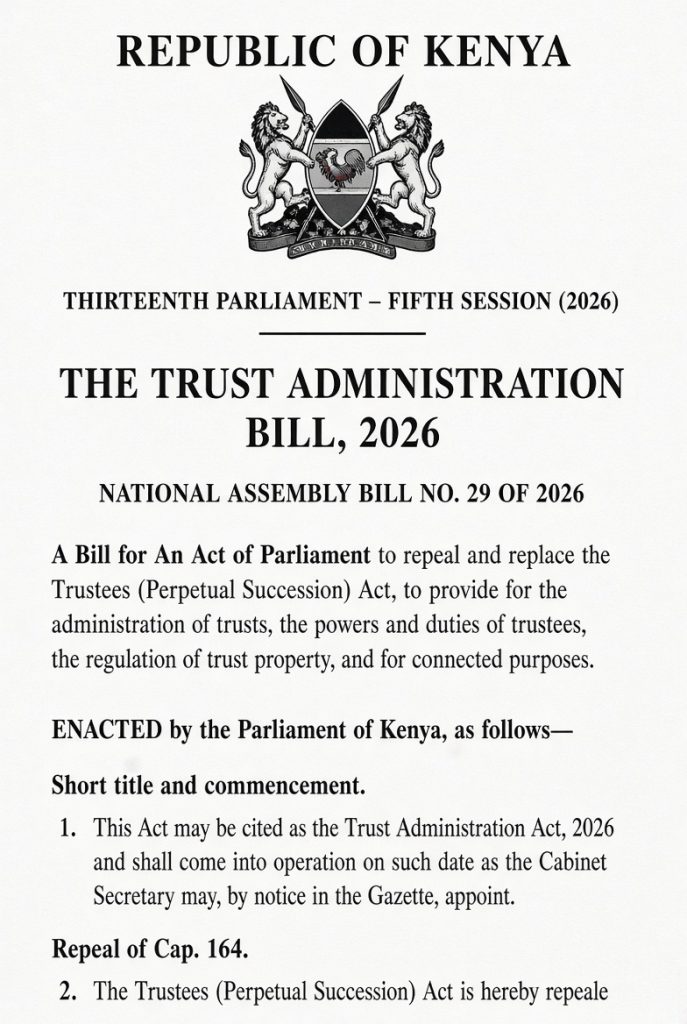
The Trust Administration Bill 2026 is before Kenya’s National Assembly as Bill No. 29 of 2026.
What Is the Kenya Trust Administration Bill 2026?
The Bill seeks to establish a comprehensive legal framework for the creation, registration, administration, regulation and termination of trusts in Kenya.
It would replace key parts of the existing framework, including the Trustees Act and the Trustees (Perpetual Succession) Act, with a more structured regime for trust administration. The proposed legislation also contains provisions dealing with transparency requirements for legal persons and legal arrangements.
This is significant because trusts are widely used for legitimate purposes. A family may establish one to manage property for children, preserve family wealth, structure an inheritance or manage assets on behalf of beneficiaries.
However, the same separation between the person who establishes a trust, the trustee who controls the property and the beneficiaries who receive benefits can create an ownership-information gap.
The proposed law is designed to narrow that gap.
Why Is Kenya Changing Trust Laws Now?
The timing is closely connected to Kenya’s international anti-money-laundering obligations.
Kenya has been under FATF increased monitoring since February 2024. Among the country’s action points is the need to designate an authority responsible for regulating trusts, obtain accurate and up-to-date beneficial-ownership information and apply remedies where transparency requirements are breached.
FATF Recommendation 25 specifically addresses transparency and beneficial ownership involving legal arrangements such as trusts. FATF has strengthened its standards to make it more difficult for criminals and terrorists to hide money behind complicated legal arrangements.
Did You Know? Kenya’s trust reforms are therefore not simply about changing how families manage wealth. They are also part of a much broader international effort to make ownership structures more transparent.
The Hidden Ownership Problem the Bill Targets
Consider a simple example.
A person transfers valuable land into a trust. A trustee becomes responsible for managing the property, while several family members are named as beneficiaries. Someone looking at the land records may see the trust or trustee rather than immediately seeing the individual who ultimately benefits from the arrangement.
That structure can be perfectly legitimate.
The problem arises when similar arrangements are deliberately used to make it difficult for authorities to establish who controls or benefits from assets connected to suspicious financial activity.
The proposed legislation seeks to make the ownership chain more visible to the relevant authorities.
That is the untold issue behind the reform: the government is not trying to abolish trusts. It is trying to make the people behind them identifiable.
Trust Registration Could Become a Major Requirement
One of the most important proposed changes is the move towards a centralised registration system for trusts.
Under the Bill, registration would become significantly more important to the legal recognition and enforceability of a written trust. Legal analysis of the Bill indicates that a written trust would generally need to be registered or incorporated in accordance with the proposed framework.
This could represent a major change for people who currently have trust deeds and other documents sitting privately with trustees, lawyers or family members.
Asset owners should therefore not assume that an old trust deed will automatically remain sufficient if the proposed law is enacted in its current form.
The exact transitional requirements will matter enormously, particularly for existing family trusts.
What Happens to Beneficial Ownership Information?
Beneficial ownership is at the heart of the proposed reforms.
Trustees would be expected to maintain accurate and up-to-date information concerning the people who ultimately benefit from or exercise control over the trust.
Recent reporting on the Bill indicates that trustees would be required to retain beneficial-ownership information for at least seven years.
This means the trustee’s responsibility would extend beyond simply holding a trust deed.
The trustee would need to maintain information capable of showing the structure of the trust and the people connected to it.
For asset owners, this creates a practical obligation: trust information should be accurate, current and properly documented.
Kenya National Assembly Hansard recording the first reading of the Trust Administration Bill 2026
Does This Mean the Government Will See All Your Family Wealth?
Not necessarily.
There is an important distinction between transparency to competent authorities and making every piece of personal financial information freely available to the general public.
Some recent reports have described the proposal as creating a “public register” of trust owners. However, the available parliamentary and legal material should be read carefully before assuming that every beneficiary’s personal details will automatically become publicly searchable on the internet.
The core policy objective is to ensure that relevant authorities and regulated reporting institutions can obtain reliable information about beneficial ownership when legally required.
This distinction matters because legitimate trust arrangements often involve sensitive information about children, family members, vulnerable beneficiaries and private assets.
What Could Change for People Who Own Land Through Trusts?
Land is one of the most important assets likely to be affected by greater trust transparency.
Many Kenyans use trusts as part of family wealth planning, particularly where several beneficiaries are expected to benefit from property over time.
If the proposed framework becomes law, trustees and trust administrators may need to pay closer attention to registration, documentation and beneficial-ownership information surrounding those arrangements.
That does not mean every person who owns land through a trust will lose their property.
Rather, the legal structure through which the property is held could become subject to more formal compliance requirements.
People with substantial property held through trusts should therefore consider obtaining professional legal advice once the final legislation and transitional provisions are known.
What About Family Trusts?
Family trusts are likely to attract significant attention because they are commonly used to organise intergenerational wealth.
A typical family trust could hold:
- Residential or commercial land.
- Rental properties.
- Shares in companies.
- Investment portfolios.
- Business interests.
- Cash and other financial assets.
- Assets intended for children or future generations.
The proposed law does not make such arrangements inherently suspicious.
That is an important point.
A transparent family trust used for legitimate estate planning is fundamentally different from a trust deliberately created to disguise the proceeds of crime.
The objective is to make it easier for authorities to distinguish between the two.
New Responsibilities for Trustees
The proposed framework would place greater emphasis on professional and accountable trust administration.
Trustees would not simply be passive holders of property. Their responsibilities would include maintaining appropriate records and complying with transparency requirements.
The Bill also provides a stronger institutional framework for oversight of trusts, reflecting the broader move away from informal trust administration towards regulated compliance.
This could increase the administrative workload and potentially the cost of maintaining some trusts.
For corporate trustees, the compliance burden could be particularly important because they may manage multiple trusts and therefore hold significant volumes of sensitive ownership information.
Penalties for Non-Compliance
The proposed transparency rules would be backed by penalties rather than relying entirely on voluntary compliance.
Reporting on the Bill and submissions surrounding it indicate proposed financial penalties for failures involving beneficial-ownership information and failure to provide records to competent authorities.
This is important because the effectiveness of a beneficial-ownership system depends on the accuracy of the information submitted.
A register containing outdated names or incomplete ownership structures would not solve the problem the legislation is designed to address.
The shocking reality is that compliance may become an ongoing responsibility rather than a one-time registration exercise.
How the Bill Connects to Money Laundering
Kenya’s financial crime environment has become increasingly sophisticated.
Money can move through banks, companies, mobile-money systems, international remittance services, property transactions and digital assets before being converted into apparently legitimate wealth.
A trust can be one part of such a structure.
FATF’s standards therefore focus on identifying the natural persons who ultimately own or control legal arrangements rather than stopping at the name of a company or trustee.
Better trust records could help investigators connect a suspicious transaction to the individuals who ultimately control or benefit from the assets.
It also allows financial institutions and other reporting entities to perform more effective customer due diligence where a trust is involved.
What the Bill Means for Wealthy Kenyans
For high-net-worth individuals, the proposed law should not necessarily be viewed as a threat to legitimate wealth planning.
Instead, it signals that wealth structures are becoming more regulated.
Anyone using a trust to hold substantial assets should review:
- The trust deed and amendments.
- The identity of all trustees.
- The identity and status of beneficiaries.
- The assets currently held by the trust.
- The source and ownership history of those assets.
- Records showing changes in control or beneficiaries.
- Whether the trust will require registration or other action under the final law.
Keeping these records organised now could make future compliance considerably easier.
What About Existing Trusts?
This is one of the most important questions—and one that asset owners should watch closely.
The Bill is still proposed legislation. It has not become an Act of Parliament, and its final wording could change during the legislative process.
Parliament’s records show that the Bill has been introduced and that public participation has been part of the consideration process.
Existing trust owners should therefore avoid taking drastic action based solely on headlines.
Instead, they should monitor the final legislation and any regulations or transitional provisions that determine how existing trusts will be treated.
A lawyer specialising in trusts, succession and property law can assess the specific structure and advise whether amendments or registration will be necessary.
Will Trusts Become More Expensive to Maintain?
They could become more administratively demanding.
Registration, record keeping, professional trustee services, compliance reviews and periodic updates can create additional costs.
However, the trade-off is greater legal clarity and accountability.
For legitimate asset owners, a more predictable framework could ultimately make trusts more useful because beneficiaries, trustees, financial institutions and regulators would have clearer rules to follow.
The revealed opportunity is that stronger regulation can also increase confidence in legitimate trusts rather than simply making them more difficult to use.
What Asset Owners Should Do Now
There is no need to panic, but there is a strong reason to prepare.
If you own assets through a trust, consider the following steps:
- Locate your original trust deed. Make sure you have the latest version and all amendments.
- Confirm the trustees. Check whether the current trustees match the legal documents.
- Review beneficiaries. Make sure the records accurately reflect the intended beneficiaries.
- Prepare an asset schedule. Record property, shares, businesses and other assets held by the trust.
- Check documentation. Ensure ownership documents and financial records can be traced.
- Seek professional advice. Ask a qualified Kenyan trust or succession lawyer how the proposed framework could affect your particular arrangement.
- Monitor Parliament. The final Act and regulations—not social-media summaries—will determine the actual legal obligations.
For background, readers can follow the official Kenya Parliament Bills tracker and the Kenya Law Bills database.
Could the Bill Affect Business Owners?
Yes, particularly where business interests are held through trusts.
A trust may own shares in a private company, receive dividends or control investment interests. If the beneficial-ownership information associated with the trust becomes part of a more formal regulatory system, business owners will need to ensure that their trust and corporate records do not contradict one another.
This is particularly relevant where the same family controls several companies through different structures.
Consistency will matter.
The FATF Pressure Is Bigger Than Trusts
It would be a mistake to interpret the Bill as Kenya’s only FATF reform.
Kenya’s FATF action plan also covers risk-based supervision of financial institutions and designated non-financial businesses, suspicious transaction reporting, financial intelligence, money-laundering and terrorism-financing investigations, targeted financial sanctions, virtual-asset regulation and oversight of non-profit organisations.
Trust transparency is therefore one component of a much larger national compliance programme.
FATF’s continuing assessment makes the trust reforms particularly significant because Kenya has been specifically directed to strengthen regulation of trusts and beneficial-ownership information.
What Happens Next?
The immediate next step is parliamentary consideration.
The Bill has already been introduced in the National Assembly and subjected to the public-participation process. Its provisions can still be debated, amended and refined before Parliament completes the legislative process.
Asset owners should therefore distinguish between what the Bill currently proposes and what eventually becomes law.
That distinction is especially important when discussing issues such as the accessibility of trust information, transitional arrangements for existing trusts, registration procedures and the precise duties of trustees.
Frequently Asked Questions
1. Is the Kenya Trust Administration Bill 2026 already law?
No. It is a Bill before Parliament, not yet an enacted Act of Parliament. It was first read in the National Assembly on June 16, 2026, and remains subject to the legislative process.
2. Why is Kenya changing its trust laws?
The proposed reforms aim to create a clearer and more comprehensive trust framework while strengthening transparency and beneficial-ownership requirements. The reforms also address an issue specifically identified in Kenya’s FATF action plan.
3. Will people have to disclose who benefits from a trust?
The Bill proposes stronger beneficial-ownership record-keeping requirements for trusts, including information about people who ultimately benefit from or exercise control over the arrangement. Trustees would have continuing record-keeping responsibilities.
4. Will all trust information become publicly available?
Not necessarily. The key issue is access by competent authorities and relevant reporting institutions. Claims that every detail will automatically become publicly searchable should be treated cautiously until the final law and implementing regulations specify exactly how the register will operate.
5. What should existing trust owners do now?
They should locate their trust documents, verify trustee and beneficiary information, organise records of assets and amendments, and obtain professional advice if the trust holds significant property or business interests. They should also monitor the final legislation and transitional provisions.
6. Does the Bill mean trusts will be illegal or discouraged?
No. Trusts remain legitimate legal arrangements used for estate planning, wealth management, charitable purposes and other lawful activities. The proposed reforms are intended to increase transparency and accountability and reduce the possibility of trusts being misused for money laundering or terrorism financing.
What Kenyan Asset Owners Should Take Away
The Kenya Trust Administration Bill 2026 represents a significant shift towards greater transparency in the country’s trust sector.
The biggest change is not that Kenya is abandoning trusts. Rather, the proposed framework would make it considerably harder for the ownership and control of trust-held assets to remain undocumented or hidden from the authorities that are legally entitled to access that information.
For families using trusts legitimately, preparation is more sensible than panic. Review your documents, keep ownership information accurate, understand who the trustees and beneficiaries are, and monitor the final parliamentary version of the legislation.
For regulators and investigators, the Bill could close an important information gap. For Kenya’s international financial standing, it represents another step towards addressing the FATF recommendations that remain relevant to the country’s increased-monitoring status.
The truth is simple: if the Bill becomes law substantially as proposed, the era when a trust could function as an opaque ownership structure in Kenya will become much harder to maintain.
Are you holding land, a business or investments through a family trust? Share this article and follow OmarosaOmarosa.com for updates as Parliament considers the Trust Administration Bill 2026.
This article is for general information and does not constitute legal advice. Because the Bill is still before Parliament, readers should rely on the final enacted legislation and obtain advice from a qualified Kenyan advocate before restructuring or registering a trust.