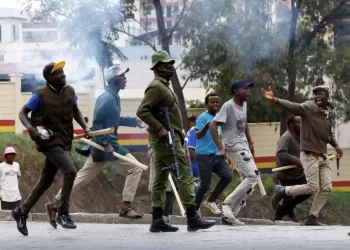


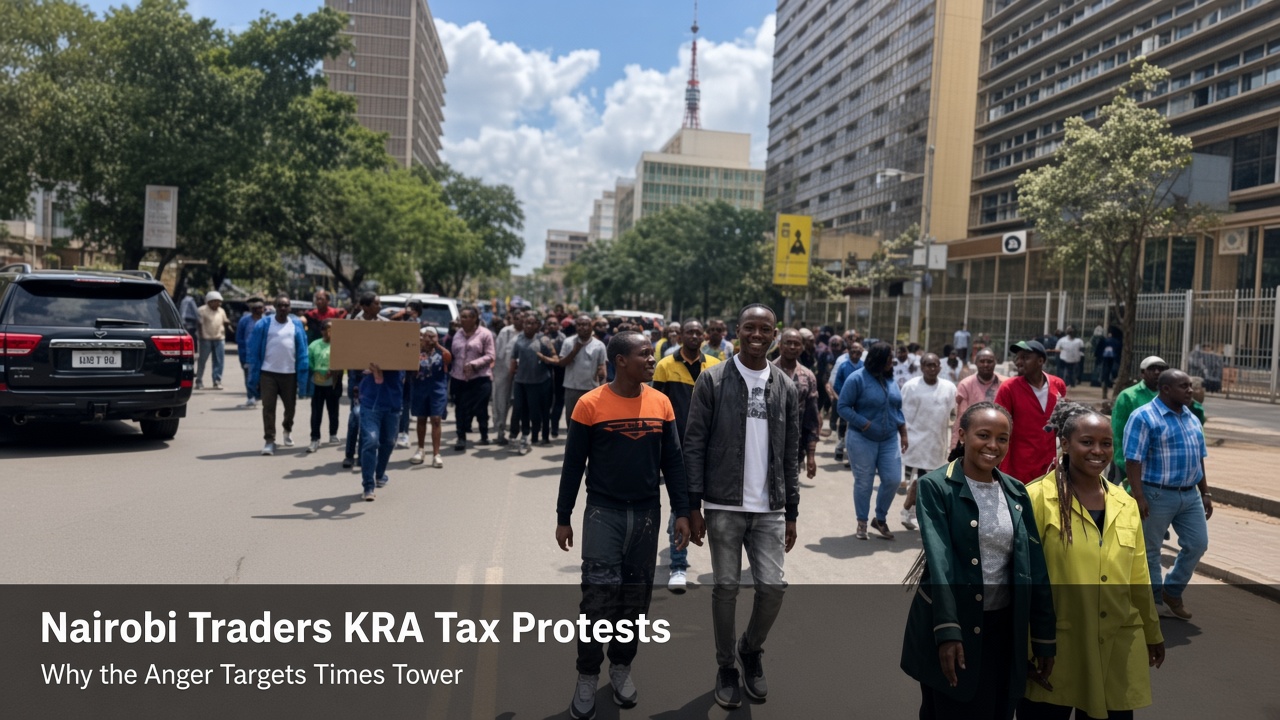
Nairobi traders KRA tax protests have become a weekly ritual along Haile Selassie Avenue and outside Times Tower. Every Friday, business owners from Kamukunji, Gikomba, Eastleigh and Nyamakima close their shops, pick up placards and demand that the Kenya Revenue Authority engage them before imposing new costs. The latest wave of Nairobi traders KRA tax protests centres on a sharp rise in the minimum customs valuation benchmark for consolidated cargo. While some observers still blame Nairobi County, the evidence points clearly to national tax policy as the source of the pressure now squeezing the city’s small traders.
A Customs Benchmark Nobody Asked For
The current round of Nairobi traders KRA tax protests was triggered by a decision to raise the minimum customs valuation benchmark for a 40-foot container of consolidated cargo from Sh2.5 million to Sh3.2 million. The 28 percent increase — an extra Sh700,000 per container — took effect on 20 August 2026. Traders who rely on shared containers to import merchandise, largely from China, immediately warned that the change would inflate costs and compress already thin margins.
On Friday 28 August, many traders shut their businesses and marched as part of the ongoing Nairobi traders KRA tax protests. Closed shopfronts appeared along Moi Avenue, Kenyatta Avenue and Tom Mboya Street, even as trade continued largely uninterrupted in Eastleigh. Police were stationed outside Times Tower in anticipation of further demonstrations.
This was not an isolated incident. Weeks earlier, in July, Kamukunji and Eastleigh business owners had staged a separate protest outside KRA headquarters over what they described as harsh enforcement measures, including pressure to adopt the electronic Tax Invoice Management System (eTIMS). Some traders openly called for the resignation of the Commissioner General. That demonstration followed KRA’s own engagement sessions with Eastleigh traders in April, during which the agency acknowledged low eTIMS uptake as a genuine friction point and promised support. Traders involved in the Nairobi traders KRA tax protests have therefore not refused dialogue. They have participated, watched fresh levies arrive anyway, and concluded that the engagement remains largely cosmetic.
KRA maintains that the Sh3.2 million figure is a minimum risk-reference point for a simplified clearance arrangement, not an automatic tax bill. Actual liability, the agency says, continues to rest on the declared value and classification of goods. Traders who prefer can de-consolidate cargo and declare individually. KRA also argues that the review targets a real problem: under-declaration, misclassification and concealment of goods that erode government revenue. After pushback, the authority granted a one-month grace period before the new benchmark fully applies.
Both statements can be true at the same time. KRA has a legitimate interest in protecting revenue. Traders participating in the Nairobi traders KRA tax protests have an equally legitimate fear that a reference point raised by 28 percent will function, in practice, as a floor few can undercut without inviting additional scrutiny.
Why the Blame Belongs at Treasury and Times Tower
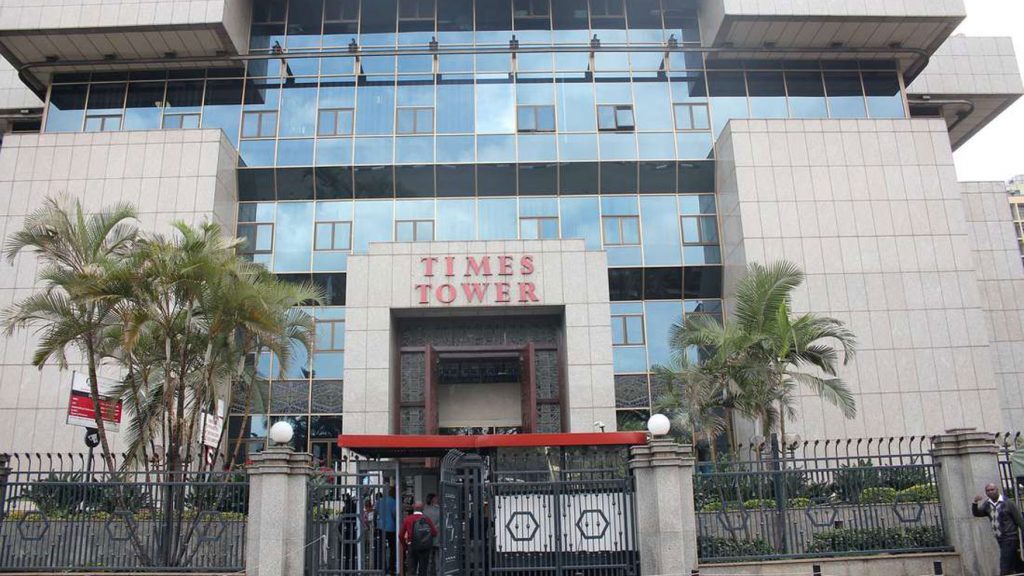
Treasury and Times Tower
Single business permits, market cess and county-level trade licensing fall under Nairobi County’s mandate. The county can — and often should — be criticised for how it administers those instruments. Customs valuation benchmarks, VAT thresholds, import duty, excise adjustments and the eTIMS regime, however, are products of national tax law and KRA administrative policy. Governor Sakaja’s administration did not draft the Finance Bill provisions behind these charges, does not set customs benchmarks, and holds no statutory authority over KRA’s enforcement posture.
When a Gikomba trader closes her stall on a Friday as part of the Nairobi traders KRA tax protests, she is protesting a national institution operating under a national government mandate. Conflating county and national responsibility lets the actual decision-makers off the hook. It is Treasury’s revenue targets — designed to close persistent budget deficits and service public debt — that drive KRA’s aggressive net-widening. It is the national government’s broader fiscal strategy, not the Nairobi County Assembly, that determines how hard to squeeze the informal and small-trader economy.
The Hustler Contradiction
The sharpest edge of the Nairobi traders KRA tax protests is political. The current national administration built its 2022 campaign and much of its subsequent legitimacy on the “hustler” narrative — the promise that government would finally stand with the mama mboga, the boda boda rider, the Gikomba trader and the small importer against a system long tilted toward big capital and political dynasties. The Hustler Fund, the bottom-up economic model and repeated rhetoric about lifting people “from the bottom of the pyramid” all rested on that promise.
Traders in Kamukunji and Gikomba are, almost by definition, the constituency that platform was written for. That a customs benchmark hike, tighter eTIMS enforcement and rising compliance costs are now landing hardest on exactly this group is the contradiction driving much of the anger on the streets — arguably more than the arithmetic of any single levy. When people who were promised priority instead feel they are being squeezed to plug a revenue gap, the sense of betrayal compounds the economic pain behind the Nairobi traders KRA tax protests.
Finding the Middle Ground
A purely one-sided reading of the Nairobi traders KRA tax protests serves no one. Several facts remain true:
- Kenya’s revenue base is genuinely strained. Consolidated cargo has long provided a channel for under-declaration and misclassification that costs the exchequer real money. KRA did not invent the problem.
- Traders themselves are not uniformly compliant. Low eTIMS adoption has made it harder to distinguish legitimate small businesses from larger importers using “consolidated cargo” as cover.
- Not all traders share the same tactics or intensity of grievance. Some businesses remained open through the latest protest, indicating that anger, while widespread, is not universal and that earlier engagement channels have achieved partial success.
- The county is not blameless. Even though customs and VAT sit with KRA, Nairobi’s own permit and cess regime adds to the cumulative cost of doing business. Traders experience the total burden at the till and rarely separate “county pain” from “national pain.”
The honest picture is a system in which multiple layers of government each take a bite, at a moment when the aggregate bite exceeds what many small traders can absorb. The sequencing and communication of the KRA change — more than the principle behind it — turned frustration into a weekly ritual of Nairobi traders KRA tax protests.
What Could Actually Fix This
- A binding, time-bound negotiation table. KRA should convert the current one-month grace period into a formal joint technical committee with recognised trader associations from Kamukunji, Gikomba, Nyamakima and Eastleigh. The committee should jointly review the Sh3.2 million benchmark, publish the methodology used to calculate it, and commit to revisiting the figure against actual import data rather than announcing changes unilaterally.
- Tiered benchmarks instead of flat increases. A single national figure ignores the difference between a container of low-value household goods and one of high-value electronics. A graduated, category-based valuation system would target under-declaration in high-risk goods without penalising genuinely low-margin traders.
- Decouple enforcement from punishment during transition. Traders who voluntarily de-consolidate or adopt eTIMS in good faith should receive an explicit, penalty-free compliance window rather than facing simultaneous pressure on both invoicing and valuation.
- National–county coordination on the cost of doing business. Treasury, KRA and Nairobi County should jointly audit the cumulative levy burden on a typical small trader — permits, cess, customs, VAT and presumptive tax. Because traders experience these charges as one bill, a joint task force could recommend which layer gives way when the total becomes unsustainable.
- Make the hustler rhetoric concrete. If small traders are the political base the government says it prioritises, that priority should translate into a formal seat for trader associations in Finance Bill consultations on customs and VAT matters that affect informal trade — not merely after-the-fact clarification statements once Nairobi traders KRA tax protests make headlines.
- Predictable, published review cycles. Sudden mid-year benchmark changes breed distrust. Tying customs valuation reviews to a fixed, pre-announced annual cycle aligned with the Finance Bill process would allow traders to plan and price goods accordingly, reducing the shock element that fuels protest.
The Bottom Line
Nairobi’s small traders are not wrong to be angry, and they are not wrong about where that anger should be directed. The Nairobi traders KRA tax protests highlight a national government and KRA problem, dressed in a devolution-era habit of blaming the nearest visible official — in this case Governor Sakaja — for a fire the county did not start.
The deeper wound is political. A government that rose to power promising to champion hustlers is now presiding over policies that make hustling harder. Fixing that will require more than a KRA press statement clarifying what a benchmark technically means. It will require genuine, binding negotiation, transparent valuation methods, and a national government willing to treat its “bottom of the pyramid” base as a partner in tax policy rather than a talking point at election time.
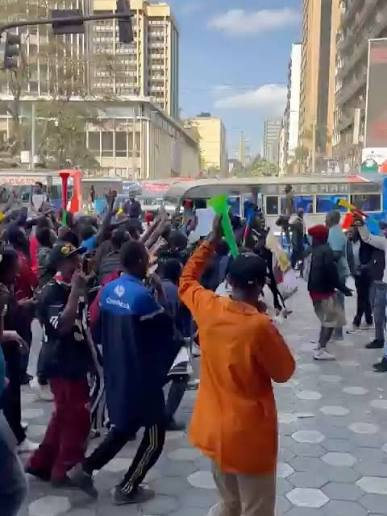
Traders in Nairobi’s informal markets face rising compliance and import costs that have fuelled the ongoing Nairobi traders KRA tax protests.
Frequently Asked Questions
What triggered the latest Nairobi traders KRA tax protests?
The immediate trigger was KRA’s decision to raise the minimum customs valuation benchmark for a 40-foot consolidated cargo container from Sh2.5 million to Sh3.2 million, a 28 percent increase that took effect on 20 August 2026.
Is Nairobi County responsible for the customs benchmark hike behind the Nairobi traders KRA tax protests?
No. Customs valuation benchmarks, import duties and the eTIMS regime fall under national tax law and KRA administrative authority. Nairobi County controls permits, cess and local licensing, but not customs policy.
What does KRA say about the new Sh3.2 million benchmark?
KRA describes the figure as a minimum risk-reference point for simplified clearance, not an automatic tax. Actual liability remains based on declared value and goods classification. Traders may also choose to de-consolidate and declare individually.
Have traders tried to engage KRA before the Nairobi traders KRA tax protests?
Yes. KRA held engagement sessions with Eastleigh traders in April 2026 and acknowledged low eTIMS uptake. Despite those talks, new measures continued to land, leading many traders to view the dialogue as insufficient.
What practical steps could reduce tension behind the Nairobi traders KRA tax protests?
Recommendations include a joint technical committee with published methodology, tiered rather than flat benchmarks, a penalty-free transition window for voluntary compliance, and formal trader representation in Finance Bill consultations on customs and VAT issues.
Why do some observers link the Nairobi traders KRA tax protests to the “hustler” narrative?
The national administration campaigned on prioritising small-scale traders and informal workers. Policies that increase costs for exactly that constituency have created a political contradiction that amplifies economic grievances.