

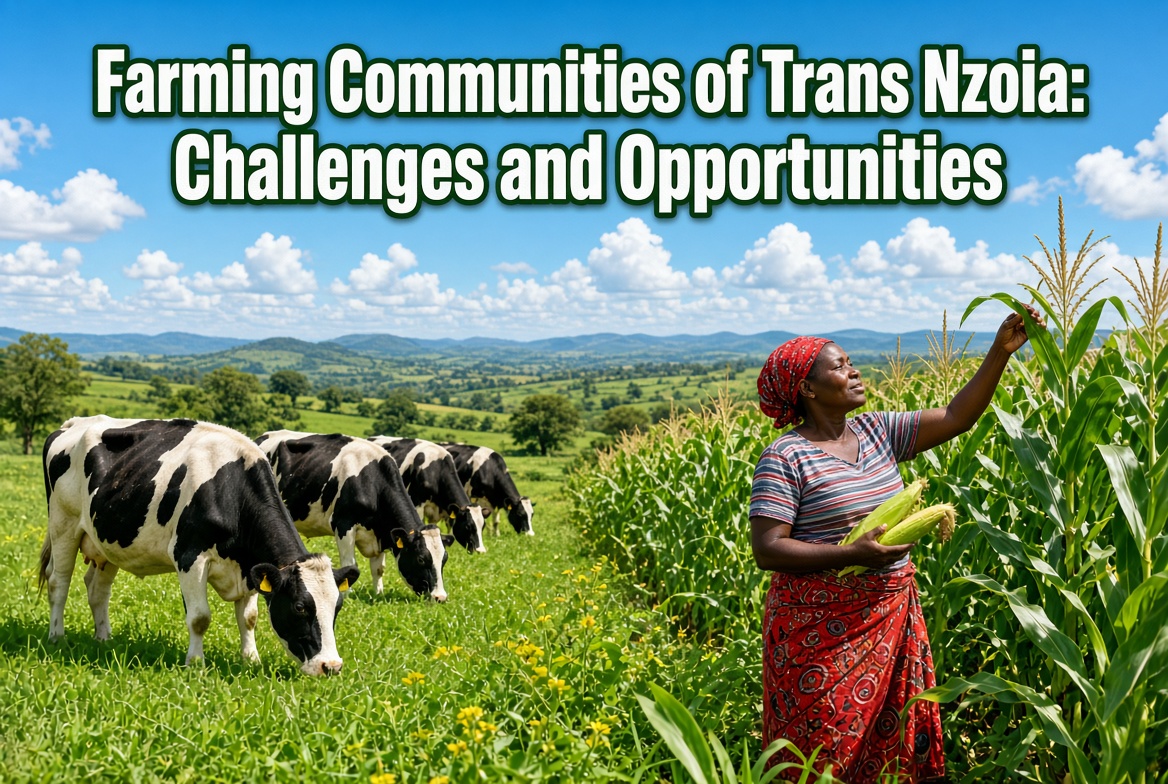
Did You Know? Trans Nzoia is often described as one of Kenya’s most productive agricultural regions, but the story behind its farms is more complicated than endless fields of maize and wheat. Thousands of farming households face rising costs, shrinking land sizes, changing weather patterns and uncertainty over markets.
Yet there is also an untold opportunity. As agriculture changes, Trans Nzoia farming communities could benefit from modern technology, value addition, climate-smart farming, better markets and stronger farmer organizations.
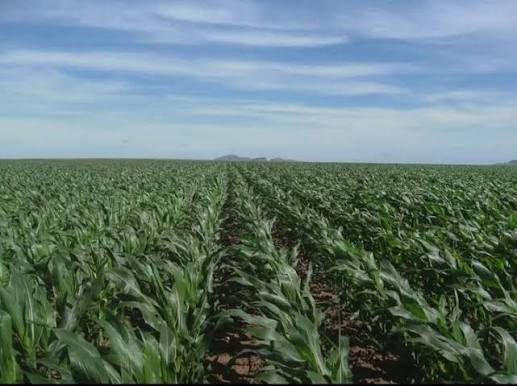
Farming remains a major source of livelihoods for communities across Trans Nzoia County.
The Agricultural Heart of Trans Nzoia
Trans Nzoia has long been associated with large-scale agriculture. The county’s fertile land and agricultural tradition have supported the production of staple crops and livestock for generations.
However, agriculture is changing. Population growth, land subdivision, urban expansion and changing economic conditions are placing new pressure on farming communities.
The shocking truth is that fertile land alone does not guarantee food security or household prosperity. Farmers must now contend with rising input prices, changing climate conditions and increasingly demanding markets.
This means the future of Trans Nzoia farming communities depends on how successfully they adapt.
1. Land Use Is Becoming a Major Challenge
Land is the foundation of agriculture, but land-use patterns are changing. As families grow and land is inherited across generations, some farms become divided into smaller plots.
Smaller plots can still be productive, but they may require a different farming model. A farmer with limited acreage may not achieve the same results by copying a large-scale maize farming system.
Instead, smallholders may need to consider higher-value enterprises, mixed farming, improved livestock production, horticulture or other activities suitable for smaller areas.
Major Land-Use Pressures Include:
- Subdivision of family land into smaller plots.
- Expansion of towns and trading centres.
- Competition between farming, housing and commercial development.
- Pressure on grazing land and natural resources.
- Changing land ownership and inheritance patterns.
The hidden opportunity is better land-use planning. Farmers who understand the productive capacity of their land can make smarter decisions about what to grow or raise.
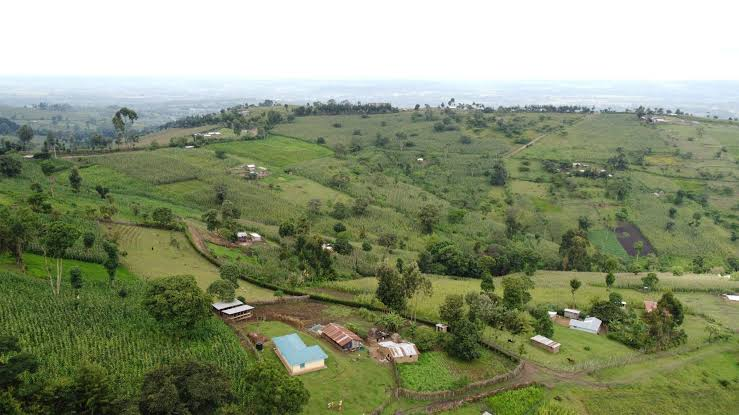
Changing land use and subdivision are reshaping the future of farming communities.
2. Smallholder Farmers Face a Different Reality
Not every farmer in Trans Nzoia operates hundreds of acres. Many households farm relatively small pieces of land and must carefully balance household needs with commercial production.
For these farmers, the biggest challenge is often efficiency. Production costs can consume a large percentage of potential income.
A smallholder farmer must ask a critical question before every season: What can this piece of land realistically produce, and where will the profit come from?
This is where diversification becomes important. Depending entirely on one crop can expose a household to major financial risk.
Potential Smallholder Opportunities Include:
- Dairy farming with well-managed animals.
- Vegetable production where water is available.
- High-quality poultry production.
- Avocado and other long-term orchard crops where suitable.
- Fodder production for livestock.
- Collective marketing through farmer groups.
The secret is not necessarily to farm more land. It is to make each available acre work more efficiently.
3. Climate Change Is Changing the Farming Calendar
One of the biggest challenges facing Trans Nzoia farming communities is climate uncertainty. Farmers traditionally depend on seasonal patterns to determine when to prepare land and plant crops.
When rainfall becomes less predictable, farming decisions become more difficult. A delayed season can affect planting schedules, crop growth and the availability of livestock feed.
Extreme weather can also create additional problems, including crop damage, soil erosion and pressure on water resources.
This is why climate-smart agriculture is becoming increasingly important.
Climate-Smart Practices May Include:
- Improving soil organic matter.
- Using appropriate crop varieties.
- Harvesting and conserving water.
- Diversifying crops and livestock.
- Protecting soil from erosion.
- Planting trees where appropriate.
- Using weather and agricultural information to improve planning.
For information on agricultural research and climate-related farming practices, farmers can consult the Kenya Agricultural and Livestock Research Organization (KALRO).
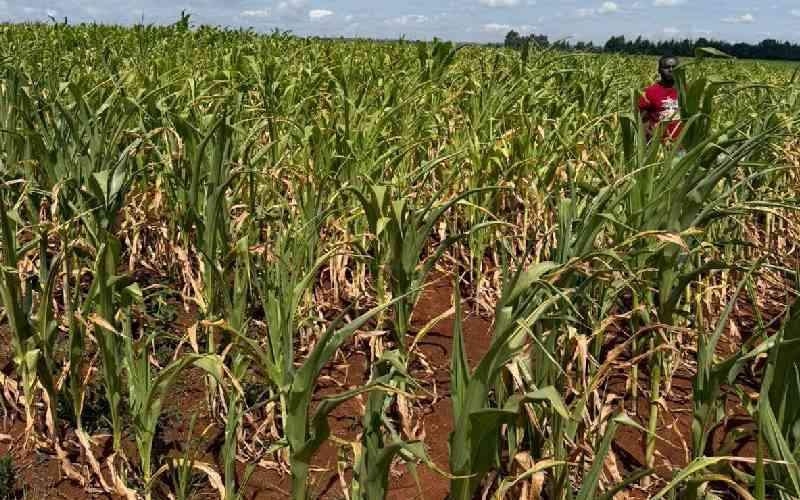
Climate uncertainty is making planning increasingly important for farmers in Trans Nzoia.
4. Rising Farm Costs Are Squeezing Farmers
The price of farm inputs can determine whether a season ends in profit or loss. Farmers must budget for seed, fertilizer, chemicals, labour, machinery, transport and other expenses.
The shocking reality is that a good harvest does not automatically mean a good profit.
A farmer may produce a large quantity of maize or another crop but discover that the cost of production was too high compared with the selling price.
This makes record keeping essential.
Every Farmer Should Track:
- Total land preparation costs.
- Seed and fertilizer expenses.
- Labour costs.
- Machinery and fuel expenses.
- Spraying and pest-control costs.
- Harvesting costs.
- Storage and transport expenses.
- Total sales and actual profit.
Without records, farmers may know their revenue but not their true profit.
5. Markets Remain Both an Opportunity and a Problem
Producing food is only part of the agricultural business. Farmers must also find reliable buyers.
Many agricultural communities experience the same problem: produce is ready, but prices are disappointing or buyers are limited.
This is where farmer organizations and cooperatives can potentially play an important role. Collective action may improve access to information, storage, transport and larger markets.
The most successful agricultural businesses increasingly think about the market before production begins.
Farmers should investigate:
- Who will buy the produce?
- What quality standards are required?
- What is the expected market price?
- Can the produce be stored?
- How much will transport cost?
- Are there processors or institutional buyers?
The Agriculture and Food Authority is one of the institutions involved in agricultural commodity regulation and development.
6. Agricultural Policy Can Directly Affect Farmers
Agricultural policy may sound like something discussed in government offices, but policy decisions can directly affect what farmers pay for inputs, how commodities are regulated and which agricultural programmes receive support.
Farmers are affected by decisions involving:
- Input support programmes.
- Seed and fertilizer regulation.
- Crop and livestock health policies.
- Food safety standards.
- Agricultural extension services.
- Market regulations.
- Import and export policies.
The truth is that farmers need access to clear and reliable information about policies that affect their businesses.
Official agricultural policy and programme information can be found through the Kenya Ministry of Agriculture and Livestock Development.
7. Young People Could Transform Trans Nzoia Agriculture
One of the biggest opportunities for the region lies in attracting younger people into agriculture.
Modern farming requires more than physical labour. It increasingly involves technology, data, marketing, machinery, logistics and business management.
A young entrepreneur does not necessarily need to own a large farm to participate in agriculture.
Opportunities Beyond Traditional Farming Include:
- Agricultural machinery services.
- Seedling and nursery businesses.
- Veterinary and livestock support services.
- Farm produce transportation.
- Produce aggregation and marketing.
- Food processing and packaging.
- Agricultural technology services.
This is an important shift. Agriculture is not just about owning land. It is an entire economic ecosystem.
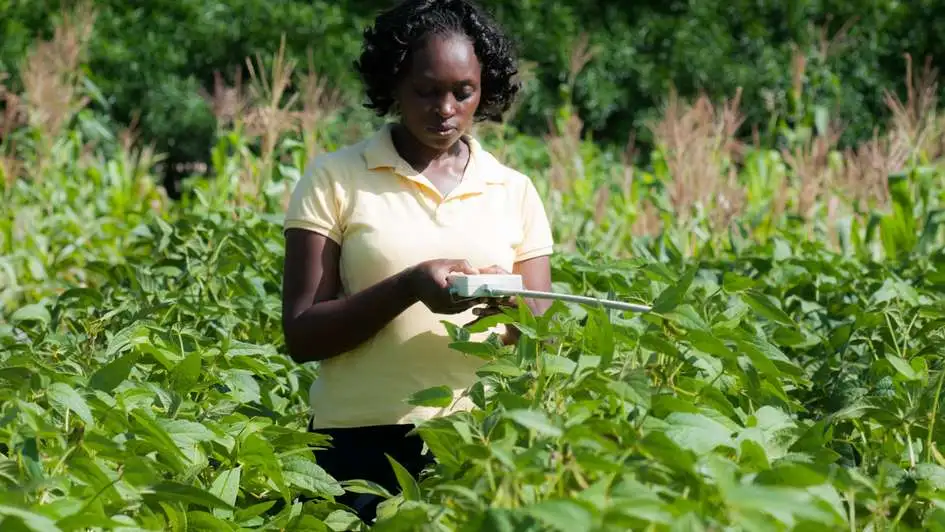
Younger entrepreneurs could play an important role in modernizing Trans Nzoia’s agricultural economy.
8. Value Addition Could Create More Local Jobs
One of the biggest opportunities for farming communities is moving beyond the sale of raw produce.
When agricultural products are processed, packaged or prepared for specialised markets, more economic activity can remain within the local community.
Potential value-addition opportunities may include better grain handling, milk processing, produce grading, packaging and other legally regulated agricultural businesses.
However, value addition requires proper planning. Entrepreneurs must understand the market, equipment requirements, quality standards and applicable licences.
9. Farmer Groups Can Create Strength Through Cooperation
An individual smallholder may struggle to negotiate with large buyers. A group of organized farmers may have greater bargaining power.
Farmer groups and cooperatives can potentially help members access training, bulk purchasing, market information and collective selling opportunities.
However, good governance is essential. Members need transparency, proper financial management and clear leadership structures.
The hidden truth is that cooperation works best when farmers share information and trust the systems they create.
10. Technology Is Slowly Changing Farming Communities
Mobile phones, digital payments and online information are changing how farmers access markets and agricultural knowledge.
Farmers can increasingly use technology to:
- Check weather information.
- Communicate with buyers.
- Compare agricultural prices.
- Access training material.
- Keep farm records.
- Promote products.
Technology will not solve every farming problem, but better access to information can improve decision-making.
What the Future Could Look Like for Trans Nzoia Farming Communities
The future of Trans Nzoia agriculture will depend on how communities respond to today’s challenges.
Land pressure will require smarter land use. Climate uncertainty will require better planning and resilient farming systems. Smallholders will need efficient enterprises. Markets will require stronger organization and better quality control.
At the same time, agriculture presents major opportunities for employment, entrepreneurship and local economic development.
The most important shift may be mental: farming must increasingly be treated as a business, supported by knowledge, records, technology and market research.
Frequently Asked Questions About Farming in Trans Nzoia
What are the biggest challenges facing farmers in Trans Nzoia?
Major challenges include land pressure, rising input costs, climate uncertainty, market access, pests and diseases, and the need for better agricultural information and services.
Is smallholder farming profitable in Trans Nzoia?
Smallholder farming can be profitable when farmers choose suitable enterprises, control production costs, use appropriate farming methods and identify reliable markets.
How is climate change affecting farmers in Trans Nzoia?
Changing weather patterns can affect planting schedules, water availability, crop performance and livestock feed. Farmers may need more climate-resilient production strategies.
What opportunities exist for young people in agriculture?
Young people can participate in farming, machinery services, agribusiness, produce marketing, transport, technology, processing and other agricultural value-chain businesses.
Why is land use important for Trans Nzoia farmers?
Changing land ownership, subdivision and urban expansion can affect farm sizes and agricultural production. Better planning can help farmers use available land more efficiently.
How can farmer groups help local communities?
Well-managed farmer groups may help members access training, market information, bulk purchasing and collective marketing opportunities.
The Road Ahead
The challenges facing Trans Nzoia farming communities are real, but so are the opportunities. The region still has strong agricultural potential, experienced farmers and an important position in Kenya’s food system.
The secret to the future may not be producing more of the same. It may be producing smarter, reducing waste, protecting natural resources, adapting to climate change and creating stronger connections between farmers and markets.
For Trans Nzoia’s farming communities, the future of agriculture will be shaped by the decisions made today. Farmers, young entrepreneurs and local leaders all have a role to play in building a more productive, resilient and profitable agricultural economy.