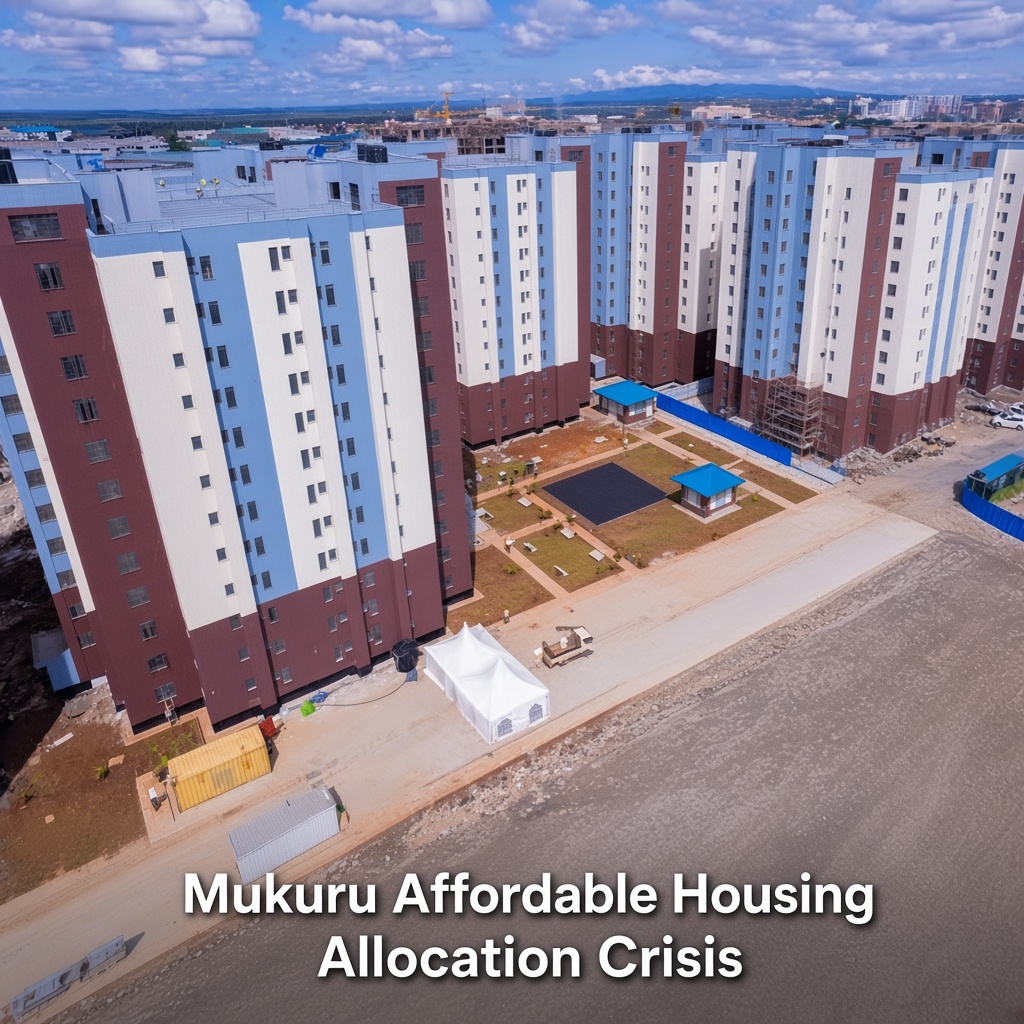
The Mukuru affordable housing allocation crisis has become one of the most visible challenges facing Kenya’s Affordable Housing Programme. Original residents of the informal settlement who registered on the Boma Yangu platform and paid deposits claim they were later informed that the units they believed they had secured had already been sold to other buyers.

Residents address the press over the Mukuru affordable housing allocation crisis.
A Flagship Project Under Pressure
The New Mukuru Housing Estate was designed as a showcase project covering roughly 56 acres in Embakasi South and planned to deliver 13,248 units. Government officials repeatedly presented it as proof that the Affordable Housing Programme could produce homes at scale. The first 1,078 units were completed and handed over in May 2025.
The estate includes bedsitter, one-bedroom and two-bedroom apartments together with schools, a hospital, a police post, a fire station and commercial spaces. On paper, residents whose homes were demolished were meant to receive priority. In practice, many of those same residents now say the system has failed them, fuelling the current Mukuru affordable housing allocation crisis.
What Residents Are Alleging
According to reports published on 27 August 2026, a group of Mukuru residents who had paid deposits gathered in Nairobi to publicise their grievances. They claim that after registering on Boma Yangu and making payments — typically around 5 per cent of the unit value — they were told the houses were already sold.
Similar complaints surfaced earlier. When President William Ruto handed over the first batch of units in May 2025, some original residents told journalists they had completed every required step on the Boma Yangu platform yet never received an allocation. One woman said she still held documentation showing a house number assigned to her but remained in the informal settlement while units went to others she described as outsiders.
Nairobi Governor Johnson Sakaja has previously acknowledged that irregularities have occurred in Mukuru, including unauthorised nighttime evictions that he said he intervened to stop.
How the Allocation System Is Supposed to Work
The official process is clear in theory. Prospective buyers register on the Boma Yangu portal or via the USSD code *832#, complete an eligibility check, apply for a specific unit type, and make savings or a deposit. The government has stated that only one unit is allowed per national ID and that residents of the original informal settlement should receive priority.
The scale of the project has made allocation highly contested. With thousands of families competing for a limited number of completed units delivered in phases, any weakness in verification or prioritisation quickly becomes visible and contributes to the Mukuru affordable housing allocation crisis.
The Delayed KSh 30,000 Relocation Payments
A parallel dispute concerns relocation facilitation payments. Families whose homes were demolished were promised support — reported at around KSh 30,000 per household in the Mukuru case — to help them move and settle while waiting for permanent units.
Many say they have waited up to six months for these funds. Some remain without either a new house or the interim payment, leaving them displaced from their original homes and without the resources to secure temporary accommodation elsewhere in Nairobi.
Similar complaints have been raised in nearby projects such as Mariguini and Makongeni, where residents and the Law Society of Kenya have questioned both the adequacy of the compensation and the timing of evictions relative to payment.
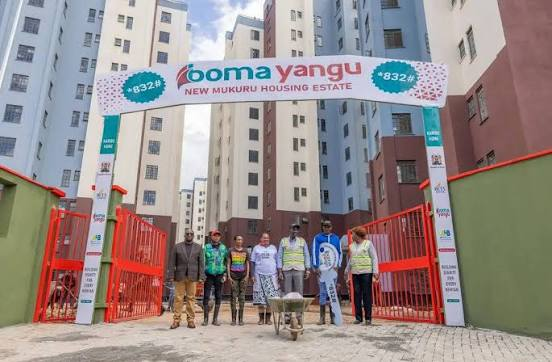
Completed residential blocks at the New Mukuru Estate where allocation disputes continue.
Claims That Outsiders Received Priority
The central accusation from many Mukuru residents is that units intended for original community members were allocated to people with no connection to the demolished settlement. Some believe the back-end allocation process on Boma Yangu is either poorly coordinated with the stated priority rules or is open to influence by intermediaries.
Government officials have defended the overall programme, stressing that demand far exceeds the number of completed units available at any one time. Officials have also clarified that completed units are meant for ownership rather than rental. Nevertheless, the gap between the priority rules on paper and the lived experience of many original residents remains the source of the current Mukuru affordable housing allocation crisis.
A Programme Expanding Faster Than Its Systems
Nationally the Affordable Housing Programme continues to expand. By early 2026 more than 262,000 units were under construction across 47 counties and Boma Yangu registrations had surpassed one million. The government presents these figures as signs of strong public interest.
The Mukuru dispute, however, suggests that the administrative systems required to verify original residency, prioritise allocations, track deposits accurately, disburse relocation payments and complete handovers have not kept pace with the speed of construction and public marketing.
What Affected Residents Are Demanding
As of late August 2026, the families at the centre of the crisis are calling for three main actions:
- A transparent audit of who actually received units in the completed phases of the Mukuru estate.
- Immediate disbursement of outstanding KSh 30,000 relocation payments.
- A clear public explanation from the Affordable Housing Board and Boma Yangu administrators of how allocation decisions were made.
Whether the government responds with an independent review or simply restates the overall progress of the national programme will shape whether this remains a local grievance or becomes a broader test of credibility for one of the country’s most visible development initiatives.
Frequently Asked Questions
What is the Mukuru affordable housing allocation crisis?
It refers to claims by original Mukuru residents that units they registered and paid deposits for through Boma Yangu were later reported as sold, leaving them without homes despite following official procedures.
How much is the relocation payment in Mukuru?
Residents report that the facilitation payment is around KSh 30,000 per household. Many say they have waited six months or longer for the funds.
Are original Mukuru residents supposed to get priority?
Yes. Government statements have indicated that residents of the informal settlement whose homes were demolished should receive priority in allocation.
What is Boma Yangu?
Boma Yangu is the official digital platform and USSD service (*832#) through which Kenyans register, save and apply for units under the Affordable Housing Programme.
How many units are planned for the New Mukuru Estate?
The full development is designed to deliver 13,248 units of different sizes, delivered in phases.
Has the government responded to the latest complaints?
As of 28 August 2026, affected residents continue to call for a transparent audit and payment of outstanding funds. Official responses have so far focused on the broader progress of the national programme.
The Mukuru affordable housing allocation crisis highlights the gap that can open between ambitious construction targets and the administrative systems needed to deliver homes fairly to the people the projects were designed to serve. Original residents who lost their homes, registered officially, paid deposits and waited for both units and relocation support now find themselves without clear answers.
Transparent verification of allocations, timely payment of promised facilitation funds, and consistent application of priority rules for displaced communities will be essential if the Affordable Housing Programme is to retain public confidence in Nairobi and beyond.