

The Kenya G-to-G fuel deal has returned to the centre of regional controversy after Ugandan President Yoweri Museveni labelled the arrangement a “monumental scam” that ripped off Ugandan taxpayers. Speaking on 17 September 2026 during the groundbreaking of a major fuel storage terminal, Museveni revealed that a Kenyan senator had alerted him that Uganda was purchasing petroleum products through intermediaries based in Kenya rather than dealing directly with bulk suppliers or refiners.
President William Ruto had previously described the framework as “akili tupu” — pure brainpower — and an innovative masterclass strategy that stabilised Kenya’s fuel supply and eased pressure on foreign-exchange reserves. Museveni’s characterisation directly challenges that narrative and has triggered fresh calls inside Kenya for transparency and accountability.
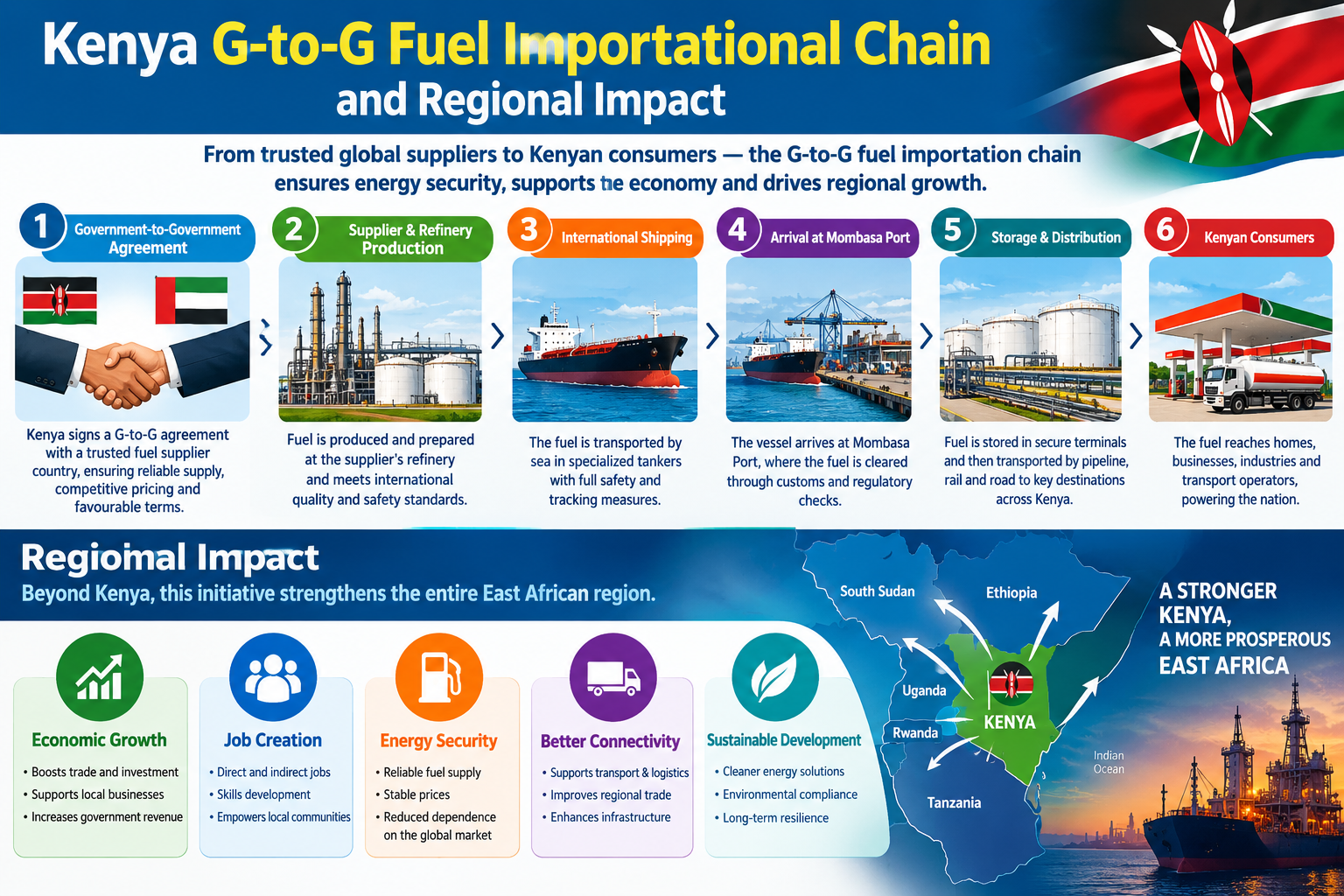
How the Kenya G-to-G Fuel Deal Worked
Kenya introduced the government-to-government petroleum supply framework in 2023. The arrangement involved agreements with major Gulf suppliers including Saudi Aramco, Abu Dhabi National Oil Company (ADNOC) and Emirates National Oil Company (ENOC). Fuel was supplied on extended credit terms of up to 180 days, intended to reduce the monthly dollar demand that had strained Kenya’s reserves and contributed to earlier shortages.
In practice, Gulf suppliers nominated private Kenyan oil marketing companies — among them Gulf Energy, Galana Energies and others — as local counterparts rather than the National Oil Corporation of Kenya. These firms handled logistics, handling and distribution. Government officials have maintained that the nominated companies acted as agents rather than independent traders buying and reselling on their own account. Critics argue the structure still allowed significant margins to be captured between the Gulf suppliers and final consumers in Kenya and transit markets.
Uganda, which historically relied on Kenyan oil marketing companies and the Kenya Pipeline Company network for its imports through Mombasa, eventually shifted towards more direct procurement through the Uganda National Oil Company (UNOC) working with global traders. Museveni stated that after the change, premiums on diesel fell from approximately $118 to $83 per metric tonne, petrol from $97.50 to $61.50, and aviation fuel showed similar reductions.
Caption: The Kenya G-to-G fuel deal is under renewed scrutiny after Museveni’s public criticism.
Domestic Reaction in Kenya
The Motorist Association of Kenya has demanded a full forensic audit of the entire G-to-G system, including disclosure of intermediaries, commissions, contracts and pricing formulas. Opposition figures, including Eugene Wamalwa and Ndindi Nyoro, have seized on Museveni’s remarks to accuse brokers of self-enrichment at the expense of ordinary citizens in both countries. Former Deputy President Rigathi Gachagua has framed the arrangement as “Government to Ruto.”
The Kenyan government has previously defended the framework as essential for supply security and price stabilisation, particularly during periods of global volatility. Energy officials have argued that without the structured credit and long-term commitments, Kenya would have faced deeper foreign-exchange pressure and more frequent shortages.
Repercussions for Kenya
Politically, the Kenya G-to-G fuel deal now provides opposition parties with powerful ammunition ahead of the 2027 election cycle. Public trust in energy pricing mechanisms, already fragile, is likely to erode further if no independent audit is conducted. Calls for transparency could intensify pressure on the Energy and Petroleum Regulatory Authority and the Treasury.
Economically, any forced restructuring of the contracts risks short-term supply uncertainty. At the same time, prolonged controversy may discourage some Gulf partners or raise the cost of future credit facilities if Kenya is perceived as politically unstable in its energy policy.
Impact on Neighbouring Countries and Regional Perception
Uganda’s experience is the most immediate. By moving to direct sourcing while still using Mombasa and the Kenyan pipeline, Kampala has demonstrated that it can reduce premiums without abandoning Kenyan infrastructure entirely. The message to other landlocked neighbours — Rwanda, Burundi, South Sudan and parts of eastern Democratic Republic of Congo — is clear: reliance on Kenyan intermediaries may carry an avoidable cost.
Perception of Kenya as the natural and trustworthy energy logistics hub of East Africa has been damaged. Regional governments may accelerate efforts to diversify import routes, expand their own storage capacity, or negotiate direct contracts with Gulf and international traders. Tanzania’s ports could gain relative attractiveness if Kenya is seen as extracting rents through opaque layers.
Diplomatically, Museveni’s public language — “monumental scam” and “government-to-middlemen” — is unusually blunt between two partners that have historically maintained close ties. It risks injecting mistrust into broader discussions on infrastructure, trade and the LAPSSET corridor. Kenya’s ability to position itself as a transparent facilitator of regional energy security has been weakened at a moment when it is simultaneously promoting major projects such as the Lamu refinery.
What Happens Next
Pressure for a forensic audit of the Kenya G-to-G fuel deal is likely to grow in Parliament and among consumer groups. The government faces a choice between defending the framework as a necessary stabilisation tool or opening the books to demonstrate that margins were reasonable and competitive.
For East Africa, the episode underscores a deeper structural issue: as long as landlocked countries depend on coastal infrastructure controlled by a single neighbour, questions of transparency and fair pricing will remain politically explosive. Museveni’s intervention has made those questions impossible to ignore.
The Kenya G-to-G fuel deal was sold as a smart solution to a foreign-exchange crisis. Whether it survives as a model of regional energy cooperation or becomes a cautionary tale of middlemen and lost trust will depend on how Nairobi responds in the coming weeks.
Related reading: For context on Kenya’s broader energy ambitions, see our coverage of the Ruto Lamu refinery project.
External sources for further verification include reporting by The Star and Nation Africa.
Frequently Asked Questions
What did Museveni say about the Kenya G-to-G fuel deal?
He described it as a “monumental scam” and a government-to-middlemen arrangement that allowed intermediaries in Kenya to inflate costs for Uganda.
When was the Kenya G-to-G fuel deal introduced?
In 2023, as a response to foreign-exchange pressure and supply instability.
Which Gulf companies are involved?
Saudi Aramco, ADNOC and ENOC are the primary suppliers under the framework.
Did Uganda stop using Kenyan infrastructure?
No. Uganda continues to import through Mombasa and use the Kenya Pipeline network, but has shifted to more direct procurement through its national oil company.
What savings did Uganda claim after changing its model?
Premiums on diesel fell from about $118 to $83 per metric tonne and on petrol from $97.50 to $61.50, according to Museveni’s figures.
What are the main demands inside Kenya?
A full forensic audit of intermediaries, commissions, contracts and pricing under the G-to-G system.