


In the first half of the second millennium A.D., northern Mozambican port towns were frequented by traders from Somalia, Ethiopia, Egypt, Arabia, Persia, and India. The Portuguese were able to wrest much of the coastal trade from Arab Muslims in the centuries after 1500, and they set up their own colonies. Portugal did not relinquish Mozambique until 1975. Large-scale emigration, economic dependence on South Africa, a severe drought, and a prolonged civil war hindered the country’s development until the mid-1990s.
The ruling Front for the Liberation of Mozambique (FRELIMO) party formally abandoned Marxism in 1989, and a new constitution the following year provided for multiparty elections and a free-market economy. A UN-negotiated peace agreement between FRELIMO and rebel Mozambique National Resistance (RENAMO) forces ended the fighting in 1992. In 2004, Mozambique underwent a delicate transition as Joaquim CHISSANO stepped down after 18 years in office. His elected successor, Armando GUEBUZA, served two terms and then passed executive power to Filipe NYUSI in 2015. RENAMO’s residual armed forces intermittently engaged in a low-level insurgency after 2012, but a 2016 cease-fire eventually led to the two sides signing a comprehensive peace deal in 2019.
Since 2017, violent extremists — who an official ISIS media outlet recognized as ISIS’s network in Mozambique for the first time in 2019 — have been conducting attacks against civilians and security services in the northern province of Cabo Delgado. In 2021, Rwanda and the Southern African Development Community deployed forces to support Mozambique’s efforts to counter the extremist group.TipVisit the Definitions and Notes page to view a description of each topic.Definitions and Notes
Geography
Location
Southeastern Africa, bordering the Mozambique Channel, between South Africa and Tanzania
Geographic coordinates
18 15 S, 35 00 E
Map references
Africa
Area
total : 799,380 sq km
land: 786,380 sq km
water: 13,000 sq km
comparison ranking: total 36
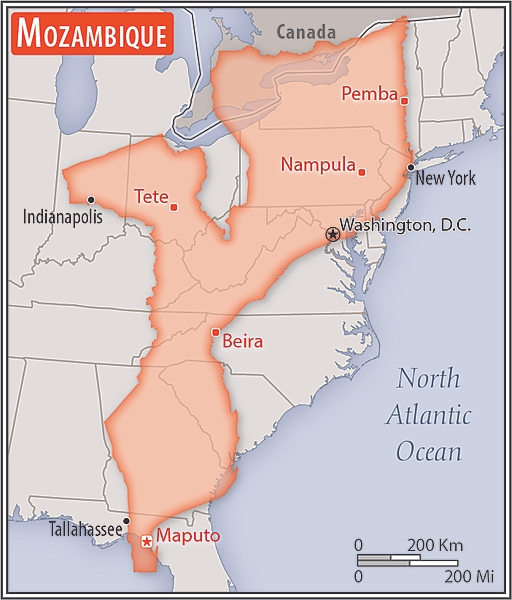
Area – comparative
slightly more than five times the size of Georgia; slightly less than twice the size of California
Area comparison map.:
Land boundaries
total: 4,783 km
border countries (6): Malawi 1498 km; South Africa 496 km; Eswatini 108 km; Tanzania 840 km; Zambia 439 km; Zimbabwe 1,402 km
Coastline
2,470 km
Maritime claims
territorial sea: 12 nm
exclusive economic zone: 200 nm
Climate
tropical to subtropical
Terrain
mostly coastal lowlands, uplands in center, high plateaus in northwest, mountains in west
Elevation
highest point: Monte Binga 2,436 m
lowest point: Indian Ocean 0 m
mean elevation: 345 m
Natural resources
coal, titanium, natural gas, hydropower, tantalum, graphite
Land use
agricultural land: 52.7% (2022 est.)
arable land: 7.2% (2022 est.)
permanent crops: 0.4% (2022 est.)
permanent pasture: 45.1% (2022 est.)
forest: 46.1% (2022 est.)
other: 1.2% (2022 est.)
Irrigated land
1,180 sq km (2012)
Major lakes (area sq km)
fresh water lake(s): Lake Malawi (shared with Malawi and Tanzania) – 22,490
Major rivers (by length in km)
Rio Zambeze (Zambezi) river mouth (shared with Zambia [s]), Angola, Namibia, Botswana, and Zimbabwe) – 2,740 km; Rio Limpopo river mouth (shared with South Africa [s], Botswana, and Zimbabwe) – 1,800 km
note: [s] after country name indicates river source; [m] after country name indicates river mouth
Major watersheds (area sq km)
Indian Ocean drainage: Zambezi (1,332,412 sq km)
Population distribution
three large population clusters are found along the southern coast between Maputo and Inhambane, in the central area between Beira and Chimoio along the Zambezi River, and in and around the northern cities of Nampula, Cidade de Nacala, and Pemba; the northwest and southwest are the least populated areas, as shown in this population distribution map
Natural hazards
severe droughts; devastating cyclones and floods in central and southern provinces
Geography – note
the Zambezi River flows through the north-central and most fertile part of the country
People and Society
Population
total: 33,350,954 (2024 est.)
male: 16,449,734
female: 16,901,220
comparison rankings: total 46; female 44; male 46
Nationality
noun: Mozambican(s)
adjective: Mozambican
Ethnic groups
African 99% (Makhuwa, Tsonga, Lomwe, Sena, and others), Mestizo 0.8%, other (includes European, Indian, Pakistani, Chinese) 0.2% (2017 est.)
Languages
Makhuwa 26.1%, Portuguese (official) 16.6%, Tsonga 8.6%, Nyanja 8.1, Sena 7.1%, Lomwe 7.1%, Chuwabo 4.7%, Ndau 3.8%, Tswa 3.8%, other Mozambican languages 11.8%, other 0.5%, unspecified 1.8% (2017 est.)
Religions
Roman Catholic 27.2%, Muslim 18.9%, Zionist Christian 15.6%, Evangelical/Pentecostal 15.3%, Anglican 1.7%, other 4.8%, none 13.9%, unspecified 2.5% (2017 est.)
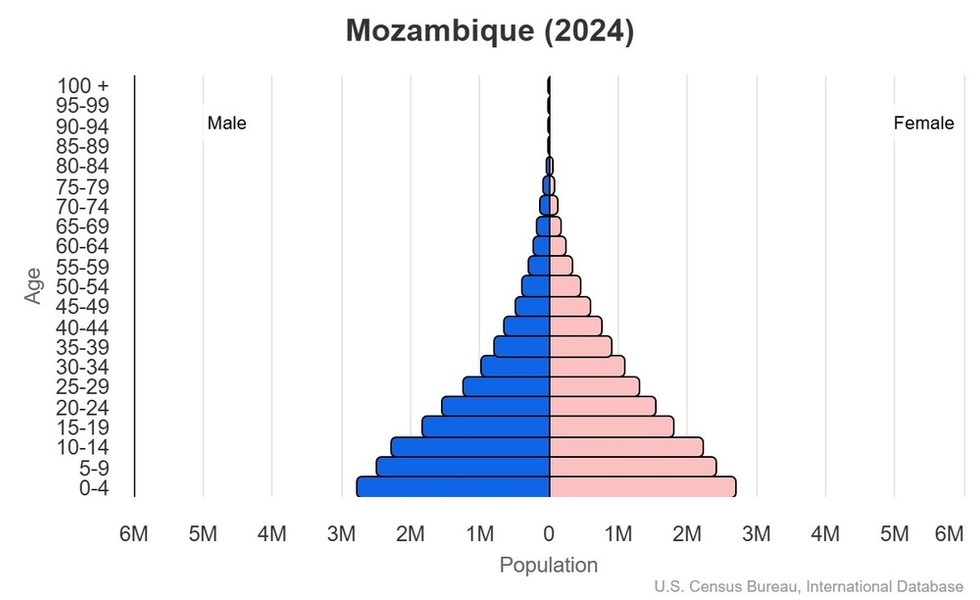
Age structure
0-14 years: 44.7% (male 7,548,247/female 7,350,012)
15-64 years: 52.4% (male 8,428,457/female 9,061,065)
65 years and over: 2.9% (2024 est.) (male 473,030/female 490,143)
2024 population pyramid:
Dependency ratios
total dependency ratio: 90.7 (2024 est.)
youth dependency ratio: 85.2 (2024 est.)
elderly dependency ratio: 5.5 (2024 est.)
potential support ratio: 18.2 (2024 est.)
Median age
total: 17.3 years (2024 est.)
male: 16.7 years
female: 17.9 years
comparison ranking: total 222
Population growth rate
2.54% (2024 est.)
comparison ranking: 17
Birth rate
36.5 births/1,000 population (2024 est.)
comparison ranking: 9
Death rate
9.6 deaths/1,000 population (2024 est.)
comparison ranking: 40
Net migration rate
-1.5 migrant(s)/1,000 population (2024 est.)
comparison ranking: 158
Population distribution
three large population clusters are found along the southern coast between Maputo and Inhambane, in the central area between Beira and Chimoio along the Zambezi River, and in and around the northern cities of Nampula, Cidade de Nacala, and Pemba; the northwest and southwest are the least populated areas, as shown in this population distribution map
Urbanization
urban population: 38.8% of total population (2023)
rate of urbanization: 4.24% annual rate of change (2020-25 est.)
Major urban areas – population
1.852 million Matola, 1.163 million MAPUTO (capital), 969,000 Nampula (2023)
Sex ratio
at birth: 1.03 male(s)/female
0-14 years: 1.03 male(s)/female
15-64 years: 0.93 male(s)/female
65 years and over: 0.97 male(s)/female
total population: 0.97 male(s)/female (2024 est.)
Mother’s mean age at first birth
19.2 years (2011 est.)
note: data represents median age at first birth among women 20-49
Maternal mortality ratio
127 deaths/100,000 live births (2020 est.)
comparison ranking: 58
Infant mortality rate
total: 58.2 deaths/1,000 live births (2024 est.)
male: 60.1 deaths/1,000 live births
female: 56.2 deaths/1,000 live births
comparison ranking: total 9
Life expectancy at birth
total population: 58.3 years (2024 est.)
male: 57.1 years
female: 59.6 years
comparison ranking: total population 224
Total fertility rate
4.66 children born/woman (2024 est.)
comparison ranking: 12
Gross reproduction rate
2.29 (2024 est.)
Contraceptive prevalence rate
27.1% (2015)
Drinking water source
improved:
urban: 93.4% of population
rural: 61.5% of population
total: 73.3% of population
unimproved:
urban: 6.6% of population
rural: 38.5% of population
total: 26.7% of population (2020 est.)
Health expenditure
9.1% of GDP (2021)
8% of national budget (2022 est.)
Physician density
0.18 physicians/1,000 population (2022)
Hospital bed density
0.7 beds/1,000 population (2021 est.)
Sanitation facility access
improved:
urban: 71.9% of population (2015 est.)
rural: 24.7% of population
total: 42.2% of population
unimproved:
urban: 28.1% of population
rural: 75.3% of population
total: 57.8% of population (2020 est.)
Obesity – adult prevalence rate
7.2% (2016)
comparison ranking: 160
Alcohol consumption per capita
total: 1.46 liters of pure alcohol (2019 est.)
beer: 1.03 liters of pure alcohol (2019 est.)
wine: 0.22 liters of pure alcohol (2019 est.)
spirits: 0.21 liters of pure alcohol (2019 est.)
other alcohols: 0 liters of pure alcohol (2019 est.)
comparison ranking: total 140
Tobacco use
total: 14.3% (2020 est.)
male: 23% (2020 est.)
female: 5.6% (2020 est.)
comparison ranking: total 105
Children under the age of 5 years underweight
14.8% (2019/20)
comparison ranking: 33
Currently married women (ages 15-49)
63.7% (2023 est.)
Child marriage
women married by age 15: 16.8% (2015)
women married by age 18: 52.9% (2015)
men married by age 18: 9.7% (2015)
Education expenditure
6% of GDP (2022 est.)
18.8% national budget (2021 est.)
comparison ranking: Education expenditure (% GDP) 30
Literacy
total population: 60% (2020 est.)
male: 72% (2020 est.)
female: 49% (2020 est.)
School life expectancy (primary to tertiary education)
total: 10 years
male: 10 years
female: 9 years (2017)
Environment
Environment – current issues
increased population migration to urban and coastal areas; desertification; soil erosion; deforestation; water pollution from artisanal mining; pollution of surface and coastal waters; wildlife preservation (elephant poaching for ivory)
Environment – international agreements
party to: Biodiversity, Climate Change, Climate Change-Kyoto Protocol, Climate Change-Paris Agreement, Comprehensive Nuclear Test Ban, Desertification, Endangered Species, Hazardous Wastes, Law of the Sea, Ozone Layer Protection, Ship Pollution, Tropical Timber 2006, Wetlands
signed, but not ratified: none of the selected agreements
Climate
tropical to subtropical
Land use
agricultural land: 52.7% (2022 est.)
arable land: 7.2% (2022 est.)
permanent crops: 0.4% (2022 est.)
permanent pasture: 45.1% (2022 est.)
forest: 46.1% (2022 est.)
other: 1.2% (2022 est.)
Urbanization
urban population: 38.8% of total population (2023)
rate of urbanization: 4.24% annual rate of change (2020-25 est.)
Air pollutants
particulate matter emissions: 16.45 micrograms per cubic meter (2019 est.)
carbon dioxide emissions: 7.94 megatons (2016 est.)
methane emissions: 16.26 megatons (2020 est.)
Waste and recycling
municipal solid waste generated annually: 2.5 million tons (2014 est.)
municipal solid waste recycled annually: 25,000 tons (2014 est.)
percent of municipal solid waste recycled: 1% (2014 est.)
Major lakes (area sq km)
fresh water lake(s): Lake Malawi (shared with Malawi and Tanzania) – 22,490
Major rivers (by length in km)
Rio Zambeze (Zambezi) river mouth (shared with Zambia [s]), Angola, Namibia, Botswana, and Zimbabwe) – 2,740 km; Rio Limpopo river mouth (shared with South Africa [s], Botswana, and Zimbabwe) – 1,800 km
note: [s] after country name indicates river source; [m] after country name indicates river mouth
Major watersheds (area sq km)
Indian Ocean drainage: Zambezi (1,332,412 sq km)
Total water withdrawal
municipal: 370 million cubic meters (2020 est.)
industrial: 30 million cubic meters (2020 est.)
agricultural: 1.08 billion cubic meters (2020 est.)
Total renewable water resources
217.1 billion cubic meters (2020 est.)
Government
Country name
conventional long form: Republic of Mozambique
conventional short form: Mozambique
local long form: Republica de Mocambique
local short form: Mocambique
former: Portuguese East Africa, People’s Republic of Mozambique
etymology: named for an offshore island; the island was named after Mussa bin BIQUE (or Mussa Ibn MALIK), an influential Arab slave trader who set himself up as sultan on the island in the 15th century
Government type
presidential republic
Capital
name: Maputo
geographic coordinates: 25 57 S, 32 35 E
time difference: UTC+2 (7 hours ahead of Washington, DC, during Standard Time)
etymology: named after the Maputo River, which drains into Maputo Bay south of the city; the river is said to be named after the son of Muagobe, a local chief in the 18th century
Administrative divisions
10 provinces (provincias, singular – provincia), 1 city (cidade)*; Cabo Delgado, Gaza, Inhambane, Manica, Maputo, Cidade de Maputo*, Nampula, Niassa, Sofala, Tete, Zambezia
Legal system
mixed system of Portuguese civil law and customary law
Constitution
history: previous 1975, 1990; latest adopted 16 November 2004, effective 21 December 2004
amendment process: proposed by the president of the republic or supported by at least one third of the Assembly of the Republic membership; passage of amendments affecting constitutional provisions, including the independence and sovereignty of the state, the republican form of government, basic rights and freedoms, and universal suffrage, requires at least a two-thirds majority vote by the Assembly and approval in a referendum; referenda not required for passage of other amendments
International law organization participation
has not submitted an ICJ jurisdiction declaration; non-party state to the ICCt
Citizenship
citizenship by birth: no
citizenship by descent only: at least one parent must be a citizen of Mozambique
dual citizenship recognized: no
residency requirement for naturalization: 5 years
Suffrage
18 years of age; universal
Executive branch
chief of state: President Daniel Francisco CHAPO (since 15 January 2025)
head of government: Prime Minister Maria Benvinda Delfina LEVI (since 17 January 2025)
cabinet: Cabinet appointed by the president
election/appointment process: president elected directly by absolute-majority popular vote in 2 rounds, if needed, for a 5-year term (eligible for 2 consecutive terms); election last held on 9 October 2024 (next to be held by October 2029); prime minister appointed by the president
most recent election date: 9 October 2024
election results:
2024: Daniel CHAPO elected president in first round; percent of vote – Daniel CHAPO (FRELIMO) 65.2%, Venâncio MONDLANE (PODEMOS) 24.2%, Ossufo MOMADE (RENAMO) 6.6%
Legislative branch
legislature name: Assembly of the Republic (Assembleia da Republica)
legislative structure: unicameral
number of seats: 250 (all directly elected)
electoral system: proportional representation
scope of elections: full renewal
term in office: 5 years
most recent election date: 10/9/2024
parties elected and seats per party: Mozambique Liberation Front (FRELIMO) (171); Optimist Party for the Development of Mozambique (PODEMOS) (43); Mozambican National Resistance (RENAMO) (28); Other (8)
percentage of women in chamber: 39.2%
expected date of next election: October 2029
Judicial branch
highest court(s): Supreme Court (consists of the court president, vice president, and 5 judges); Constitutional Council (consists of 7 judges)
judge selection and term of office: Supreme Court president appointed by the president of the republic; vice president appointed by the president in consultation with the Higher Council of the Judiciary (CSMJ) and ratified by the Assembly of the Republic; other judges elected by the Assembly; judges serve 5-year renewable terms; Constitutional Council judges appointed – 1 by the president, 5 by the Assembly, and 1 by the CSMJ; judges serve 5-year nonrenewable terms
subordinate courts: Administrative Court (capital city only); provincial courts or Tribunais Judicias de Provincia; District Courts or Tribunais Judicias de Districto; customs courts; maritime courts; courts marshal; labor courts; community courts
Political parties
Democratic Movement of Mozambique (Movimento Democratico de Mocambique) or MDM
Liberation Front of Mozambique (Frente de Liberatacao de Mocambique) or FRELIMO
Mozambican National Resistance (Resistencia Nacional Mocambicana) or RENAMO
Diplomatic representation in the US
chief of mission: Ambassador Alfredo Fabião NUVUNGA (since 19 April 2023)
chancery: 1525 New Hampshire Avenue NW, Washington, DC 20036
telephone: [1] (202) 293-7147
FAX: [1] (202) 835-0245
email address and website:
[email protected]
https://usa.embamoc.gov.mz/
Diplomatic representation from the US
chief of mission: Ambassador Peter Hendrick VROOMAN (since 3 March 2022)
embassy: Avenida Marginal 5467, Maputo
mailing address: 2330 Maputo Place, Washington DC 20521-2330
telephone: [258] (84) 095-8000
email address and website:
[email protected]
https://mz.usembassy.gov/
International organization participation
ACP, AfDB, AU, C, CD, CPLP, EITI (compliant country), FAO, G-77, IAEA, IBRD, ICAO, ICC (NGOs), ICRM, IDA, IDB, IFAD, IFC, IFRCS, IHO, ILO, IMF, IMO, IMSO, Interpol, IOC, IOM, IPU, ISO (correspondent), ITSO, ITU, ITUC (NGOs), MIGA, NAM, OIC, OIF (observer), OPCW, SADC, UN, UNCDF, UNCTAD, UNDP, UNDSS, UNECA, UNEP, UNESCO, UNFPA, UNHCR, UNIDO, UNODC, UNOPS, UNV, UNWTO, Union Latina, UPU, WCO, WFP, WFTU (NGOs), WHO, WIPO, WMO, WTO
Independence
25 June 1975 (from Portugal)
National holiday
Independence Day, 25 June (1975)
Flag description
three equal horizontal bands of green (top), black, and yellow, with a red isosceles triangle based on the hoist side; the black band is edged in white; centered in the triangle is a yellow five-pointed star with a crossed rifle and hoe in black superimposed on an open white book; green stands for the riches of the land, white for peace, black for the African continent, yellow for the country’s minerals, and red for the fight for independence; the rifle symbolizes defense and vigilance, the hoe refers to the country’s agriculture, the open book stresses the importance of education, and the star represents Marxism and internationalism
note: one of two national flags featuring a firearm; the other is Guatemala
National symbol(s)
rifle, hoe, and book
National color(s)
green, black, yellow, white, red
National anthem
name: “Patria Amada” (Lovely Fatherland)
lyrics/music: Salomao J. MANHICA/unknown
note: adopted 2002
National heritage
total World Heritage Sites: 1 (cultural)
selected World Heritage Site locales: Island of Mozambique
Economy
Economic overview
low-income East African economy; subsistence farming dominates labor force; return to growth led by agriculture and extractive industries; Islamist insurgency threatens natural gas projects in north; ongoing foreign debt restructuring and resolution under IMF Highly Indebted Poor Countries (HIPC) initiative
Real GDP (purchasing power parity)
$50.844 billion (2023 est.)
$48.222 billion (2022 est.)
$46.206 billion (2021 est.)
note: data in 2021 dollars
comparison ranking: 125
Real GDP growth rate
5.44% (2023 est.)
4.36% (2022 est.)
2.38% (2021 est.)
note: annual GDP % growth based on constant local currency
comparison ranking: 37
Real GDP per capita
$1,500 (2023 est.)
$1,500 (2022 est.)
$1,500 (2021 est.)
note: data in 2021 dollars
comparison ranking: 218
GDP (official exchange rate)
$20.954 billion (2023 est.)
note: data in current dollars at official exchange rate
Inflation rate (consumer prices)
7.1% (2023 est.)
10.3% (2022 est.)
6.4% (2021 est.)
note: annual % change based on consumer prices
comparison ranking: 171
GDP – composition, by sector of origin
agriculture: 25.9% (2023 est.)
industry: 21.3% (2023 est.)
services: 40.8% (2023 est.)
note: figures may not total 100% due to non-allocated consumption not captured in sector-reported data
comparison rankings: services 193; industry 130; agriculture 18
GDP – composition, by end use
household consumption: 78% (2023 est.)
government consumption: 17.2% (2023 est.)
investment in fixed capital: 19.9% (2023 est.)
investment in inventories: 0% (2023 est.)
exports of goods and services: 45.3% (2023 est.)
imports of goods and services: -60.3% (2023 est.)
note: figures may not total 100% due to rounding or gaps in data collection
Agricultural products
cassava, maize, sugarcane, tomatoes, beans, potatoes, sweet potatoes, bananas, coconuts, onions (2023)
note: top ten agricultural products based on tonnage
Industries
aluminum, petroleum products, chemicals (fertilizer, soap, paints), textiles, cement, glass, asbestos, tobacco, food, beverages
Industrial production growth rate
13.76% (2023 est.)
note: annual % change in industrial value added based on constant local currency
comparison ranking: 8
Labor force
15.173 million (2024 est.)
note: number of people ages 15 or older who are employed or seeking work
comparison ranking: 42
Unemployment rate
3.5% (2024 est.)
3.5% (2023 est.)
3.6% (2022 est.)
note: % of labor force seeking employment
comparison ranking: 64
Youth unemployment rate (ages 15-24)
total: 7.4% (2024 est.)
male: 7.5% (2024 est.)
female: 7.2% (2024 est.)
note: % of labor force ages 15-24 seeking employment
comparison ranking: total 151
Population below poverty line
46.1% (2014 est.)
note: % of population with income below national poverty line
Gini Index coefficient – distribution of family income
50.3 (2019 est.)
note: index (0-100) of income distribution; higher values represent greater inequality
comparison ranking: 11
Household income or consumption by percentage share
lowest 10%: 1.7% (2019 est.)
highest 10%: 41.1% (2019 est.)
note: % share of income accruing to lowest and highest 10% of population
Remittances
3.17% of GDP (2023 est.)
1.3% of GDP (2022 est.)
4.57% of GDP (2021 est.)
note: personal transfers and compensation between resident and non-resident individuals/households/entities
Budget
revenues: $5.388 billion (2022 est.)
expenditures: $4.91 billion (2022 est.)
note: central government revenues and expenses (excluding grants/extrabudgetary units/social security funds) converted to US dollars at average official exchange rate for year indicated
Public debt
76.6% of GDP (2022 est.)
note: central government debt as a % of GDP
comparison ranking: 42
Taxes and other revenues
22.7% (of GDP) (2022 est.)
note: central government tax revenue as a % of GDP
comparison ranking: 64
Current account balance
-$2.498 billion (2024 est.)
-$2.207 billion (2023 est.)
-$6.367 billion (2022 est.)
note: balance of payments – net trade and primary/secondary income in current dollars
comparison ranking: 163
Exports
$9.358 billion (2024 est.)
$9.405 billion (2023 est.)
$9.409 billion (2022 est.)
note: balance of payments – exports of goods and services in current dollars
comparison ranking: 119
Exports – partners
India 18%, China 13%, South Africa 9%, UAE 6%, Thailand 4% (2023)
note: top five export partners based on percentage share of exports
Exports – commodities
coal, natural gas, aluminum, gold, precious stones (2023)
note: top five export commodities based on value in dollars
Imports
$10.488 billion (2024 est.)
$11.18 billion (2023 est.)
$15.932 billion (2022 est.)
note: balance of payments – imports of goods and services in current dollars
comparison ranking: 120
Imports – partners
South Africa 34%, China 14%, India 13%, UAE 6%, Singapore 3% (2023)
note: top five import partners based on percentage share of imports
Imports – commodities
refined petroleum, chromium ore, iron alloys, iron ore, palm oil (2023)
note: top five import commodities based on value in dollars
Reserves of foreign exchange and gold
$3.513 billion (2024 est.)
$3.637 billion (2023 est.)
$2.939 billion (2022 est.)
note: holdings of gold (year-end prices)/foreign exchange/special drawing rights in current dollars
comparison ranking: 116
Debt – external
$8.274 billion (2023 est.)
note: present value of external debt in current US dollars
comparison ranking: 55
Exchange rates
meticais (MZM) per US dollar –
Exchange rates:
63.905 (2024 est.)
63.886 (2023 est.)
63.851 (2022 est.)
65.465 (2021 est.)
69.465 (2020 est.)
Energy
Electricity access
electrification – total population: 33.2% (2022 est.)
electrification – urban areas: 79.4%
electrification – rural areas: 5%
Electricity
installed generating capacity: 2.86 million kW (2023 est.)
consumption: 12.983 billion kWh (2023 est.)
exports: 11.483 billion kWh (2023 est.)
imports: 8.287 billion kWh (2023 est.)
transmission/distribution losses: 3.38 billion kWh (2023 est.)
comparison rankings: transmission/distribution losses 147; imports 30; exports 21; consumption 92; installed generating capacity 110
Electricity generation sources
fossil fuels: 16.3% of total installed capacity (2023 est.)
solar: 0.4% of total installed capacity (2023 est.)
hydroelectricity: 82.7% of total installed capacity (2023 est.)
biomass and waste: 0.6% of total installed capacity (2023 est.)
Coal
production: 10.583 million metric tons (2023 est.)
consumption: 13,000 metric tons (2023 est.)
exports: 10.658 million metric tons (2023 est.)
imports: 900 metric tons (2023 est.)
proven reserves: 1.792 billion metric tons (2023 est.)
Petroleum
refined petroleum consumption: 42,000 bbl/day (2023 est.)
Natural gas
production: 8.873 billion cubic meters (2023 est.)
consumption: 1.625 billion cubic meters (2023 est.)
exports: 7.09 billion cubic meters (2023 est.)
proven reserves: 2.832 trillion cubic meters (2021 est.)
Carbon dioxide emissions
9.549 million metric tonnes of CO2 (2023 est.)
from coal and metallurgical coke: -68,287 metric tonnes of CO2 (2023 est.)
from petroleum and other liquids: 6.244 million metric tonnes of CO2 (2023 est.)
from consumed natural gas: 3.373 million metric tonnes of CO2 (2023 est.)
comparison ranking: total emissions 110
Energy consumption per capita
5.789 million Btu/person (2023 est.)
comparison ranking: 167
Communications
Telephones – fixed lines
total subscriptions: 29,000 (2022 est.)
subscriptions per 100 inhabitants: (2022 est.) less than 1
comparison ranking: total subscriptions 168
Telephones – mobile cellular
total subscriptions: 15 million (2022 est.)
subscriptions per 100 inhabitants: 42 (2022 est.)
comparison ranking: total subscriptions 73
Broadcast media
1 state-run TV station supplemented by a private TV station; Portuguese state TV’s African service, RTP Africa, and Brazilian-owned TV Miramar are available; state-run radio provides nearly 100% territorial coverage and broadcasts in multiple languages; a number of privately owned and community-operated stations; transmissions of multiple international broadcasters are available (2019)
Internet country code
.mz
Internet users
percent of population: 20% (2023 est.)
Broadband – fixed subscriptions
total: 65,000 (2022 est.)
subscriptions per 100 inhabitants: (2022 est.) less than 1
comparison ranking: total 142
Transportation
Civil aircraft registration country code prefix
C9
Airports
92 (2025)
comparison ranking: 60
Railways
total: 4,787 km (2014)
narrow gauge: 4,787 km (2014) 1.067-m gauge
Merchant marine
total: 36 (2023)
by type: general cargo 9, other 27
comparison ranking: total 130
Ports
total ports: 11 (2024)
large: 0
medium: 2
small: 5
very small: 4
ports with oil terminals: 3
key ports: Beira, Chinde, Inhambane, Maputo, Mocambique, Pebane, Porto Belo
Military and Security
Military and security forces
Armed Forces for the Defense of Mozambique (Forcas Armadas de Defesa de Mocambique, FADM): Army, Mozambique Navy, Mozambique Air Force
Ministry of Interior: Mozambique National Police (PRM; includes the Rapid Intervention Unit, UIR), the National Criminal Investigation Service (SERNIC), Border Security Force; other security forces include the Presidential Guard and the Force for the Protection of High-Level Individuals (2025)
note 1: the FADM and other security forces are referred to collectively as the Mozambican Defense and Security Forces (FDS)
note 2: the PRM, SERNIC, and the UIR are responsible for law enforcement and internal security; the Border Security Force is responsible for protecting the country’s international borders and for carrying out police duties within 24 miles of borders
note 3: in 2023, the Mozambique Government legalized local militias that have been assisting security forces operating in Cabo Delgado against Islamic militants since 2020; this Local Force is comprised of ex-combatants and other civilians and receives training, uniforms, weapons, and logistical support from the FADM
Military expenditures
2% of GDP (2024 est.)
1.5% of GDP (2023 est.)
1.3% of GDP (2022 est.)
1.2% of GDP (2021 est.)
1.1% of GDP (2020 est.)
Military and security service personnel strengths
estimated 12,000 active FADM (2025)
Military equipment inventories and acquisitions
the FADM’s inventory consists primarily of Russian and Soviet-era equipment, although in recent years it has received some more modern equipment from a variety of countries, mostly as aid/donations (2024)
Military service age and obligation
registration for military service is mandatory for all men and women at 18 years of age; 18-35 years of age for selective compulsory military service; 18 years of age for voluntary service for men and women; 24-month service obligation (note – in 2023, the Mozambique Government said it intended to raise the length of service from two to five years) (2023)
Military – note
the FADM is responsible for external security, cooperating with police on internal security, and responding to natural disasters and other emergencies; the current primary focus of the FADM is countering an insurgency driven by militants with ties to the Islamic State of Iraq and ash-Sham (ISIS) terrorist group in the northern province of Cabo Delgado, an area known for rich liquid natural gas deposits; insurgent attacks in the province began in 2017, and the fighting has left an estimated 6,000 dead and 1 million displaced; several countries from the Southern Africa Development Community (SADC) and the EU, as well as Rwanda and the US have provided various forms of military assistance to the FADM; the SADC countries and Rwanda have sent more than 3,000 military and security personnel, while some EU member states and the US have provided training assistance; in the first half of 2024, the SADC began withdrawing personnel, although the insurgency remained active (2024)
Terrorism
Terrorist group(s)
Terrorist group(s): Islamic State of Iraq and ash-Sham – Mozambique (ISIS-M)
note: details about the history, aims, leadership, organization, areas of operation, tactics, targets, weapons, size, and sources of support of the group(s) appear(s) in the Terrorism reference guide
Transnational Issues
Refugees and internally displaced persons
refugees (country of origin): 10,655 (Burundi) (refugees and asylum seekers) (2023); 9,340 (Democratic Republic of Congo) (refugees and asylum seekers) (2024)
IDPs: 850,599 (north Mozambique, violence between the government and an opposition group, violence associated with extremists groups in 2018, political violence 2019) (2023)
Illicit drugs
a transit country for large shipments of heroin and methamphetamine originating from Afghanistan to primarily South Africa