Between A.D. 800 and 1100, immigrant Muslim Arabs and Persians set up coastal trading posts along the Gulf of Aden and the Indian Ocean, solidifying present-day Somalia’s close trading relationship with the Arab Peninsula. In the late 19th century, Britain, France, and Italy established colonies in the Somali Peninsula that lasted until 1960, when British Somaliland gained independence and joined with Italian Somaliland to form the Republic of Somalia.
The country functioned as a parliamentary democracy until 1969, when General Mohamed SIAD Barre took control in a coup, beginning a 22-year socialist dictatorship. In an effort to centralize power, SIAD called for the eradication of the clan, the key cultural and social organizing principle in Somali society. Resistance to SIAD’s socialist leadership, which was causing a rapid deterioration of the country, prompted allied clan militias to overthrow SIAD in 1991, resulting in state collapse. Subsequent fighting between rival clans for resources and territory overwhelmed the country, causing a manmade famine and prompting international intervention. Beginning in 1993, the UN spearheaded an international humanitarian mission, but the international community largely withdrew by 1995 after an incident that became known as Black Hawk Down, in which two US military helicopters were shot down in Mogadishu. The fighting and subsequent siege and rescue resulted in 21 deaths and 82 wounded among the international forces.
International peace conferences in the 2000s resulted in a number of transitional governments that operated outside Somalia. Left largely to themselves, Somalis in the country established alternative governance structures; some areas formed their own administrations, such as Somaliland and Puntland, while others developed localized institutions. Many local populations turned to sharia courts, an Islamic judicial system that implements religious law. Several of these courts came together in 2006 to form the Islamic Courts Union (ICU). The ICU established order in many areas of central and southern Somalia, including Mogadishu, but was forced out when Ethiopia intervened militarily in 2006 on behalf of the Somali Transitional Federal Government (TFG). As the TFG settled in the capital, the ICU fled to rural areas or left Somalia altogether, but the organization reemerged less than a year later as the Islamic insurgent and terrorist movement al-Shabaab, which is still active today.
In 2007, the African Union (AU) established a peacekeeping force, took over security responsibility for the country, and gave the TFG space to develop Somalia’s new government. By 2012, Somali powerbrokers agreed on a provisional constitution with a loose federal structure and established a central government in Mogadishu called the Somali Federal Government (SFG). Since then, the country has seen several interim regional administrations and three presidential elections, but significant governance and security problems remain because al-Shabaab still controls large portions of the country.TipVisit the Definitions and Notes page to view a description of each topic.Definitions and Notes
Geography
Location
Eastern Africa, bordering the Gulf of Aden and the Indian Ocean, east of Ethiopia
Geographic coordinates
10 00 N, 49 00 E
Map references
Africa
Area
total : 637,657 sq km
land: 627,337 sq km
water: 10,320 sq km
comparison ranking: total 46
Area – comparative
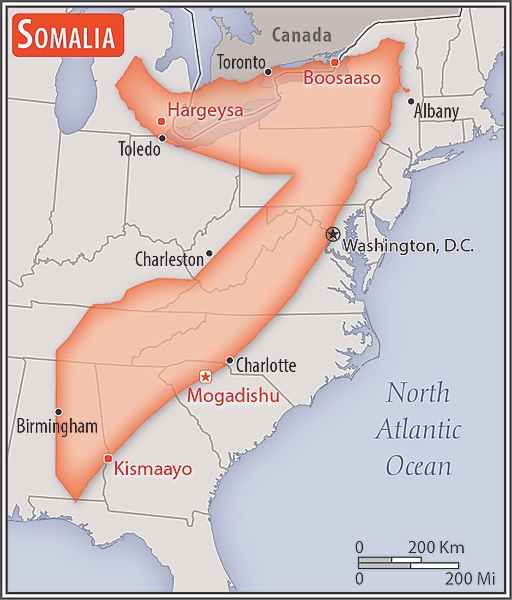
almost five times the size of Alabama; slightly smaller than Texas
Area comparison map:
Land boundaries
total: 2,385 km
border countries (3): Djibouti 61 km; Ethiopia 1,640 km; Kenya 684 km
Coastline
3,025 km
Maritime claims
territorial sea: 200 nm; note: the US does not recognize this claim
exclusive economic zone: 200 nm
Climate
principally desert; northeast monsoon (December to February), moderate temperatures in north and hot in south; southwest monsoon (May to October), torrid in the north and hot in the south, irregular rainfall, hot and humid periods (tangambili) between monsoons
Terrain
mostly flat to undulating plateau rising to hills in north
Elevation
highest point: Mount Shimbiris 2,460 m
lowest point: Indian Ocean 0 m
mean elevation: 410 m
Natural resources
uranium and largely unexploited reserves of iron ore, tin, gypsum, bauxite, copper, salt, natural gas, likely oil reserves
Land use
agricultural land: 70.3% (2022 est.)
arable land: 1.8% (2022 est.)
permanent crops: 0% (2022 est.)
permanent pasture: 68.5% (2022 est.)
forest: 9.3% (2022 est.)
other: 20.4% (2022 est.)
Irrigated land
2,000 sq km (2012)
Major aquifers
Ogaden-Juba Basin
Population distribution
distribution varies greatly throughout the country; least densely populated areas are in the northeast and central regions, as well as areas along the Kenyan border; most populated areas are in and around the cities of Mogadishu, Marka, Boorama, Hargeysa, and Baidoa, as shown on this population distribution map
Natural hazards
recurring droughts; frequent dust storms over eastern plains in summer; floods during rainy season
Geography – note
strategic location on Horn of Africa along southern approaches to Bab el Mandeb and route through Red Sea and Suez Canal
People and Society
Population
total: 13,017,273 (2024 est.)
male: 6,546,312
female: 6,470,961
comparison rankings: total 78; female 78; male 79
Nationality
noun: Somali(s)
adjective: Somali
Ethnic groups
predominantly Somali with lesser numbers of Arabs, Bantus, and others
Languages
Somali (official), Arabic (official), Italian, English
major-language sample(s):
Buugga Xaqiiqda Aduunka, waa laga maarmaanka macluumaadka assasiga. (Somali)
The World Factbook, the indispensable source for basic information.
Religions
Muslim 99.9% (Sunni Muslim 98.1%, Shia Muslim 1.2%, Islamic schismatic 0.6%), ethnic religionist 0.1% (2020 est.)
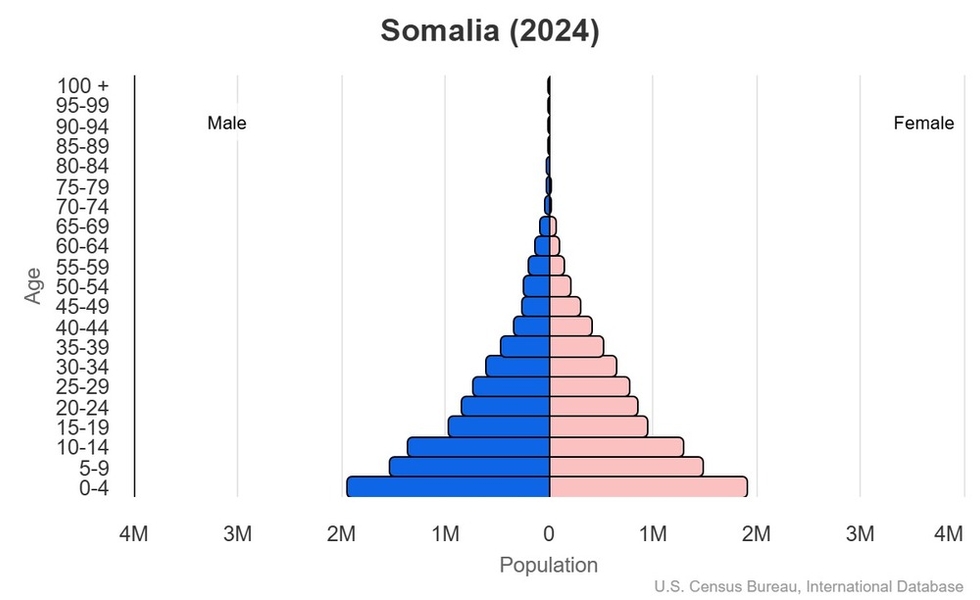
Age structure
0-14 years: 41.4% (male 2,689,086/female 2,694,372)
15-64 years: 55.8% (male 3,699,721/female 3,568,163)
65 years and over: 2.8% (2024 est.) (male 157,505/female 208,426)
2024 population pyramid:
Dependency ratios
total dependency ratio: 100.9 (2024 est.)
youth dependency ratio: 97.6 (2024 est.)
elderly dependency ratio: 3.2 (2024 est.)
potential support ratio: 30.8 (2024 est.)
Median age
total: 19.1 years (2024 est.)
male: 19.3 years
female: 18.9 years
comparison ranking: total 215
Population growth rate
2.55% (2024 est.)
comparison ranking: 15
Birth rate
37.4 births/1,000 population (2024 est.)
comparison ranking: 8
Death rate
11.2 deaths/1,000 population (2024 est.)
comparison ranking: 23
Net migration rate
-0.7 migrant(s)/1,000 population (2024 est.)
comparison ranking: 136
Population distribution
distribution varies greatly throughout the country; least densely populated areas are in the northeast and central regions, as well as areas along the Kenyan border; most populated areas are in and around the cities of Mogadishu, Marka, Boorama, Hargeysa, and Baidoa, as shown on this population distribution map
Urbanization
urban population: 47.9% of total population (2023)
rate of urbanization: 4.2% annual rate of change (2020-25 est.)
Major urban areas – population
2.610 million MOGADISHU (capital), 1.127 million Hargeysa (2023)
Sex ratio
at birth: 1.03 male(s)/female
0-14 years: 1 male(s)/female
15-64 years: 1.04 male(s)/female
65 years and over: 0.76 male(s)/female
total population: 1.01 male(s)/female (2024 est.)
Maternal mortality ratio
621 deaths/100,000 live births (2020 est.)
comparison ranking: 7
Infant mortality rate
total: 83.6 deaths/1,000 live births (2024 est.)
male: 93.2 deaths/1,000 live births
female: 73.7 deaths/1,000 live births
comparison ranking: total 2
Life expectancy at birth
total population: 56.5 years (2024 est.)
male: 54.1 years
female: 59 years
comparison ranking: total population 225
Total fertility rate
5.12 children born/woman (2024 est.)
comparison ranking: 8
Gross reproduction rate
2.52 (2024 est.)
Contraceptive prevalence rate
6.9% (2018/19)
Drinking water source
improved:
urban: 96.4% of population
rural: 73.7% of population
total: 84.2% of population
unimproved:
urban: 3.6% of population
rural: 26.3% of population
total: 15.8% of population (2020 est.)
Health expenditure
2.5% of national budget (2022 est.)
Physician density
0.05 physicians/1,000 population (2014)
Hospital bed density
0.9 beds/1,000 population (2019 est.)
Sanitation facility access
improved:
urban: 82.4% of population
rural: 33.8% of population
total: 56.2% of population
unimproved:
urban: 17.6% of population
rural: 66.2% of population
total: 43.8% of population (2020 est.)
Obesity – adult prevalence rate
8.3% (2016)
comparison ranking: 153
Alcohol consumption per capita
total: 0 liters of pure alcohol (2019 est.)
beer: 0 liters of pure alcohol (2019 est.)
wine: 0 liters of pure alcohol (2019 est.)
spirits: 0 liters of pure alcohol (2019 est.)
other alcohols: 0 liters of pure alcohol (2019 est.)
comparison ranking: total 188
Currently married women (ages 15-49)
62.9% (2023 est.)
Education expenditure
0.3% of GDP (2019 est.)
4.2% national budget (2019 est.)
comparison ranking: Education expenditure (% GDP) 200
Literacy
total population: 54% (2022 est.) NA
male: 65% (2022 est.) NA
female: 44% (2022 est.) NA
Environment
Environment – current issues
water scarcity; contaminated water; improper waste disposal; deforestation; land degradation; overgrazing; soil erosion; desertification
Environment – international agreements
party to: Biodiversity, Climate Change, Climate Change-Kyoto Protocol, Climate Change-Paris Agreement, Desertification, Endangered Species, Hazardous Wastes, Law of the Sea, Ozone Layer Protection
signed, but not ratified: Nuclear Test Ban
Climate
principally desert; northeast monsoon (December to February), moderate temperatures in north and hot in south; southwest monsoon (May to October), torrid in the north and hot in the south, irregular rainfall, hot and humid periods (tangambili) between monsoons
Land use
agricultural land: 70.3% (2022 est.)
arable land: 1.8% (2022 est.)
permanent crops: 0% (2022 est.)
permanent pasture: 68.5% (2022 est.)
forest: 9.3% (2022 est.)
other: 20.4% (2022 est.)
Urbanization
urban population: 47.9% of total population (2023)
rate of urbanization: 4.2% annual rate of change (2020-25 est.)
Air pollutants
particulate matter emissions: 14.28 micrograms per cubic meter (2019 est.)
carbon dioxide emissions: 0.65 megatons (2016 est.)
methane emissions: 20.13 megatons (2020 est.)
Waste and recycling
municipal solid waste generated annually: 2,326,099 tons (2016 est.)
Major aquifers
Ogaden-Juba Basin
Total water withdrawal
municipal: 20 million cubic meters (2020 est.)
industrial: 2 million cubic meters (2017 est.)
agricultural: 3.28 billion cubic meters (2020 est.)
Total renewable water resources
14.7 billion cubic meters (2020 est.)
Government
Country name
conventional long form: Federal Republic of Somalia
conventional short form: Somalia
local long form: Jamhuuriyadda Federaalka Soomaaliya (Somali)/ Jumhuriyat as Sumal al Fidiraliyah (Arabic)
local short form: Soomaaliya (Somali)/ As Sumal (Arabic)
former: British Somaliland, Italian Somaliland, Somali Republic, Somali Democratic Republic
etymology: the name means “Land of the Somali,” a local ethnic group; the origin of the group’s name is unclear but may come from 1) a Cushitic word meaning “dark,” 2) the local phrase soo mal, meaning “go and milk” (referring to offering guests milk), 3) the name of a local chief, or 4) the Arabic zamla, meaning “cattle”
Government type
federal parliamentary republic
Capital
name: Mogadishu
geographic coordinates: 2 04 N, 45 20 E
time difference: UTC+3 (8 hours ahead of Washington, DC, during Standard Time)
etymology: the name is probably derived from the Arabic word mukaddas, meaning “holy”
Administrative divisions
18 regions (gobollo, singular – gobol); Awdal, Bakool, Banaadir, Bari, Bay, Galguduud, Gedo, Hiiraan, Jubbada Dhexe (Middle Jubba), Jubbada Hoose (Lower Jubba), Mudug, Nugaal, Sanaag, Shabeellaha Dhexe (Middle Shabeelle), Shabeellaha Hoose (Lower Shabeelle), Sool, Togdheer, Woqooyi Galbeed
Legal system
mixed system of civil law, Islamic (sharia) law, and customary law (referred to as Xeer)
Constitution
history: previous 1961, 1979; latest drafted 12 June 2012, adopted 1 August 2012
amendment process: proposed by the federal government, by members of the state governments, the Federal Parliament, or by public petition; proposals require review by a joint committee of Parliament with inclusion of public comments and state legislatures’ comments; passage requires at least two-thirds majority vote in both houses of Parliament and approval by a majority of votes cast in a referendum; constitutional clauses on Islamic principles, the federal system, human rights and freedoms, powers and authorities of the government branches, and inclusion of women in national institutions cannot be amended
International law organization participation
accepts compulsory ICJ jurisdiction with reservations; non-party state to the ICCt
Citizenship
citizenship by birth: no
citizenship by descent only: the father must be a citizen of Somalia
dual citizenship recognized: no
residency requirement for naturalization: 7 years
Suffrage
18 years of age; universal suffrage starting with 24 June 2024 local elections
Executive branch
chief of state: President HASSAN SHEIKH Mohamud (since 23 May 2022)
head of government: Prime Minister Hamza Abdi BARRE (since 25 June 2022)
cabinet: Cabinet appointed by the prime minister, approved by the House of the People
election/appointment process: president indirectly elected by the Federal Parliament by two-thirds majority vote in 2 rounds, if needed, for a single 4-year term; prime minister appointed by the president, approved by the House of the People
most recent election date: 15 May 2022
election results:
2022: HASSAN SHEIKH Mohamud elected president in third round – Federal Parliament percent of vote in first round – Said ABDULLAHI DENI (Kaah) 20.2%, Mohamed ABDULLAHI Mohamed “Farmaajo” (TPP) 18.3%, HASSAN SHEIKH Mohamud (PDP) 16.2%, Hassan Ali KHAYRE (independent) 14.6%, other 30.7%; Federal Parliament percent of vote in second round – HASSAN SHEIKH Mohamud 34.1%, Mohamed ABDULLAHI Mohamed “Farmaajo” 25.7%, Said ABDULLAHI DENI 21%, Hassan Ali KHAYRE 19.2%; Federal Parliament percent of vote in third round – HASSAN SHEIKH Mohamud 66%, Mohamed ABDULLAHI Mohamed “Farmaajo” 34%
2017: Mohamed ABDULLAHI Mohamed “Farmaajo” elected president in second round; Federal Parliament number of votes in first round – HASSAN SHEIKH Mohamud (PDP) 88, Mohamed ABDULLAHI Mohamed “Farmaajo” (TPP) 72, Sheikh SHARIF Sheikh Ahmed (ARS) 49, other 37; Federal Parliament number of votes in second round – Mohamed ABDULLAHI Mohamed “Farmaajo” 184, HASSAN SHEIKH Mohamud 97, Sheikh SHARIF Sheikh Ahmed 45
expected date of next election: 2026
Legislative branch
legislature name: Federal Parliament
legislative structure: bicameral
note: despite the formation of political parties in 2020, the 2021 parliamentary elections maintained a primarily clan-based system of appointments; seats in the legislature were apportioned to Somali member states and not by party representation
Legislative branch – lower chamber
chamber name: House of the People (Golaha Shacabka)
number of seats: 275 (all indirectly elected)
scope of elections: full renewal
term in office: 5 years
most recent election date: 11/1/2021 to 5/5/2022
percentage of women in chamber: 19%
expected date of next election: October 2026
Legislative branch – upper chamber
chamber name: Upper House (Aqalka Sare)
number of seats: 54 (all indirectly elected)
scope of elections: full renewal
term in office: 5 years
most recent election date: 7/27/2021 to 11/13/2021
percentage of women in chamber: 25.9%
expected date of next election: July 2026
Judicial branch
highest court(s): the provisional constitution stipulates the establishment of the Constitutional Court (consists of 5 judges, including the chief judge and deputy chief judge)
judge selection and term of office: judges appointed by the president on proposal of the Judicial Service Commission, a 9-member judicial and administrative body; judge tenure NA
subordinate courts: federal courts; federal member state-level courts; military courts; sharia courts
note: under the terms of the 2004 Transitional National Charter, a Supreme Court based in Mogadishu and the Appeal Court were established, but most regions have reverted to local forms of conflict resolution, whether secular, Somali customary law, or Islamic law
Political parties
Cosmopolitan Democratic Party
Green Party
Himilo Qaran Party
Ilays Party
Justice and Reconciliation Party
National Progressive Party
Peace and Unity Party
Qaransoor Party
Qiimo Qaran Party
Security and Justice Party
Social Justice Party
Somali Labour Party
Somali Republic Party
Somali Social Unity Party or SSUP
Union for Peace and Development Party or PDP
Wadajir Party
note: in 2017 an independent electoral commission (the NIEC) was inaugurated with a mandate to oversee the process of registration of political parties in the country; as of 2021, the NIEC had registered a total of 110 parties
Diplomatic representation in the US
chief of mission: Ambassador DAHIR Hassan Abdi (since 18 September 2024)
chancery: 1609 22nd Street NW, Washington, DC 20008
telephone: [1] (202) 853-9164
email address and website:
[email protected]
https://somaliembassydc.net/
Diplomatic representation from the US
chief of mission: Ambassador Richard H. RILEY (since 20 June 2024)
embassy: Mogadishu, (reopened October 2019 on the grounds of the Mogadishu Airport)
mailing address: P.O. Box 606 Village Market
00621 Nairobi, Kenya
telephone: [254] 20 363-6451
email address and website:
[email protected]
https://so.usembassy.gov/
International organization participation
ACP, AfDB, AFESD, AMF, AU, CAEU (candidate), EAC, FAO, G-77, IBRD, ICAO, ICRM, IDA, IDB, IFAD, IFC, IFRCS, IGAD, ILO, IMF, IMO, Interpol, IOC, IOM, IPU, ITSO, ITU, LAS, NAM, OIC, OPCW, OPCW (signatory), UN, UNCTAD, UNESCO, UNHCR, UNHRC, UNIDO, UPU, WFTU (NGOs), WHO, WIPO, WMO
Independence
1 July 1960 (from a merger of British Somaliland, which became independent from the UK on 26 June 1960, and Italian Somaliland, which became independent from the Italian-administered UN trusteeship on 1 July 1960 to form the Somali Republic)
National holiday
Foundation of the Somali Republic, 1 July (1960); note – 26 June (1960) in Somaliland
Flag description
light blue with a large white five-pointed star in the center; the blue field was originally influenced by the UN flag but today is said to represent the sky and the Indian Ocean; the five points of the star represent the regions in the horn of Africa where Somali people live: the former British Somaliland and Italian Somaliland (which together make up Somalia), Djibouti, Ogaden (Ethiopia), and the Northeast Province (Kenya)
National symbol(s)
leopard
National color(s)
blue, white
National anthem
name: “Qolobaa Calankeed” (Every Nation Has its own Flag)
lyrics/music: lyrics/music: Abdullahi QARSHE
note: adopted 2012; written in 1959
“Qolobaa Calankeed” (Every Nation Has its own Flag):
Government – note
regional and local governing bodies continue to exist and control various areas of the country, including the self-declared Republic of Somaliland in northwestern Somalia
Economy
Economic overview
low-income African Horn economy; 30 years of war and instability crippled economic potential; high remittances for basic survival; new fiscal federalism approach; cleared some unsustainable debt; environmentally fragile; digitally driven urbanization efforts
Real GDP (purchasing power parity)
$25.747 billion (2023 est.)
$24.706 billion (2022 est.)
$24.05 billion (2021 est.)
note: data in 2021 dollars
comparison ranking: 155
Real GDP growth rate
4.22% (2023 est.)
2.73% (2022 est.)
3.31% (2021 est.)
note: annual GDP % growth based on constant local currency
comparison ranking: 70
Real GDP per capita
$1,400 (2023 est.)
$1,400 (2022 est.)
$1,400 (2021 est.)
note: data in 2021 dollars
comparison ranking: 220
GDP (official exchange rate)
$10.969 billion (2023 est.)
note: data in current dollars at official exchange rate
Inflation rate (consumer prices)
1.5% (2017 est.)
-71.1% (2016 est.)
comparison ranking: 40
GDP – composition, by end use
household consumption: 123.5% (2023 est.)
government consumption: 7.3% (2023 est.)
investment in fixed capital: 22.4% (2023 est.)
investment in inventories: 0% (2023 est.)
exports of goods and services: 19.7% (2023 est.)
imports of goods and services: -73% (2023 est.)
note: figures may not total 100% due to rounding or gaps in data collection
Agricultural products
camel milk, milk, goat milk, sheep milk, sugarcane, fruits, sorghum, cassava, vegetables, maize (2023)
note: top ten agricultural products based on tonnage
Industries
light industries, including sugar refining, textiles, wireless communication
Industrial production growth rate
4.3% (2014 est.)
note: annual % change in industrial value added based on constant local currency
comparison ranking: 69
Labor force
3.439 million (2024 est.)
note: number of people ages 15 or older who are employed or seeking work
comparison ranking: 102
Unemployment rate
18.9% (2024 est.)
18.9% (2023 est.)
19% (2022 est.)
note: % of labor force seeking employment
comparison ranking: 191
Youth unemployment rate (ages 15-24)
total: 33.9% (2024 est.)
male: 32.1% (2024 est.)
female: 37% (2024 est.)
note: % of labor force ages 15-24 seeking employment
comparison ranking: total 18
Population below poverty line
54.4% (2022 est.)
note: % of population with income below national poverty line
Gini Index coefficient – distribution of family income
36.8 (2017 est.)
comparison ranking: 61
Remittances
15.82% of GDP (2023 est.)
17.01% of GDP (2022 est.)
18.29% of GDP (2021 est.)
note: personal transfers and compensation between resident and non-resident individuals/households/entities
Public debt
76.7% of GDP (2017 est.)
comparison ranking: 41
Taxes and other revenues
0% (of GDP) (2023 est.)
note: central government tax revenue as a % of GDP
comparison ranking: 205
Current account balance
-$464 million (2017 est.)
-$427 million (2016 est.)
comparison ranking: 117
Exports
$2.164 billion (2023 est.)
$1.804 billion (2022 est.)
$1.532 billion (2021 est.)
note: GDP expenditure basis – exports of goods and services in current dollars
comparison ranking: 164
Exports – partners
UAE 35%, Saudi Arabia 27%, Oman 18%, Djibouti 8%, India 3% (2023)
note: top five export partners based on percentage share of exports
Exports – commodities
sheep and goats, gold, postage stamps/documents, other animals, cattle (2023)
note: top five export commodities based on value in dollars
Imports
$8.002 billion (2023 est.)
$7.456 billion (2022 est.)
$5.969 billion (2021 est.)
note: GDP expenditure basis – imports of goods and services in current dollars
comparison ranking: 134
Imports – partners
UAE 29%, China 19%, India 15%, Turkey 8%, Oman 5% (2023)
note: top five import partners based on percentage share of imports
Imports – commodities
raw sugar, tobacco, broadcasting equipment, rice, milk (2023)
note: top five import commodities based on value in dollars
Reserves of foreign exchange and gold
$30.45 million (2014 est.)
comparison ranking: 195
Debt – external
$2.563 billion (2023 est.)
note: present value of external debt in current US dollars
comparison ranking: 91
Exchange rates
Somali shillings (SOS) per US dollar –
Exchange rates:
23,097.987 (2017 est.)
23,061.784 (2016 est.)
22,254.236 (2015 est.)
20,230.929 (2014 est.)
19,283.8 (2013 est.)
Energy
Electricity access
electrification – total population: 48.9% (2022 est.)
electrification – urban areas: 76.7%
electrification – rural areas: 30.6%
Electricity
installed generating capacity: 156,000 kW (2023 est.)
consumption: 396.792 million kWh (2023 est.)
transmission/distribution losses: 15.408 million kWh (2023 est.)
comparison rankings: transmission/distribution losses 22; consumption 181; installed generating capacity 180
Electricity generation sources
fossil fuels: 82.5% of total installed capacity (2023 est.)
solar: 16% of total installed capacity (2023 est.)
wind: 1.5% of total installed capacity (2023 est.)
Coal
imports: 4 metric tons (2023 est.)
Petroleum
refined petroleum consumption: 6,000 bbl/day (2023 est.)
Natural gas
proven reserves: 5.663 billion cubic meters (2021 est.)
Carbon dioxide emissions
838,000 metric tonnes of CO2 (2023 est.)
from coal and metallurgical coke: 10 metric tonnes of CO2 (2023 est.)
from petroleum and other liquids: 838,000 metric tonnes of CO2 (2023 est.)
comparison ranking: total emissions 175
Energy consumption per capita
649,000 Btu/person (2023 est.)
comparison ranking: 195
Communications
Telephones – fixed lines
total subscriptions: 91,000 (2022 est.)
subscriptions per 100 inhabitants: 1 (2022 est.) less than 1
comparison ranking: total subscriptions 136
Telephones – mobile cellular
total subscriptions: 8.84 million (2022 est.)
subscriptions per 100 inhabitants: 50 (2022 est.)
comparison ranking: total subscriptions 96
Broadcast media
2 private TV stations rebroadcast Al-Jazeera and CNN; 1 state-operated TV station and 1 private TV station; state-operated Radio Mogadishu; 1 SW and roughly 10 private FM radio stations in Mogadishu; several radio stations in central and southern regions; transmissions of at least 2 international broadcasters available (2019)
Internet country code
.so
Internet users
percent of population: 28% (2022 est.)
Broadband – fixed subscriptions
total: 119,000 (2022 est.)
subscriptions per 100 inhabitants: 1 (2022 est.)
comparison ranking: total 128
Transportation
Civil aircraft registration country code prefix
6O
Airports
40 (2025)
comparison ranking: 103
Merchant marine
total: 4 (2023)
by type: general cargo 1, other 3
comparison ranking: total 172
Ports
total ports: 6 (2024)
large: 1
medium: 0
small: 2
very small: 3
ports with oil terminals: 2
key ports: Baraawe, Berbera, Boosaaso, Kismaayo, Marka, Muqdisho
Military and Security
Military and security forces
Somali Armed Forces (SAF; aka Somali Defense Force): Somali National Army (SNA; aka Land Forces), Somali Navy, Somali Air Force
Ministry of Internal Security: Somali National Police (SNP, includes Coast Guard, commando unit) (2024)
note 1: Somalia has numerous militia (“ma’awisley”) and regional/state forces operating throughout the country; these forces include ones that are clan- and warlord-based, semi-official paramilitary and special police forces (“darwish”), and externally sponsored militias
note 2: Somaliland and Puntland have separate military, security, and paramilitary forces
Military expenditures
6% of GDP (2021 est.)
6% of GDP (2020 est.)
5.6% of GDP (2019 est.)
6% of GDP (2018 est.)
5.9% of GDP (2017 est.)
Military and security service personnel strengths
estimated 20,000 active Somali Armed Forces (2025)
note: tens of thousands of militia forces are also active in Somalia
Military equipment inventories and acquisitions
the SNA’s inventory is a mix of older, secondhand, and donated equipment from a variety of suppliers, including Italy, Russia, South Africa, Turkey, the UK, and the US (2024)
Military service age and obligation
18 is the legal minimum age for voluntary military service for men and women; conscription of men aged 18-40 and women aged 18-30 is authorized, but not currently utilized (2023)
Military – note
the Somali National Army (SNA) is a lightly armed force of more than a dozen brigades; its most effective units are assessed to be the US-trained Danab (“Lightning”) Advanced Infantry Brigade and those of the Turkish-trained Gorgor (“Eagle”) Special Division; SNA soldiers have also received training from Egypt, Eritrea, Ethiopia, the EU, Uganda, and the UK; the SNA and supporting security and militia forces are actively conducting operations against the al-Shabaab terrorist group; al-Shabaab controls large parts of southern and central Somalia
the African Union Mission in Somalia (AMISOM) operated in the country with the approval of the UN from 2007-2022; its mission included assisting Somali forces in providing security for a stable political process, enabling the gradual handing over of security responsibilities from AMISOM to the Somali security forces, and reducing the threat posed by al-Shabaab and other armed opposition groups; in April 2022, AMISOM was reconfigured and replaced with the AU Transition Mission in Somalia (ATMIS); the ATMIS mission was to support the Somalia Federal Government (FGS) in implementing the security objectives of the FGS’s security transition plan, a comprehensive strategy developed by the FGS and its international partners in 2018 and updated in 2021 to gradually transfer security responsibilities from ATMIS to Somali security forces; originally about 20,000-strong (civilians, military, and police), ATMIS began reducing its staffing levels in mid-2023 and ended its mission at the end of 2024; the follow-on force for ATMIS, the Support and Stabilization Mission in Somalia (AUSSOM) was formed in January 2025 and slated to have about 12,000 personnel, including soldiers, police and civilian support staff (2025)
Terrorism
Terrorist group(s)
Terrorist group(s): al-Shabaab; Islamic State of Iraq and ash-Sham – Somalia
note: details about the history, aims, leadership, organization, areas of operation, tactics, targets, weapons, size, and sources of support of the group(s) appear(s) in the Terrorism reference guide
Transnational Issues
Refugees and internally displaced persons
refugees (country of origin): 23,364 (Ethiopia), 9,969 (Yemen) (2023)
IDPs: 3.864 million (civil war since 1988, clan-based competition for resources; famine; insecurity because of fighting between al-Shabaab and the Transitional Federal Government’s allied forces) (2022)