


English settlers from Saint Kitts first colonized Anguilla in 1650. Great Britain administered the island until the early 19th century, when — against the wishes of the inhabitants — Anguilla was incorporated into a single British dependency along with Saint Kitts and Nevis. Several attempts at separation failed. In 1971, two years after a revolt, Anguilla was finally allowed to secede; this arrangement was formally recognized in 1980, when Anguilla became a separate British dependency. In 2017, Hurricane Irma caused extensive damage on the island, particularly to communications and residential and business infrastructure.TipVisit the Definitions and Notes page to view a description of each topic.Definitions and Notes
Geography
Location
Caribbean, islands between the Caribbean Sea and North Atlantic Ocean, east of Puerto Rico
Geographic coordinates
18 15 N, 63 10 W
Map references
Central America and the Caribbean
Area
total : 91 sq km
land: 91 sq km
water: 0 sq km
comparison ranking: total 225
Area – comparative
about one-half the size of Washington, D.C.
Land boundaries
total: 0 km
Coastline
61 km
Maritime claims
territorial sea: 12 nm
exclusive economic zone: 200 nm
exclusive fishing zone: 200 nm
Climate
tropical; moderated by northeast trade winds
Terrain
flat and low-lying island of coral and limestone
Elevation
highest point: Crocus Hill 73 m
lowest point: Caribbean Sea 0 m
Natural resources
salt, fish, lobster
Land use
agricultural land: 0% (2022 est.)
arable land: 0% (2018 est.)
permanent crops: 0% (2018 est.)
permanent pasture: 0% (2018 est.)
forest: 61.1% (2022 est.)
other: 38.9% (2022 est.)
Irrigated land
0 sq km (2020)
Population distribution
most of the population is concentrated in The Valley in the center of the island; settlement is fairly uniform in the southwest, but rather sparse in the northeast
Natural hazards
frequent hurricanes and other tropical storms (July to October)
Geography – note
the most northerly of the Leeward Islands in the Lesser Antilles
People and Society
Population
total: 19,416 (2024 est.)
male: 9,107
female: 10,309
comparison rankings: total 219; female 219; male 219
Nationality
noun: Anguillan(s)
adjective: Anguillan
Ethnic groups
African/Black 85.3%, Hispanic 4.9%, mixed 3.8%, White 3.2%, East Indian/Indian 1%, other 1.6%, unspecified 0.3% (2011 est.)
note: data represent population by ethnic origin
Languages
English (official)
Religions
Protestant 73.2% (includes Anglican 22.7%, Methodist 19.4%, Pentecostal 10.5%, Seventh Day Adventist 8.3%, Baptist 7.1%, Church of God 4.9%, Presbyterian 0.2%, Brethren 0.1%), Roman Catholic 6.8%, Jehovah’s Witness 1.1%, other Christian 10.9%, other 3.2%, unspecified 0.3%, none 4.5% (2011 est.)
Age structure
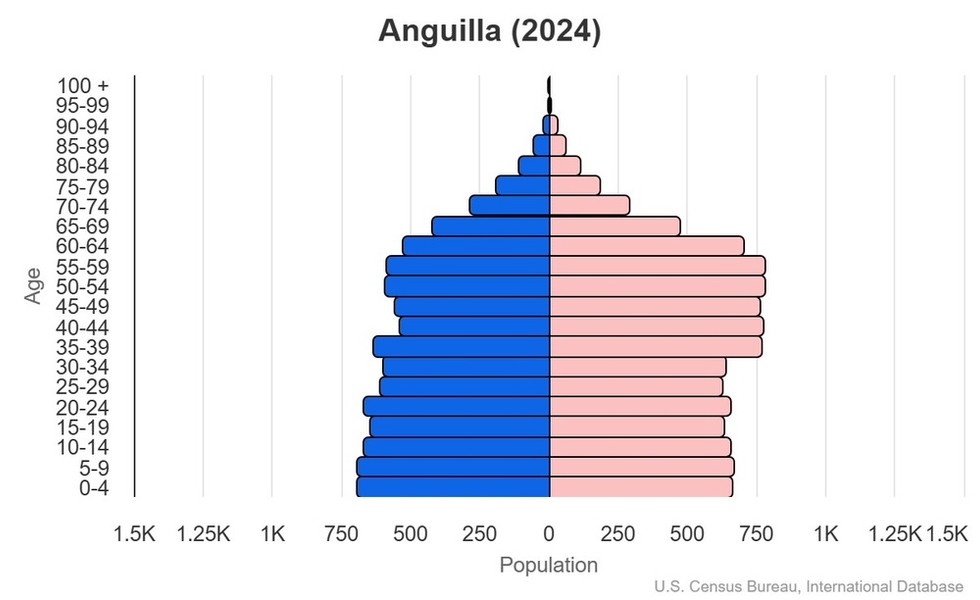
0-14 years: 20.8% (male 2,056/female 1,992)
15-64 years: 67.5% (male 5,958/female 7,147)
65 years and over: 11.7% (2024 est.) (male 1,093/female 1,170)
2024 population pyramid:
Dependency ratios
total dependency ratio: 48.2 (2024 est.)
youth dependency ratio: 30.9 (2024 est.)
elderly dependency ratio: 17.3 (2024 est.)
potential support ratio: 5.8 (2024 est.)
Median age
total: 37.1 years (2024 est.)
male: 34.8 years
female: 39 years
comparison ranking: total 83
Population growth rate
1.74% (2024 est.)
comparison ranking: 53
Birth rate
11.8 births/1,000 population (2024 est.)
comparison ranking: 154
Death rate
4.7 deaths/1,000 population (2024 est.)
comparison ranking: 204
Net migration rate
10.3 migrant(s)/1,000 population (2024 est.)
comparison ranking: 9
Population distribution
most of the population is concentrated in The Valley in the center of the island; settlement is fairly uniform in the southwest, but rather sparse in the northeast
Urbanization
urban population: 100% of total population (2023)
rate of urbanization: 0.47% annual rate of change (2020-25 est.)
Major urban areas – population
1,000 THE VALLEY (capital) (2018)
Sex ratio
at birth: 1.03 male(s)/female
0-14 years: 1.03 male(s)/female
15-64 years: 0.83 male(s)/female
65 years and over: 0.93 male(s)/female
total population: 0.88 male(s)/female (2024 est.)
Infant mortality rate
total: 3 deaths/1,000 live births (2024 est.)
male: 3.9 deaths/1,000 live births
female: 2.1 deaths/1,000 live births
comparison ranking: total 208
Life expectancy at birth
total population: 82.6 years (2024 est.)
male: 80 years
female: 85.3 years
comparison ranking: total population 26
Total fertility rate
1.72 children born/woman (2024 est.)
comparison ranking: 157
Gross reproduction rate
0.85 (2024 est.)
Contraceptive prevalence rate
NA
Drinking water source
improved:
urban: 97.5% of population
total: 97.5% of population
unimproved:
urban: 2.5% of population
total: 2.5% of population (2017 est.)
Physician density
1.51 physicians/1,000 population (2018)
Sanitation facility access
improved:
urban: 99.1% of population
total: 99.1% of population
unimproved:
urban: 0.9% of population
total: 0.9% of population (2017 est.)
Currently married women (ages 15-49)
46.1% (2023 est.)
Education expenditure
2.5% of GDP (2022 est.)
10.3% national budget (2024 est.)
comparison ranking: Education expenditure (% GDP) 174
Environment
Environment – current issues
inadequate potable water
Climate
tropical; moderated by northeast trade winds
Land use
agricultural land: 0% (2022 est.)
arable land: 0% (2018 est.)
permanent crops: 0% (2018 est.)
permanent pasture: 0% (2018 est.)
forest: 61.1% (2022 est.)
other: 38.9% (2022 est.)
Urbanization
urban population: 100% of total population (2023)
rate of urbanization: 0.47% annual rate of change (2020-25 est.)
Government
Country name
conventional long form: none
conventional short form: Anguilla
etymology: in 1493, Christopher COLUMBUS named the island Anguilla, meaning “eel” in Spanish, because of the island’s elongated shape
Government type
parliamentary democracy (House of Assembly); self-governing overseas territory of the UK
Dependency status
overseas territory of the UK
Capital
name: The Valley
geographic coordinates: 18 13 N, 63 03 W
time difference: UTC-4 (1 hour ahead of Washington, DC, during Standard Time)
etymology: name may derive from the capital’s location among several hills
Administrative divisions
none (overseas territory of the UK)
Legal system
common law based on the English model
Constitution
history: several previous; latest 1 April 1982
Citizenship
see United Kingdom
Suffrage
18 years of age; universal
Executive branch
chief of state: King CHARLES III (since 8 September 2022); represented by Governor Julia CROUCH (since 11 September 2023)
head of government: Premier Cora RICHARDSON-HODGE (since 27 February 2025)
cabinet: Executive Council appointed by the governor from among elected members of the House of Assembly
election/appointment process: the monarchy is hereditary; governor appointed by the monarch; following legislative elections, the governor usually appoints the leader of the majority party or majority coalition as premier
Legislative branch
legislature name: House of Assembly
legislative structure: unicameral
number of seats: 11 (7 directly elected, 2 appointed, 2 ex-officio members)
electoral system: plurality/majority
scope of elections: full renewal
term in office: 5 years
most recent election date: 6/29/2020
parties elected and seats per party: APM (7); AUF (4)
percentage of women in chamber: 27.3%
Judicial branch
highest court(s): the Eastern Caribbean Supreme Court (ECSC) is the superior court of the Organization of Eastern Caribbean States; the ECSC is headquartered on St. Lucia and consists of the Court of Appeal — headed by the chief justice and 4 judges — and the High Court with 18 judges; the Court of Appeal travels to member states on a schedule to hear appeals from the High Court and subordinate courts
judge selection and term of office: Eastern Caribbean Supreme Court chief justice appointed by the British monarch; other justices and judges appointed by the Judicial and Legal Services Commission; Court of Appeal justices appointed for life with mandatory retirement at age 65; High Court judges appointed for life with mandatory retirement at age 62
subordinate courts: Magistrate’s Court; Juvenile Court
Political parties
Anguilla Progressive Movement or APM; (formerly Anguilla United Movement or AUM)
Anguilla United Front or AUF
Diplomatic representation in the US
none (overseas territory of the UK)
Diplomatic representation from the US
embassy: none (overseas territory of the UK); alternate contact is the US Embassy in Barbados [1] (246) 227-4000
International organization participation
Caricom (associate), CDB, Interpol (subbureau), OECS, UNESCO (associate), UPU
Independence
none (overseas territory of the UK)
National holiday
Anguilla Day, 30 May (1967)
Flag description
blue, with the flag of the UK in the upper hoist-side quadrant and the Anguillan coat of arms centered in the outer half of the flag; the coat of arms depicts three orange dolphins in an interlocking circular design on a white background with a turquoise-blue field below; the white in the background represents peace, the blue base symbolizes the sea, faith, youth, and hope, and the three dolphins stand for endurance, unity, and strength
National symbol(s)
dolphin
National coat of arms
the Anguillan coat of arms features three interlocking dolphins jumping out of seawater; they represent endurance, unity, and strength, and their circular motion stands for continuity; the white background symbolizes peace and tranquility, and the turquoise-blue base represents the sea, as well as faith, youth, and hope

National anthem
name: “God Bless Anguilla”
lyrics/music: Alex RICHARDSON
note: local anthem adopted 1981; as an overseas territory of the United Kingdom, “God Save the King” is official (see United Kingdom)
Economy
Economic overview
small, tourism-dependent, territorial-island economy; very high public debt; COVID-19 crippled economic activity; partial recovery underway via tourism, benefitting from its high amount of timeshare residences; considering reopening oil refinery
Inflation rate (consumer prices)
1.3% (2017 est.)
-0.6% (2016 est.)
comparison ranking: 35
GDP – composition, by sector of origin
agriculture: 3% (2017 est.)
industry: 10.5% (2017 est.)
services: 86.4% (2017 est.)
comparison rankings: services 12; industry 191; agriculture 139
GDP – composition, by end use
household consumption: 74.1% (2017 est.)
government consumption: 18.3% (2017 est.)
investment in fixed capital: 26.8% (2017 est.)
exports of goods and services: 48.2% (2017 est.)
imports of goods and services: -67.4% (2017 est.)
Agricultural products
small quantities of tobacco, vegetables; cattle raising
Industries
tourism, boat building, offshore financial services
Industrial production growth rate
4% (2017 est.)
comparison ranking: 79
Budget
revenues: $81.925 million (2017 est.)
expenditures: $72.352 million (2017 est.)
note: central government revenues and expenses (excluding grants/extrabudgetary units/social security funds) converted to US dollars at average official exchange rate for year indicated
Public debt
20.1% of GDP (2015 est.)
comparison ranking: 186
Taxes and other revenues
46.7% (of GDP) (2017 est.)
comparison ranking: 5
Current account balance
-$23.2 million (2017 est.)
-$25.3 million (2016 est.)
comparison ranking: 92
Exports
$7.9 million (2017 est.)
$3.9 million (2016 est.)
note: Data are in current year dollars and do not include illicit exports or re-exports.
comparison ranking: 219
Exports – partners
Chile 60%, Netherlands 8%, Brazil 5%, Hungary 4%, USA 4% (2023)
note: top five export partners based on percentage share of exports
Exports – commodities
packaged medicine, garments, vehicle parts/accessories, vaccines, cars (2023)
note: top five export commodities based on value in dollars
Imports
$186.2 million (2017 est.)
$170.1 million (2016 est.)
comparison ranking: 215
Imports – partners
Chile 50%, USA 27%, Botswana 15%, Japan 1%, Dominican Republic 1% (2023)
note: top five import partners based on percentage share of imports
Imports – commodities
poultry, copper ore, natural gas, refined petroleum, fish (2023)
note: top five import commodities based on value in dollars
Reserves of foreign exchange and gold
$76.38 million (2017 est.)
$48.14 million (2015 est.)
comparison ranking: 190
Exchange rates
East Caribbean dollars (XCD) per US dollar –
Exchange rates:
2.7 (2023 est.)
2.7 (2022 est.)
2.7 (2021 est.)
2.7 (2020 est.)
2.7 (2019 est.)
Energy
Electricity access
electrification – total population: 100% (2020)
Communications
Telephones – fixed lines
total subscriptions: 6,000 (2021 est.)
subscriptions per 100 inhabitants: 38 (2021 est.)
comparison ranking: total subscriptions 198
Telephones – mobile cellular
total subscriptions: 26,000 (2021 est.)
subscriptions per 100 inhabitants: 170 (2021 est.)
comparison ranking: total subscriptions 212
Broadcast media
1 private TV station; multi-channel cable TV subscription services are available; about 10 radio stations, one of which is government-owned (2024)
Internet country code
.ai
Internet users
percent of population: 81.6% (2021 est.)
Broadband – fixed subscriptions
total: 5,000 (2018 est.)
subscriptions per 100 inhabitants: 35 (2018 est.)
comparison ranking: total 195
Transportation
Civil aircraft registration country code prefix
VP-A
Airports
1 (2025)
comparison ranking: 225
Merchant marine
total: 2 (2023)
by type: other 2
comparison ranking: total 176
Military and Security
Military – note
defense is the responsibility of the UK
Transnational Issues
Illicit drugs
transshipment point for South American narcotics destined for the US and Europe