The archipelago was once largely under the control of Buddhist and Hindu rulers. By around the 7th century, a Buddhist kingdom arose on Sumatra and expanded into Java and the Malay Peninsula until it was conquered in the late 13th century by the Hindu Majapahit Empire from Java. Majapahit (1290-1527) united most of modern-day Indonesia and Malaysia. Traders introduced Islam around the 11th century, and the religion was gradually over the next 500 years. The Portuguese conquered parts of Indonesia in the 16th century, but the Dutch ousted them (except in East Timor) and began colonizing the islands in the early 17th century. It would be the early 20th century before Dutch colonial rule was established across the entirety of what would become the boundaries of the modern Indonesian state.
Japan occupied the islands from 1942 to 1945. Indonesia declared its independence shortly before Japan’s surrender, but it required four years of sometimes brutal fighting, intermittent negotiations, and UN mediation before the Netherlands agreed to transfer sovereignty in 1949. A period of sometimes unruly parliamentary democracy ended in 1957 when President SOEKARNO declared martial law and instituted “Guided Democracy.” After an abortive coup in 1965 by alleged communist sympathizers, SOEKARNO was gradually eased from power. From 1967 until 1998, President SUHARTO ruled Indonesia with his “New Order” government. After street protests toppled SUHARTO in 1998, free and fair legislative elections took place in 1999 while the country’s first direct presidential election occurred in 2004. Indonesia has since become a robust democracy, holding four direct presidential elections, each considered by international observers to have been largely free and fair.
Indonesia is now the world’s third-most-populous democracy and the world’s largest Muslim-majority nation. It has had strong economic growth since overcoming the Asian financial crisis of the late 1990s. By the 2020s, it had the largest economy in Southeast Asia, and its economy ranked in the world’s top 10 in terms of purchasing power parity. It has also made considerable gains in reducing poverty. Although relations amongst its diverse population–there are more than 300 ethnic groups–have been harmonious in the 2000s, there have been areas of sectarian discontent and violence, as well as instances of religious extremism and terrorism. A political settlement to an armed separatist conflict in Aceh was achieved in 2005, but a separatist group in Papua continued to conduct a low-intensity conflict as of 2024.TipVisit the Definitions and Notes page to view a description of each topic.Definitions and Notes
Geography
Location
Southeastern Asia, archipelago between the Indian Ocean and the Pacific Ocean
Geographic coordinates
5 00 S, 120 00 E
Map references
Southeast Asia
Area
total : 1,904,569 sq km
land: 1,811,569 sq km
water: 93,000 sq km
comparison ranking: total 16
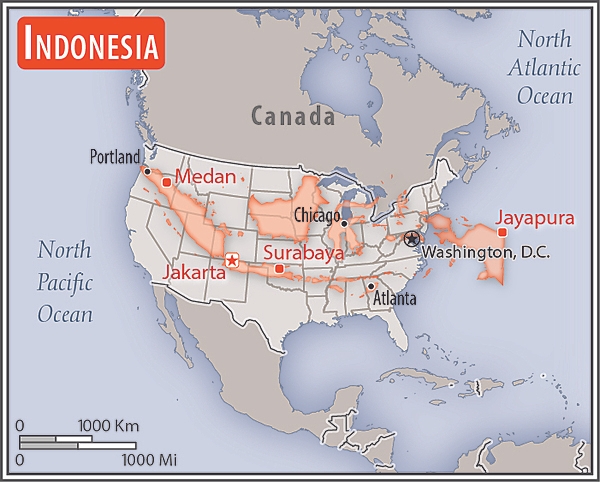
Area – comparative
slightly less than three times the size of Texas
Area comparison map:
Land boundaries
total: 2,958 km
border countries (3): Malaysia 1,881 km; Papua New Guinea 824 km; Timor-Leste 253 km
Coastline
54,716 km
Maritime claims
territorial sea: 12 nm
exclusive economic zone: 200 nm
measured from claimed archipelagic straight baselines
Climate
tropical; hot, humid; more moderate in highlands
Terrain
mostly coastal lowlands; larger islands have interior mountains
Elevation
highest point: Puncak Jaya 4,884 m
lowest point: Indian/Pacific Oceans 0 m
mean elevation: 367 m
Natural resources
petroleum, tin, natural gas, nickel, timber, bauxite, copper, fertile soils, coal, gold, silver
note: Indonesia is the World’s leading producer of nickel with an output of 1.6 million mt in 2022
Land use
agricultural land: 29.8% (2022 est.)
arable land: 9.5% (2022 est.)
permanent crops: 14.5% (2022 est.)
permanent pasture: 5.8% (2022 est.)
forest: 48% (2022 est.)
other: 22.2% (2022 est.)
Irrigated land
67,220 sq km (2012)
Major lakes (area sq km)
fresh water lake(s): Danau Toba – 1,150 sq km
note – located in the caldera of a super volcano that erupted more than 70,000 years ago; it is the largest volcanic lake in the World
Major rivers (by length in km)
Sepik (shared with Papua New Guinea [s]) – 1,126 km; Fly (shared with Papua New Guinea [s]) – 1,050 km
note: [s] after country name indicates river source; [m] after country name indicates river mouth
Population distribution
major concentration on the island of Java, which is considered one of the most densely populated places on earth; of the outer islands, Sumatra contains some of the most significant clusters, particularly in the south near the Selat Sunda and along the northeastern coast near Medan; the cities of Makasar (Sulawesi), Banjarmasin (Kalimantan) are also heavily populated
Natural hazards
occasional floods; severe droughts; tsunamis; earthquakes; volcanoes; forest fires
volcanism: Indonesia contains the most volcanoes of any country in the world – some 76 are historically active; significant volcanic activity occurs on Java, Sumatra, the Sunda Islands, Halmahera Island, Sulawesi Island, Sangihe Island, and in the Banda Sea; Merapi (2,968 m), Indonesia’s most active volcano and in eruption since 2010, has been deemed a Decade Volcano by the International Association of Volcanology and Chemistry of the Earth’s Interior, worthy of study due to its explosive history and close proximity to human populations; on 22 December 2018, a large explosion and flank collapse destroyed most of the 338 m high island of Anak Krakatau (Child of Krakatau) and generated a deadly tsunami inundating portions of western Java and southern Sumatra leaving more than 400 dead; other notable historically active volcanoes include Agung, Awu, Karangetang, Krakatau (Krakatoa), Makian, Raung, Sinabung, and Tambora; see note 2 under “Geography – note”
Geography – note
note 1: 13,466 islands are in the archipelago, of which 922 are permanently inhabited; Indonesia is the world’s largest country composed solely of islands; the country straddles the equator and occupies a strategic location along major sea lanes from the Indian Ocean to the Pacific Ocean
note 2: Indonesia is one of the countries along the Ring of Fire, a belt of active volcanoes and earthquake epicenters bordering the Pacific Ocean; up to 90% of the world’s earthquakes and some 75% of the world’s volcanoes occur within the Ring of Fire; 80% of tsunamis, caused by volcanic or seismic events, occur within the “Pacific Ring of Fire”
note 3: despite having the fourth largest population in the world, Indonesia is the most heavily forested region on earth after the Amazon
People and Society
Population
total: 281,562,465 (2024 est.)
male: 140,800,047
female: 140,762,418
comparison rankings: total 4; female 4; male 4
Nationality
noun: Indonesian(s)
adjective: Indonesian
Ethnic groups
Javanese 40.1%, Sundanese 15.5%, Malay 3.7%, Batak 3.6%, Madurese 3%, Betawi 2.9%, Minangkabau 2.7%, Buginese 2.7%, Bantenese 2%, Banjarese 1.7%, Balinese 1.7%, Acehnese 1.4%, Dayak 1.4%, Sasak 1.3%, Chinese 1.2%, other 15% (2010 est.)
Languages
Bahasa Indonesia (official, modified form of Malay), English, Dutch, local dialects (of which the most widely spoken is Javanese); note – more than 700 languages are used in Indonesia
major-language sample(s):
Fakta Dunia, sumber informasi dasar yang sangat diperlukan. (Indonesian)
The World Factbook, the indispensable source for basic information.
Religions
Muslim 87.4%, Protestant 7.5%, Roman Catholic 3.1%, Hindu 1.7%, other 0.8% (includes Buddhist and Confucian) (2022 est.)
Age structure
0-14 years: 23.8% (male 34,247,218/female 32,701,367)
15-64 years: 68.3% (male 96,268,201/female 95,961,293)
65 years and over: 8% (2024 est.) (male 10,284,628/female 12,099,758)
2024 population pyramid:

Dependency ratios
total dependency ratio: 46.5 (2024 est.)
youth dependency ratio: 34.8 (2024 est.)
elderly dependency ratio: 11.6 (2024 est.)
potential support ratio: 8.6 (2024 est.)
Median age
total: 31.5 years (2024 est.)
male: 30.8 years
female: 32.3 years
comparison ranking: total 125
Population growth rate
0.73% (2024 est.)
comparison ranking: 120
Birth rate
14.8 births/1,000 population (2024 est.)
comparison ranking: 115
Death rate
6.8 deaths/1,000 population (2024 est.)
comparison ranking: 128
Net migration rate
-0.7 migrant(s)/1,000 population (2024 est.)
comparison ranking: 132
Population distribution
major concentration on the island of Java, which is considered one of the most densely populated places on earth; of the outer islands, Sumatra contains some of the most significant clusters, particularly in the south near the Selat Sunda and along the northeastern coast near Medan; the cities of Makasar (Sulawesi), Banjarmasin (Kalimantan) are also heavily populated
Urbanization
urban population: 58.6% of total population (2023)
rate of urbanization: 1.99% annual rate of change (2020-25 est.)
Major urban areas – population
11.249 million JAKARTA (capital), 3.729 million Bekasi, 3.044 million Surabaya, 3.041 million Depok, 2.674 million Bandung, 2.514 million Tangerang (2023)
Sex ratio
at birth: 1.05 male(s)/female
0-14 years: 1.05 male(s)/female
15-64 years: 1 male(s)/female
65 years and over: 0.85 male(s)/female
total population: 1 male(s)/female (2024 est.)
Mother’s mean age at first birth
22.4 years (2017 est.)
note: data represents median age at first birth among women 25-49
Maternal mortality ratio
173 deaths/100,000 live births (2020 est.)
comparison ranking: 52
Infant mortality rate
total: 18.9 deaths/1,000 live births (2024 est.)
male: 21.3 deaths/1,000 live births
female: 16.4 deaths/1,000 live births
comparison ranking: total 80
Life expectancy at birth
total population: 73.6 years (2024 est.)
male: 71.3 years
female: 76 years
comparison ranking: total population 148
Total fertility rate
1.96 children born/woman (2024 est.)
comparison ranking: 110
Gross reproduction rate
0.96 (2024 est.)
Contraceptive prevalence rate
55.5% (2018)
Drinking water source
improved:
urban: 98.2% of population
rural: 86.8% of population
total: 93.3% of population
unimproved:
urban: 1.8% of population
rural: 13.2% of population
total: 6.7% of population (2020 est.)
Health expenditure
3.7% of GDP (2021)
8% of national budget (2022 est.)
Physician density
0.52 physicians/1,000 population (2023)
Hospital bed density
1.4 beds/1,000 population (2021 est.)
Sanitation facility access
improved:
urban: 97.2% of population
rural: 86.5% of population
total: 92.5% of population
unimproved:
urban: 2.8% of population
rural: 13.5% of population
total: 7.5% of population (2020 est.)
Obesity – adult prevalence rate
6.9% (2016)
comparison ranking: 162
Alcohol consumption per capita
total: 0.08 liters of pure alcohol (2019 est.)
beer: 0.06 liters of pure alcohol (2019 est.)
wine: 0.01 liters of pure alcohol (2019 est.)
spirits: 0.02 liters of pure alcohol (2019 est.)
other alcohols: 0 liters of pure alcohol (2019 est.)
comparison ranking: total 178
Tobacco use
total: 39% (2025 est.)
male: 74.9% (2025 est.)
female: 3.1% (2025 est.)
comparison ranking: total 3
Children under the age of 5 years underweight
17.7% (2018)
comparison ranking: 24
Currently married women (ages 15-49)
70% (2023 est.)
Child marriage
women married by age 15: 2% (2017)
women married by age 18: 16.3% (2017)
Education expenditure
1.3% of GDP (2023 est.)
13.9% national budget (2022 est.)
comparison ranking: Education expenditure (% GDP) 194
Literacy
total population: 96% (2020 est.)
male: 97% (2020 est.)
female: 95% (2020 est.)
School life expectancy (primary to tertiary education)
total: 14 years
male: 14 years
female: 14 years (2018)
People – note
Indonesia is the fourth most populous nation in the World after China, India, and the United States; more than half of the Indonesian population – roughly 150 million people or 55% – live on the island of Java (about the size of California) making it the most crowded island on earth
Environment
Environment – current issues
large-scale deforestation (much of it illegal) and related wildfires cause heavy smog; over-exploitation of marine resources; air pollution from vehicle emissions; waste disposal; water pollution from industrial wastes, sewage
Environment – international agreements
party to: Biodiversity, Climate Change, Climate Change-Kyoto Protocol, Climate Change-Paris Agreement, Comprehensive Nuclear Test Ban, Desertification, Endangered Species, Hazardous Wastes, Law of the Sea, Nuclear Test Ban, Ozone Layer Protection, Ship Pollution, Tropical Timber 2006, Wetlands
signed, but not ratified: Marine Life Conservation
Climate
tropical; hot, humid; more moderate in highlands
Land use
agricultural land: 29.8% (2022 est.)
arable land: 9.5% (2022 est.)
permanent crops: 14.5% (2022 est.)
permanent pasture: 5.8% (2022 est.)
forest: 48% (2022 est.)
other: 22.2% (2022 est.)
Urbanization
urban population: 58.6% of total population (2023)
rate of urbanization: 1.99% annual rate of change (2020-25 est.)
Air pollutants
particulate matter emissions: 19.34 micrograms per cubic meter (2019 est.)
carbon dioxide emissions: 563.32 megatons (2016 est.)
methane emissions: 244.5 megatons (2020 est.)
Waste and recycling
municipal solid waste generated annually: 65.2 million tons (2016 est.)
municipal solid waste recycled annually: 4.564 million tons (2016 est.)
percent of municipal solid waste recycled: 7% (2016 est.)
Major lakes (area sq km)
fresh water lake(s): Danau Toba – 1,150 sq km
note – located in the caldera of a super volcano that erupted more than 70,000 years ago; it is the largest volcanic lake in the World
Major rivers (by length in km)
Sepik (shared with Papua New Guinea [s]) – 1,126 km; Fly (shared with Papua New Guinea [s]) – 1,050 km
note: [s] after country name indicates river source; [m] after country name indicates river mouth
Total water withdrawal
municipal: 23.8 billion cubic meters (2020 est.)
industrial: 9.14 billion cubic meters (2020 est.)
agricultural: 189.7 billion cubic meters (2020 est.)
Total renewable water resources
2.02 trillion cubic meters (2020 est.)
Geoparks
total global geoparks and regional networks: 10
global geoparks and regional networks: Batur; Belitong; Ciletuh – Palabuhanratu; Gunung Sewu; Ijen; Maros Pangkep; Merangin Jambi; Raja Ampat; Rinjani-Lombok; Toba Caldera (2023)
Government
Country name
conventional long form: Republic of Indonesia
conventional short form: Indonesia
local long form: Republik Indonesia
local short form: Indonesia
former: Netherlands East Indies (Dutch East Indies), Netherlands New Guinea
etymology: the name is an 18th-century construct of two Greek words, “Indos” (India) and “nesoi” (islands), meaning “Indian islands”
Government type
presidential republic
Capital
name: Jakarta
geographic coordinates: 6 10 S, 106 49 E
time difference: UTC+7 (12 hours ahead of Washington, DC, during Standard Time)
time zone note: Indonesia has three time zones
etymology: derives from the Sanscrit name Jayakarta, meaning “victory and prosperity;” Prince FATILLAH conquered and renamed the city, formerly known as Sunda Kelapa, in 1527
note: in 2022, the relocation of the country’s capital was approved, from Jakarta to a site on the island of Borneo between Samarinda City and the port city of Balikpapan; Nusantara (“archipelago”), the new capital, was in development as of 2024 and is expected to be completed in 2045
Administrative divisions
35 provinces (provinsi-provinsi, singular – provinsi), 1 autonomous province*, 1 special region** (daerah istimewa), and 1 national capital district*** (daerah khusus ibukota); Aceh*, Bali, Banten, Bengkulu, Gorontalo, Jakarta***, Jambi, Jawa Barat (West Java), Jawa Tengah (Central Java), Jawa Timur (East Java), Kalimantan Barat (West Kalimantan), Kalimantan Selatan (South Kalimantan), Kalimantan Tengah (Central Kalimantan), Kalimantan Timur (East Kalimantan), Kalimantan Utara (North Kalimantan), Kepulauan Bangka Belitung (Bangka Belitung Islands), Kepulauan Riau (Riau Islands), Lampung, Maluku, Maluku Utara (North Maluku), Nusa Tenggara Barat (West Nusa Tenggara), Nusa Tenggara Timur (East Nusa Tenggara), Papua, Papua Barat (West Papua), Papua Barat Daya (Southwest Papua), Papua Pegunungan (Papua Highlands), Papua Selatan (South Papua), Papua Tengah (Central Papua), Riau, Sulawesi Barat (West Sulawesi), Sulawesi Selatan (South Sulawesi), Sulawesi Tengah (Central Sulawesi), Sulawesi Tenggara (Southeast Sulawesi), Sulawesi Utara (North Sulawesi), Sumatera Barat (West Sumatra), Sumatera Selatan (South Sumatra), Sumatera Utara (North Sumatra), Yogyakarta**
Legal system
civil law system based on the Roman-Dutch model and influenced by customary law
Constitution
history: drafted July to August 1945, effective 18 August 1945, abrogated by 1949 and 1950 constitutions; 1945 constitution restored 5 July 1959
amendment process: proposed by the People’s Consultative Assembly, with at least two thirds of its members present; passage requires simple majority vote by the Assembly membership; constitutional articles on the unitary form of the state cannot be amended
International law organization participation
has not submitted an ICJ jurisdiction declaration; non-party state to the ICCt
Citizenship
citizenship by birth: no
citizenship by descent only: at least one parent must be a citizen of Indonesia
dual citizenship recognized: no
residency requirement for naturalization: 5 continuous years
Suffrage
17 years of age; universal; married persons regardless of age
Executive branch
chief of state: President PRABOWO Subianto Djojohadikusumo (since 20 October 2024)
head of government: President PRABOWO Subianto Djojohadikusumo (since 20 October 2024)
cabinet: Cabinet appointed by the president
election/appointment process: president and vice president directly elected by absolute-majority popular vote for a 5-year term (eligible for a second term)
most recent election date: 14 February 2024
election results:
2024: PRABOWO Subianto elected president (assumes office 20 October 2024); percent of vote – PRABOWO Subianto (GERINDRA) 58.6%, Anies Rasyid BASWEDAN (Independent) 24.9%, GANJAR Pranowo (PDI-P) 16.5%
2019: Joko WIDODO reelected president; percent of vote – Joko WIDODO (PDI-P) 55.5%, PRABOWO Subianto Djojohadikusumo (GERINDRA) 44.5%
expected date of next election: 2029
note: the president is both chief of state and head of government
Legislative branch
legislature name: House of Representatives (Dewan Perwakilan Rakyat)
legislative structure: unicameral
number of seats: 580 (all directly elected)
electoral system: proportional representation
scope of elections: full renewal
term in office: 5 years
most recent election date: 2/14/2024
parties elected and seats per party: Indonesian Democratic Party – Struggle (PDI-P) (110); Party of Functional Groups (Golkar) (102); Great Indonesia Movement (Gerindra) (86); National Democratic Party (NasDem) (69); National Awakening Party (PKB) (68); Prosperous Justice Party (PKS) (53); National Mandate Party (PAN) (48); Democratic Party (PD) (44)
percentage of women in chamber: 21.9%
expected date of next election: April 2029
Judicial branch
highest court(s): Supreme Court or Mahkamah Agung (51 judges divided into 8 chambers); Constitutional Court or Mahkamah Konstitusi (consists of 9 judges)
judge selection and term of office: Supreme Court judges nominated by Judicial Commission, appointed by president with concurrence of parliament; judges serve until retirement at age 65; Constitutional Court judges – 3 nominated by president, 3 by Supreme Court, and 3 by parliament; judges appointed by the president; judges serve until mandatory retirement at age 70
subordinate courts: High Courts of Appeal, district courts, religious courts
Political parties
Democrat Party or PD
Functional Groups Party or GOLKAR
Great Indonesia Movement Party or GERINDRA
Indonesia Democratic Party-Struggle or PDI-P
National Awakening Party or PKB
National Democratic Party or NasDem
National Mandate Party or PAN
Prosperous Justice Party or PKS
Diplomatic representation in the US
chief of mission: Ambassador (vacant); Chargé d’Affaires Ida Bagus Made BIMANTARA (since 30 November 2023)
chancery: 2020 Massachusetts Avenue NW, Washington, DC 20036
telephone: [1] (202) 775-5200
FAX: [1] (202) 775-5236
email address and website:
[email protected]
Embassy of The Republic of Indonesia, in Washington D.C., The United States of America (kemlu.go.id)
consulate(s) general: Chicago, Houston, Los Angeles, New York, San Francisco
Diplomatic representation from the US
chief of mission: Ambassador (vacant); Chargé d’Affaires Heather MERRITT (since May 2025)
embassy: Jl. Medan Merdeka Selatan No. 3-5, Jakarta 10110
mailing address: 8200 Jakarta Place, Washington DC 20521-8200
telephone: [62] (21) 5083-1000
FAX: [62] (21) 385-7189
email address and website:
[email protected]
https://id.usembassy.gov/
consulate(s) general: Surabaya
consulate(s): Medan
International organization participation
ADB, APEC, ARF, ASEAN, BIS, CD, CICA (observer), CP, D-8, EAS, EITI (compliant country), FAO, G-11, G-15, G-20, G-77, IAEA, IBRD, ICAO, ICC (national committees), ICRM, IDA, IDB, IFAD, IFC, IFRCS, IHO, ILO, IMF, IMO, IMSO, Interpol, IOC, IOM (observer), IORA, IPU, ISO, ITSO, ITU, ITUC (NGOs), MIGA, MINURSO, MINUSTAH, MONUSCO, MSG (associate member), NAM, OECD (enhanced engagement), OIC, OPCW, PIF (partner), UN, UNAMID, UNCTAD, UNESCO, UNHRC, UNIDO, UNIFIL, UNISFA, UNMIL, UNOOSA, UNWTO, UPU, WCO, WFTU (NGOs), WHO, WIPO, WMO, WTO
Independence
17 August 1945 (declared independence from the Netherlands)
National holiday
Independence Day, 17 August (1945)
Flag description
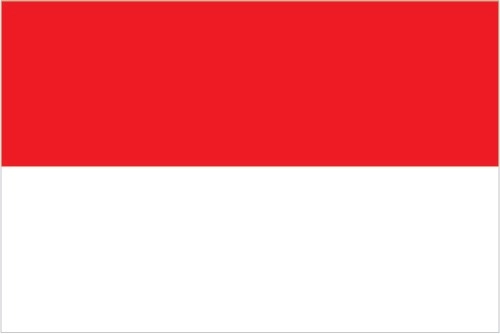
two equal horizontal bands of red (top) and white; the colors derive from the banner of the Majapahit Empire of the 13th-15th centuries; red symbolizes courage, and white represents purity
note: similar to the flags of Monaco, which is shorter, and Poland, which is white (top) and red
National symbol(s)
garuda (mythical bird)
National color(s)
red, white
National anthem
name: “Indonesia Raya” (Great Indonesia)
lyrics/music: Wage Rudolf SOEPRATMAN
note: adopted 1945
National heritage
total World Heritage Sites: 10 (6 cultural, 4 natural)
selected World Heritage Site locales: Borobudur Temple Compounds (c); Komodo National Park (n); Prambanan Temple Compounds (c); Ujung Kulon National Park (n); Sangiran Early Man Site (c); Lorentz National Park (n); Tropical Rainforest Heritage of Sumatra (n); Cultural Landscape of Bali Province (c); Ombilin Coal Mining Heritage of Sawahlunto (c); Cosmological Axis of Yogyakarta and its Historic Landmarks (c)
Economy
Economic overview
one of the fastest growing economies and largest in Southeast Asia; upper middle-income country; human capital and competitiveness phase of its 20-year development plan; COVID-19 reversed poverty reduction trajectory; strengthening financial resilience
Real GDP (purchasing power parity)
$3.906 trillion (2023 est.)
$3.718 trillion (2022 est.)
$3.531 trillion (2021 est.)
note: data in 2021 dollars
comparison ranking: 8
Real GDP growth rate
5.05% (2023 est.)
5.31% (2022 est.)
3.7% (2021 est.)
note: annual GDP % growth based on constant local currency
comparison ranking: 50
Real GDP per capita
$13,900 (2023 est.)
$13,300 (2022 est.)
$12,800 (2021 est.)
note: data in 2021 dollars
comparison ranking: 127
GDP (official exchange rate)
$1.371 trillion (2023 est.)
note: data in current dollars at official exchange rate
Inflation rate (consumer prices)
3.7% (2023 est.)
4.2% (2022 est.)
1.6% (2021 est.)
note: annual % change based on consumer prices
comparison ranking: 119
GDP – composition, by sector of origin
agriculture: 12.5% (2023 est.)
industry: 40.2% (2023 est.)
services: 42.9% (2023 est.)
note: figures may not total 100% due to non-allocated consumption not captured in sector-reported data
comparison rankings: services 183; industry 24; agriculture 64
GDP – composition, by end use
household consumption: 54.4% (2023 est.)
government consumption: 7.4% (2023 est.)
investment in fixed capital: 29.3% (2023 est.)
investment in inventories: 1.2% (2023 est.)
exports of goods and services: 21.7% (2023 est.)
imports of goods and services: -19.6% (2023 est.)
note: figures may not total 100% due to rounding or gaps in data collection
Agricultural products
oil palm fruit, rice, sugarcane, maize, coconuts, cassava, bananas, eggs, chicken, mangoes/guavas (2023)
note: top ten agricultural products based on tonnage
Industries
petroleum and natural gas, textiles, automotive, electrical appliances, apparel, footwear, mining, cement, medical instruments and appliances, handicrafts, chemical fertilizers, plywood, rubber, processed food, jewelry, and tourism
Industrial production growth rate
5% (2023 est.)
note: annual % change in industrial value added based on constant local currency
comparison ranking: 50
Labor force
143.144 million (2024 est.)
note: number of people ages 15 or older who are employed or seeking work
comparison ranking: 4
Unemployment rate
3.3% (2024 est.)
3.3% (2023 est.)
3.5% (2022 est.)
note: % of labor force seeking employment
comparison ranking: 56
Youth unemployment rate (ages 15-24)
total: 13.1% (2024 est.)
male: 13.2% (2024 est.)
female: 13% (2024 est.)
note: % of labor force ages 15-24 seeking employment
comparison ranking: total 103
Population below poverty line
9.4% (2023 est.)
note: % of population with income below national poverty line
Gini Index coefficient – distribution of family income
36.1 (2023 est.)
note: index (0-100) of income distribution; higher values represent greater inequality
comparison ranking: 67
Average household expenditures
on food: 33.5% of household expenditures (2023 est.)
on alcohol and tobacco: 7.3% of household expenditures (2023 est.)
Household income or consumption by percentage share
lowest 10%: 3.3% (2023 est.)
highest 10%: 29.9% (2023 est.)
note: % share of income accruing to lowest and highest 10% of population
Remittances
1.06% of GDP (2023 est.)
0.99% of GDP (2022 est.)
0.79% of GDP (2021 est.)
note: personal transfers and compensation between resident and non-resident individuals/households/entities
Budget
revenues: $130.872 billion (2020 est.)
expenditures: $192.97 billion (2020 est.)
Public debt
45.34% of GDP (2022 est.)
note: central government debt as a % of GDP
comparison ranking: 120
Taxes and other revenues
11.6% (of GDP) (2022 est.)
note: central government tax revenue as a % of GDP
comparison ranking: 166
Current account balance
-$8.856 billion (2024 est.)
-$2.042 billion (2023 est.)
$13.215 billion (2022 est.)
note: balance of payments – net trade and primary/secondary income in current dollars
comparison ranking: 189
Exports
$300.811 billion (2024 est.)
$291.287 billion (2023 est.)
$315.746 billion (2022 est.)
note: balance of payments – exports of goods and services in current dollars
comparison ranking: 31
Exports – partners
China 24%, USA 9%, India 8%, Japan 8%, Singapore 5% (2023)
note: top five export partners based on percentage share of exports
Exports – commodities
coal, palm oil, iron alloys, lignite, garments (2023)
note: top five export commodities based on value in dollars
Imports
$279.552 billion (2024 est.)
$262.694 billion (2023 est.)
$273.031 billion (2022 est.)
note: balance of payments – imports of goods and services in current dollars
comparison ranking: 31
Imports – partners
China 29%, Singapore 8%, Japan 7%, USA 5%, Malaysia 5% (2023)
note: top five import partners based on percentage share of imports
Imports – commodities
refined petroleum, crude petroleum, plastics, vehicle parts/accessories, integrated circuits (2023)
note: top five import commodities based on value in dollars
Reserves of foreign exchange and gold
$149.118 billion (2024 est.)
$146.359 billion (2023 est.)
$137.222 billion (2022 est.)
note: holdings of gold (year-end prices)/foreign exchange/special drawing rights in current dollars
comparison ranking: 18
Debt – external
$225.273 billion (2023 est.)
note: present value of external debt in current US dollars
comparison ranking: 3
Exchange rates
Indonesian rupiah (IDR) per US dollar –
Exchange rates:
15,855.448 (2024 est.)
15,236.885 (2023 est.)
14,849.854 (2022 est.)
14,308.144 (2021 est.)
14,582.203 (2020 est.)
Energy
Electricity access
electrification – total population: 100% (2022 est.)
electrification – urban areas: 100%
electrification – rural areas: 98.2%
Electricity
installed generating capacity: 70.826 million kW (2023 est.)
consumption: 356.135 billion kWh (2023 est.)
imports: 828.198 million kWh (2023 est.)
transmission/distribution losses: 27.477 billion kWh (2023 est.)
comparison rankings: transmission/distribution losses 196; imports 83; consumption 12; installed generating capacity 20
Electricity generation sources
fossil fuels: 82% of total installed capacity (2023 est.)
solar: 0.2% of total installed capacity (2023 est.)
wind: 0.1% of total installed capacity (2023 est.)
hydroelectricity: 6.4% of total installed capacity (2023 est.)
geothermal: 4.4% of total installed capacity (2023 est.)
biomass and waste: 6.9% of total installed capacity (2023 est.)
Coal
production: 783.453 million metric tons (2023 est.)
consumption: 281.159 million metric tons (2023 est.)
exports: 519.23 million metric tons (2023 est.)
imports: 16.935 million metric tons (2023 est.)
proven reserves: 35.055 billion metric tons (2023 est.)
Petroleum
total petroleum production: 865,000 bbl/day (2023 est.)
refined petroleum consumption: 1.645 million bbl/day (2023 est.)
crude oil estimated reserves: 2.48 billion barrels (2021 est.)
Natural gas
production: 58.691 billion cubic meters (2023 est.)
consumption: 38.378 billion cubic meters (2023 est.)
exports: 20.989 billion cubic meters (2023 est.)
imports: 727.056 million cubic meters (2023 est.)
proven reserves: 1.408 trillion cubic meters (2021 est.)
Carbon dioxide emissions
829.655 million metric tonnes of CO2 (2023 est.)
from coal and metallurgical coke: 527.923 million metric tonnes of CO2 (2023 est.)
from petroleum and other liquids: 223.352 million metric tonnes of CO2 (2023 est.)
from consumed natural gas: 78.38 million metric tonnes of CO2 (2023 est.)
comparison ranking: total emissions 6
Energy consumption per capita
37.39 million Btu/person (2023 est.)
comparison ranking: 104
Communications
Telephones – fixed lines
total subscriptions: 9.16 million (2023 est.)
subscriptions per 100 inhabitants: 3 (2023 est.)
comparison ranking: total subscriptions 19
Telephones – mobile cellular
total subscriptions: 352 million (2023 est.)
subscriptions per 100 inhabitants: 115 (2022 est.)
comparison ranking: total subscriptions 4
Broadcast media
mix of about a dozen national TV networks, including 1 public broadcaster and the rest private; more than 100 local TV stations; widespread use of satellite and cable TV systems; public radio broadcaster operates 6 national networks, as well as regional and local stations; more than 700 radio stations, with over 650 privately operated (2019)
Internet country code
.id
Internet users
percent of population: 69% (2023 est.)
Broadband – fixed subscriptions
total: 13.5 million (2023 est.)
subscriptions per 100 inhabitants: 5 (2023 est.)
comparison ranking: total 19
Transportation
Civil aircraft registration country code prefix
PK
Airports
556 (2025)
comparison ranking: 15
Heliports
53 (2025)
comparison ranking: 38
Railways
total: 8,159 km (2014)
narrow gauge: 8,159 km (2014) 1.067-m gauge (565 km electrified)
note: 4,816 km operational
Merchant marine
total: 11,422 (2023)
by type: bulk carrier 160, container ship 219, general cargo 2,347, oil tanker 714, other 7,982
comparison ranking: total 1
Ports
total ports: 123 (2024)
large: 3
medium: 6
small: 18
very small: 96
ports with oil terminals: 79
key ports: Belawan, Cilacap, Dumai, Jakarta, Kasim Terminal, Merak Mas Terminal, Palembang, Surabaya, Ujung Pandang
Military and Security
Military and security forces
Indonesian National Armed Forces (Tentara Nasional Indonesia, TNI): Army (TNI-Angkatan Darat, TNI-AD), Navy (TNI-Angkatan Laut, TNI-AL; includes Marine Corps (Korps Marinir or KorMar)), Air Force (TNI-Angkatan Udara, TNI-AU)
Indonesian National Police (aka The State Police of the Republic of Indonesia or POLRI)
Ministry of Transportation: Indonesia Sea and Coast Guard (Kesatuan Penjagaan Laut dan Pantai Republik Indonesia, KPLP); Coordinating Ministry for Political, Legal, and Security Affairs: Maritime Security Agency of the Republic of Indonesia (Badan Keamanan Laut Republik Indonesia, Bakamla) (2025)
note 1: the National Police are an independent organization reporting directly to the president of Indonesia
note 2: the KPLP ensures the safety of shipping inside the Indonesian Maritime Zone; the Bakamla conducts security and safety patrols in the territorial waters of Indonesia
Military expenditures
0.8% of GDP (2024 est.)
0.8% of GDP (2023 est.)
0.8% of GDP (2022 est.)
0.8% of GDP (2021 est.)
0.8% of GDP (2020 est.)
Military and security service personnel strengths
approximately 400,000 active Armed Forces, including about 300,000 Army (2025)
Military equipment inventories and acquisitions
the military’s inventory is a wide mix of Chinese, Russian, and Western (including US) equipment; in recent years, major suppliers have included China, France, Germany, the Netherlands, South Korea, and the US; the TNI has been engaged in a modernization program for more than a decade; Indonesia has a growing defense industry fueled by technology transfers and cooperation agreements with several countries; in 2019, the Indonesian Government said that growing its domestic defense industry would be a national priority over the following decade (2024)
Military service age and obligation
18-45 years of age for voluntary military service for men and women, with selective conscription authorized (men, age 18), but not utilized; 24-month service obligation, with reserve obligation to age 45 (officers) (2024)
note: as of 2023, women comprised about 7% of the Indonesian military
Military deployments
225 (plus about 140 police) Central African Republic (MINUSCA); 1,025 Democratic Republic of the Congo (MONUSCO); 1,225 Lebanon (UNIFIL) (2024)
Military – note
the military is responsible for external defense, combatting separatism, and responding to national emergencies and natural disasters; in certain conditions it may provide operational support to police, such as for counterterrorism operations, maintaining public order, and addressing communal conflicts
key operational priorities include an insurgency on Papua and the security of Indonesia’s vast maritime domain; the West Papua Liberation Army, the military wing of the Free Papua Organization, has been fighting a low-level insurgency in Papua since Indonesia annexed the former Dutch colony in the 1960s; maritime issues include piracy, transnational crime, illegal fishing, and incursions by People’s Republic of China (PRC) vessels; Indonesia is not a formal claimant in the South China Sea, although some of its waters lie within the PRC’s “nine-dash line” maritime claims, resulting in some stand offs in recent years; over the past decade, the Indonesian military has bolstered its presence on and around the strategically located Natuna Islands (2025)
Space
Space agency/agencies
Indonesian Space Agency (INASA; formed 2022); National Research and Innovation Agency (BRIN; established 2021); Research Organization for Aeronautics and Space (ORPA; formed 2021) (2024)
Space launch site(s)
Stasiun Peluncuran Roket rocket launch facility (West Java); building a space launch facility/spaceport on Biak, Papua (estimated completion date is 2025) (2024)
Space program overview
has had a space program since the 1960s that has focused largely on rocket development and the acquisition and operation of satellites; operates satellites; manufactures remote sensing (RS) satellites; has a sounding (research) rocket program geared towards development of an indigenous orbital satellite launch vehicle (SLV) and independent satellite launch capabilities; researching and developing a range of other space-related technologies and capabilities related to satellite payloads, communications, RS, and astronomy; has relations with several foreign space agencies and industries, including those of France, Germany, India, Japan, Russia, and the US (2024)
note: further details about the key activities, programs, and milestones of the country’s space program, as well as government spending estimates on the space sector, appear in the Space Programs reference guide
Terrorism
Terrorist group(s)
Terrorist group(s): Islamic State of Iraq and ash-Sham (aka Jemaah Anshorut Daulah); Jemaah Islamiyah
note: details about the history, aims, leadership, organization, areas of operation, tactics, targets, weapons, size, and sources of support of the group(s) appear(s) in the Terrorism reference guide
Transnational Issues
Refugees and internally displaced persons
refugees (country of origin): 5,684 (Afghanistan) (mid-year 2022)
IDPs: 72,000 (inter-communal, inter-faith, and separatist violence between 1998 and 2004 in Aceh and Papua; religious attacks and land conflicts in 2007 and 2013; most IDPs in Aceh, Maluku, East Nusa Tengarra) (2022)
stateless persons: 866 (2022)
Illicit drugs
major transit point and destination for illicit narcotics; a destination for methamphetamine, ecstasy, and other illicit drugs; methamphetamine production facilities within Indonesia