The first recorded kingdom (Choson) on the Korean Peninsula dates from approximately 2300 B.C. Over the subsequent centuries, three main kingdoms — Kogoryo, Baekche, and Silla — were established on the Peninsula. By the 5th century A.D., Kogoryo emerged as the most powerful, with control over much of the Peninsula and part of Manchuria (modern-day northeast China). However, Silla allied with the Chinese to create the first unified Korean state in 688. Following the collapse of Silla in the 9th century, Korea was unified under the Koryo (Goryeo; 918-1392) and the Chosen (Joseon; 1392-1910) dynasties.
Korea became the object of intense imperialistic rivalry among the Chinese (its traditional benefactor), Japanese, and Russian empires in the latter half of the 19th and early 20th centuries. After the Sino-Japanese War (1894-95) and the Russo-Japanese War (1904-1905), Korea was occupied by Imperial Japan. In 1910, Japan formally annexed the entire Peninsula. Korea regained its independence after Japan’s surrender to the US and its allies in 1945. A US-supported democratic government (Republic of Korea, ROK) was set up in the southern half of the Korean Peninsula, while a communist-style government backed by the Soviet Union was installed in the north (North Korea; aka Democratic People’s Republic of Korea, DPRK). During the Korean War (1950-53), US troops and UN forces fought alongside ROK soldiers to defend South Korea from a North Korean invasion supported by communist China and the Soviet Union. After the 1953 armistice, the two Koreas were separated by a demilitarized zone.
Syngman RHEE led the country as its first president from 1948 to 1960. PARK Chung-hee took over leadership of the country in a 1961 coup. During his controversial rule (1961-79), South Korea achieved rapid economic growth, with per capita income rising to roughly 17 times the level of North Korea by 1979. PARK was assassinated in 1979, and subsequent years were marked by political turmoil and continued military rule as the country’s pro-democracy movement grew. South Korea held its first free presidential election under a revised democratic constitution in 1987, with former South Korean Army general ROH Tae-woo winning a close race. In 1993, KIM Young-sam became the first civilian president of South Korea’s new democratic era. President KIM Dae-jung (1998-2003) won the Nobel Peace Prize in 2000 for his contributions to South Korean democracy and his “Sunshine Policy” of engagement with North Korea. President PARK Geun-hye, daughter of former South Korean President PARK Chung-hee, took office in 2013 as South Korea’s first female leader. In 2016, the National Assembly passed an impeachment motion against PARK over her alleged involvement in a corruption and influence-peddling scandal, triggering an early presidential election in 2017 won by MOON Jae-in. In 2022, longtime prosecutor and political newcomer YOON Suk Yeol won the presidency by the slimmest margin in South Korean history.
Discord and tensions with North Korea, punctuated by North Korean military provocations, missile launches, and nuclear tests, have permeated inter-Korean relations for years. Relations remained strained, despite a period of respite in 2018-2019 ushered in by North Korea’s participation in the 2018 Winter Olympic and Paralympic Games in South Korea and high-level diplomatic meetings, including historic US-North Korea summits. In 2024, Pyongyang announced it was ending all economic cooperation with South Korea, a move that followed earlier proclamations that it was scrapping a 2018 military pact to de-escalate tensions along their militarized border, abandoning the country’s decades-long pursuit of peaceful unification with South Korea, and designating the South as North Korea’s “principal enemy.”TipVisit the Definitions and Notes page to view a description of each topic.Definitions and Notes
Geography
Location
Eastern Asia, southern half of the Korean Peninsula bordering the Sea of Japan and the Yellow Sea
Geographic coordinates
37 00 N, 127 30 E
Map references
Asia
Area
total : 99,720 sq km
land: 96,920 sq km
water: 2,800 sq km
comparison ranking: total 109
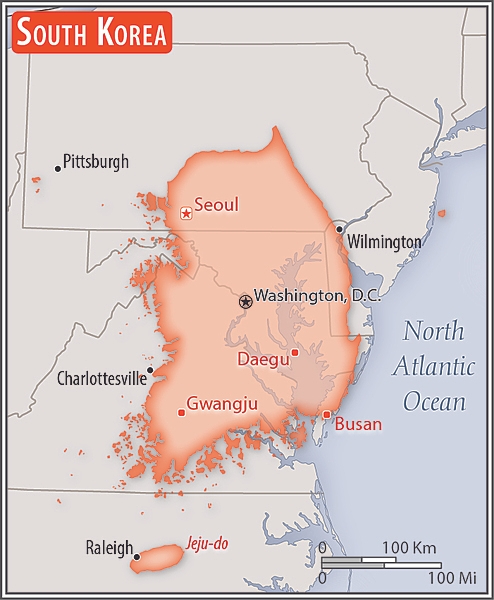
Area – comparative
slightly smaller than Pennsylvania; slightly larger than Indiana
Area comparison map:
Land boundaries
total: 237 km
border countries (1): North Korea 237 km
Coastline
2,413 km
Maritime claims
territorial sea: 12 nm; between 3 nm and 12 nm in the Korea Strait
contiguous zone: 24 nm
exclusive economic zone: 200 nm
continental shelf: not specified
Climate
temperate, with rainfall heavier in summer than winter; cold winters
Terrain
mostly hills and mountains; wide coastal plains in west and south
Elevation
highest point: Halla-san 1,950 m
lowest point: Sea of Japan 0 m
mean elevation: 282 m
Natural resources
coal, tungsten, graphite, molybdenum, lead, hydropower potential
Land use
agricultural land: 16.2% (2022 est.)
arable land: 13.5% (2022 est.)
permanent crops: 2.1% (2022 est.)
permanent pasture: 0.6% (2022 est.)
forest: 64.2% (2022 est.)
other: 19.6% (2022 est.)
Irrigated land
7,780 sq km (2012)
Population distribution
the population is primarily concentrated in the lowland areas, where density is high; Gyeonggi Province in the northwest, which surrounds the capital of Seoul and contains the port of Incheon, is the most densely populated province; Gangwon in the northeast is the least populated
Natural hazards
occasional typhoons bring high winds and floods; low-level seismic activity common in southwest
volcanism: Halla (1,950 m) is considered historically active although it has not erupted in many centuries
Geography – note
strategic location on Korea Strait; about 3,000 mostly small and uninhabited islands lie off the western and southern coasts
People and Society
Population
total: 52,081,799 (2024 est.)
male: 26,119,111
female: 25,962,688
comparison rankings: total 28; female 28; male 28
Nationality
noun: Korean(s)
adjective: Korean
Ethnic groups
homogeneous
Languages
Korean, English
major-language sample(s):
월드 팩트북, 필수적인 기본 정보 제공처 (Korean)
The World Factbook, the indispensable source for basic information.
Korean audio sample:
Religions
Protestant 17%, Buddhist 16%, Catholic 6%, none 60% (2021 est.)
note: many people also carry on at least some Confucian traditions and practices
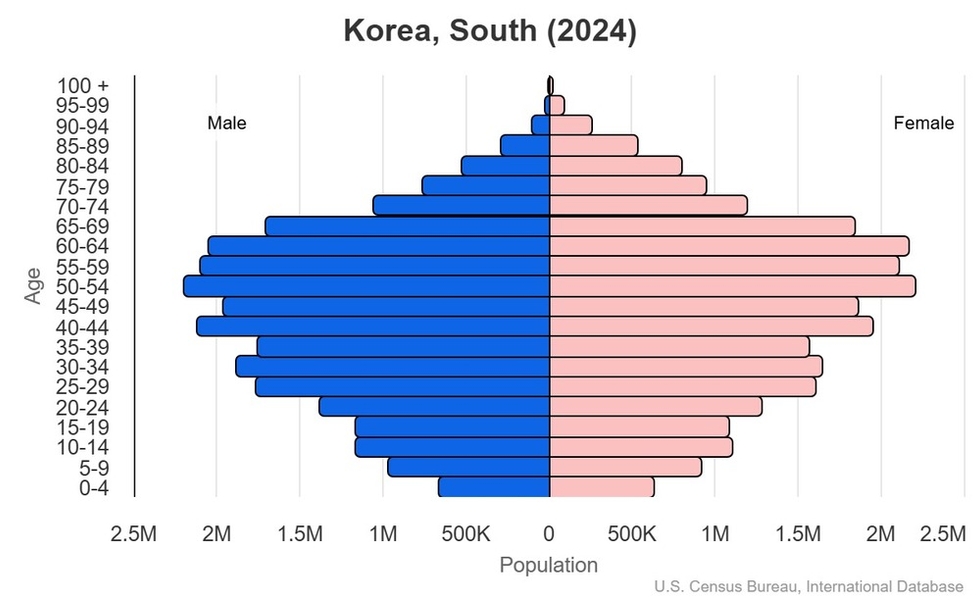
Age structure
0-14 years: 11.3% (male 3,024,508/female 2,873,523)
15-64 years: 69.4% (male 18,653,915/female 17,465,817)
65 years and over: 19.3% (2024 est.) (male 4,440,688/female 5,623,348)
2024 population pyramid:
Dependency ratios
total dependency ratio: 43.6 (2024 est.)
youth dependency ratio: 15.2 (2024 est.)
elderly dependency ratio: 28.4 (2024 est.)
potential support ratio: 3.5 (2024 est.)
Median age
total: 45.5 years (2024 est.)
male: 44 years
female: 47.3 years
comparison ranking: total 15
Population growth rate
0.21% (2024 est.)
comparison ranking: 175
Birth rate
7 births/1,000 population (2024 est.)
comparison ranking: 223
Death rate
7.4 deaths/1,000 population (2024 est.)
comparison ranking: 105
Net migration rate
2.6 migrant(s)/1,000 population (2024 est.)
comparison ranking: 43
Population distribution
the population is primarily concentrated in the lowland areas, where density is high; Gyeonggi Province in the northwest, which surrounds the capital of Seoul and contains the port of Incheon, is the most densely populated province; Gangwon in the northeast is the least populated
Urbanization
urban population: 81.5% of total population (2023)
rate of urbanization: 0.31% annual rate of change (2020-25 est.)
Major urban areas – population
9.988 million SEOUL (capital), 3.472 million Busan, 2.849 million Incheon, 2.181 million Daegu (Taegu), 1.577 million Daejon (Taejon), 1.529 million Gwangju (Kwangju) (2023)
Sex ratio
at birth: 1.05 male(s)/female
0-14 years: 1.05 male(s)/female
15-64 years: 1.07 male(s)/female
65 years and over: 0.79 male(s)/female
total population: 1.01 male(s)/female (2024 est.)
Mother’s mean age at first birth
32.2 years (2019 est.)
Maternal mortality ratio
8 deaths/100,000 live births (2020 est.)
comparison ranking: 153
Infant mortality rate
total: 2.8 deaths/1,000 live births (2024 est.)
male: 3 deaths/1,000 live births
female: 2.6 deaths/1,000 live births
comparison ranking: total 212
Life expectancy at birth
total population: 83.4 years (2024 est.)
male: 80.3 years
female: 86.6 years
comparison ranking: total population 15
Total fertility rate
1.12 children born/woman (2024 est.)
comparison ranking: 226
Gross reproduction rate
0.55 (2024 est.)
Contraceptive prevalence rate
82.3% (2018)
note: percent of women aged 20-49
Drinking water source
improved:
urban: NA
rural: NA
total: 99.9% of population
unimproved:
urban: NA
rural: NA
total: 0.1% of population (2020 est.)
Health expenditure
9.7% of GDP (2022)
14.1% of national budget (2022 est.)
Physician density
2.61 physicians/1,000 population (2022)
Hospital bed density
12.8 beds/1,000 population (2021 est.)
Sanitation facility access
improved:
urban: NA
rural: NA
total: 99.9% of population
unimproved:
urban: NA
rural: NA
total: 0.1% of population (2020 est.)
Obesity – adult prevalence rate
4.7% (2016)
comparison ranking: 184
Alcohol consumption per capita
total: 7.74 liters of pure alcohol (2019 est.)
beer: 1.72 liters of pure alcohol (2019 est.)
wine: 0.15 liters of pure alcohol (2019 est.)
spirits: 0.22 liters of pure alcohol (2019 est.)
other alcohols: 5.66 liters of pure alcohol (2019 est.)
comparison ranking: total 48
Tobacco use
total: 17.4% (2025 est.)
male: 29.7% (2025 est.)
female: 5.2% (2025 est.)
comparison ranking: total 88
Children under the age of 5 years underweight
0.3% (2020)
comparison ranking: 116
Currently married women (ages 15-49)
52.9% (2023 est.)
Education expenditure
4.9% of GDP (2021 est.)
comparison ranking: Education expenditure (% GDP) 69
Literacy
total population: 98.8% NA
male: 99.2% NA
female: 98.4% NA
School life expectancy (primary to tertiary education)
total: 17 years
male: 17 years
female: 16 years (2020)
Environment
Environment – current issues
air pollution in large cities; acid rain; water pollution from sewage and industrial effluents; drift-net fishing; solid waste disposal; transboundary air pollution from China
Environment – international agreements
party to: Antarctic-Environmental Protection, Antarctic-Marine Living Resources, Antarctic Treaty, Biodiversity, Climate Change, Climate Change-Kyoto Protocol, Climate Change-Paris Agreement, Comprehensive Nuclear Test Ban, Desertification, Endangered Species, Environmental Modification, Hazardous Wastes, Law of the Sea, Marine Dumping-London Convention, Marine Dumping-London Protocol, Nuclear Test Ban, Ozone Layer Protection, Ship Pollution, Tropical Timber 2006, Wetlands, Whaling
signed, but not ratified: none of the selected agreements
Climate
temperate, with rainfall heavier in summer than winter; cold winters
Land use
agricultural land: 16.2% (2022 est.)
arable land: 13.5% (2022 est.)
permanent crops: 2.1% (2022 est.)
permanent pasture: 0.6% (2022 est.)
forest: 64.2% (2022 est.)
other: 19.6% (2022 est.)
Urbanization
urban population: 81.5% of total population (2023)
rate of urbanization: 0.31% annual rate of change (2020-25 est.)
Air pollutants
particulate matter emissions: 24.04 micrograms per cubic meter (2019 est.)
carbon dioxide emissions: 620.3 megatons (2016 est.)
methane emissions: 30.28 megatons (2020 est.)
Waste and recycling
municipal solid waste generated annually: 18,218,975 tons (2014 est.)
municipal solid waste recycled annually: 10,567,006 tons (2014 est.)
percent of municipal solid waste recycled: 58% (2014 est.)
Total water withdrawal
municipal: 6.672 billion cubic meters (2020 est.)
industrial: 4.45 billion cubic meters (2020 est.)
agricultural: 15.96 billion cubic meters (2020 est.)
Total renewable water resources
69.7 billion cubic meters (2020 est.)
Geoparks
total global geoparks and regional networks: 5
global geoparks and regional networks: Cheongsong; Hantangang; Jeju Island; Jeonbuk West Coast; Mudeungsan (2023)
Government
Country name
conventional long form: Republic of Korea
conventional short form: South Korea
local long form: Taehan-min’guk
local short form: Han’guk
abbreviation: ROK
etymology: derived from the Chinese name for Goryeo, which was the Korean dynasty that united the peninsula in the 10th century A.D.; the South Korean name “Han’guk” derives from the long form, “Taehan-min’guk,” which is itself a derivation from “Daehan-je’guk,” which means “the Great Han Empire”
Government type
presidential republic
Capital
name: Seoul
geographic coordinates: 37 33 N, 126 59 E
time difference: UTC+9 (14 hours ahead of Washington, DC, during Standard Time)
etymology: the name originates from the Korean word meaning “capital city;” it was the capital of the unified Korea from 1392 to 1910
note: Sejong, located some 120 km (75 mi) south of Seoul, serves as an administrative capital for segments of the South Korean government
Administrative divisions
9 provinces (do, singular and plural), 6 metropolitan cities (gwangyeoksi, singular and plural), 1 special city (teugbyeolsi), and 1 special self-governing city (teukbyeoljachisi)
provinces: Chungcheongbuk-do (North Chungcheong), Chungcheongnam-do (South Chungcheong), Gangwon-do, Gyeongsangbuk-do (North Gyeongsang), Gyeonggi-do, Gyeongsangnam-do (South Gyeongsang), Jeju-do (Jeju), Jeollabuk-do (North Jeolla), Jeollanam-do (South Jeolla)
metropolitan cities: Busan (Pusan), Daegu (Taegu), Daejeon (Taejon), Gwangju (Kwangju), Incheon (Inch’on), Ulsan
special city: Seoul
special self-governing city: Sejong
Legal system
mixed system combining European civil law, Anglo-American law, and Chinese classical thought
Constitution
history: several previous; latest passed by National Assembly 12 October 1987, approved in referendum 28 October 1987, effective 25 February 1988
amendment process: proposed by the president or by majority support of the National Assembly membership; passage requires at least two-thirds majority vote by the Assembly membership, approval in a referendum by more than one half of the votes by more than one half of eligible voters, and promulgation by the president
International law organization participation
has not submitted an ICJ jurisdiction declaration; accepts ICCt jurisdiction
Citizenship
citizenship by birth: no
citizenship by descent only: at least one parent must be a citizen of South Korea
dual citizenship recognized: no
residency requirement for naturalization: 5 years
Suffrage
18 years of age; universal; note – the voting age was lowered from 19 to 18 beginning with the 2020 national election
Executive branch
chief of state: President LEE Jae-myung (since 4 June 2025)
head of government: Prime Minister KIM Min-seok (since 3 July 2025)
cabinet: State Council appointed by the president on the prime minister’s recommendation
election/appointment process: president directly elected by simple-majority popular vote for a single 5-year term; prime minister appointed by president with consent of the National Assembly
most recent election date: 3 June 2025 (special snap election in the wake of the impeachment of former President YOON Suk-yeol)
election results: 2025: LEE Jae-myung elected president; LEE Jae-myung (DPK) 49.4%, KIM Moon-soo (PPP) 41.2%, LEE Jun-seok (New Reform Party) 8.3%
2022: YOON Suk-yeol elected president; YOON Suk-yeol (PPP) 48.6%, LEE Jae-myung (DPK) 47.8%; other 3.6%
expected date of next election: 2030
note 1: the president is both chief of state and head of government; the prime minister serves as the principal executive assistant to the president, similar to the role of a vice president
note 2: President LEE Jae-myung has nominated KIM Min Seok to replace Acting Prime Minister LEE
Legislative branch
legislature name: National Assembly (Kuk Hoe)
legislative structure: unicameral
number of seats: 300 (all directly elected)
electoral system: mixed system
scope of elections: full renewal
term in office: 4 years
most recent election date: 4/10/2024
parties elected and seats per party: Democratic Party of Korea (161); People Power Party (90); People Future Party (18); Other (31)
percentage of women in chamber: 20.3%
expected date of next election: April 2028
Judicial branch
highest court(s): Supreme Court (consists of a chief justice and 13 justices); Constitutional Court (consists of a court head and 8 justices)
judge selection and term of office: Supreme Court chief justice appointed by the president with the consent of the National Assembly; other justices appointed by the president on the recommendation of the chief justice and consent of the National Assembly; position of the chief justice is a 6-year nonrenewable term; other justices serve 6-year renewable terms; Constitutional Court justices appointed – 3 by the president, 3 by the National Assembly, and 3 by the Supreme Court chief justice; court head serves until retirement at age 70, while other justices serve 6-year renewable terms with mandatory retirement at age 65
subordinate courts: High Courts; District Courts; Branch Courts (organized under the District Courts); specialized courts for family and administrative issues
Political parties
Basic Income Party
Democratic Party of Korea or DPK
New Future Party
New Reform Party
Open Democratic Party or ODP
People Power Party or PPP
Progressive Party or Jinbo Party
Rebuilding Korea Party
Social Democratic Party
note: the Democratic Alliance coalition consists of the DPK and the smaller Basic Income, Jinbo, Open Democratic, and Social Democratic parties, as well as two independents; for the 2024 election, the Basic Income Party, the ODP, and the Social Democratic Party formed the New Progressive Alliance
Diplomatic representation in the US
chief of mission: Ambassador CHO Hyundong (since 19 April 2023)
chancery: 2450 Massachusetts Avenue NW, Washington, DC 20008
telephone: [1] (202) 939-5600
FAX: [1] (202) 797-0595
email address and website:
[email protected]
https://overseas.mofa.go.kr/us-en/index.do
consulate(s) general: Anchorage (AK), Atlanta, Boston, Chicago, Dallas, Hagatna (Guam), Honolulu, Houston, Los Angeles, New York, San Francisco, Seattle, Philadelphia
Diplomatic representation from the US
chief of mission: Ambassador (vacant); Chargé d’Affaires Ambassador Joseph (Joe) YUN (since January 2025)
embassy: 188 Sejong-daero, Jongno-gu, Seoul
mailing address: 9600 Seoul Place, Washington, DC 20521-9600
telephone: [82] (2) 397-4114
FAX: [82] (2) 397-4101
email address and website:
[email protected]
https://kr.usembassy.gov/
consulate(s): Busan
International organization participation
ADB, AfDB (nonregional member), APEC, Arctic Council (observer), ARF, ASEAN (dialogue partner), Australia Group, BIS, CABEI, CD, CICA, CP, EAS, EBRD, FAO, FATF, G-20, IADB, IAEA, IBRD, ICAO, ICC (national committees), ICCt, ICRM, IDA, IEA, IFAD, IFC, IFRCS, IHO, ILO, IMF, IMO, IMSO, Interpol, IOC, IOM, IPU, ISO, ITSO, ITU, ITUC (NGOs), LAIA (observer), MIGA, MINURSO, MINUSTAH, NEA, NSG, OAS (observer), OECD, OPCW, OSCE (partner), Pacific Alliance (observer), Paris Club (associate), PCA, PIF (partner), SAARC (observer), SICA (observer), UN, UNAMID, UNCTAD, UNESCO, UNHCR, UNHRC, UNIDO, UNIFIL, UNISFA, UNMIL, UNMISS, UNMOGIP, UNOCI, UNOOSA, UNWTO, UPU, Wassenaar Arrangement, WCO, WHO, WIPO, WMO, WTO, ZC
Independence
15 August 1945 (from Japan)
National holiday
Liberation Day, 15 August (1945)
Flag description
white with a red-and-blue yin-yang symbol in the center;a black trigram (kwae) from the ancient I Ching (Book of Changes) is in each corner of the white field; the flag is called Taegukki; white is a traditional Korean color and represents peace and purity; the blue represents the negative cosmic forces of the yin, and the red symbolizes the opposite positive forces of the yang; each trigram stands for one of the universal elements, which together express the principle of movement and harmony
National symbol(s)
taegeuk (yin-yang symbol), Rose of Sharon (Hibiscus syriacus), Siberian tiger
National color(s)
red, white, blue, black
National anthem
name: “Aegukga” (Patriotic Song)
lyrics/music: YUN Ch’i-Ho or AN Ch’ang-Ho/AHN Eaktay
note: adopted 1948, well-known by 1910; both North Korea’s and South Korea’s anthems share the same name and have a vaguely similar melody but have different lyrics
National heritage
total World Heritage Sites: 16 (14 cultural, 2 natural)
selected World Heritage Site locales: Jeju Volcanic Island and Lava Tubes (n); Changdeokgung Palace Complex (c); Jongmyo Shrine (c); Seokguram Grotto and Bulguksa Temple (c); Hwaseong Fortress (c); Gochang, Hwasun, and Ganghwa Dolmen Sites (c); Gyeongju Historic Areas (c); Namhansanseong (c); Baekje Historic Areas (c); Sansa, Buddhist Mountain Monasteries in Korea (c); Royal Tombs of the Joseon Dynasty (c)
Economy
Economic overview
high-income, export- and technology-oriented East Asian economy; manufacturing led by semiconductor and automotive industries; slow growth amid declining construction investment, export risks, and recent political instability; aging workforce; increased restraint in fiscal policy while maintaining industry support initiatives
Real GDP (purchasing power parity)
$2.615 trillion (2023 est.)
$2.58 trillion (2022 est.)
$2.515 trillion (2021 est.)
note: data in 2021 dollars
comparison ranking: 14
Real GDP growth rate
1.36% (2023 est.)
2.61% (2022 est.)
4.3% (2021 est.)
note: annual GDP % growth based on constant local currency
comparison ranking: 154
Real GDP per capita
$50,600 (2023 est.)
$49,900 (2022 est.)
$48,600 (2021 est.)
note: data in 2021 dollars
comparison ranking: 41
GDP (official exchange rate)
$1.713 trillion (2023 est.)
note: data in current dollars at official exchange rate
Inflation rate (consumer prices)
2.3% (2024 est.)
3.6% (2023 est.)
5.1% (2022 est.)
note: annual % change based on consumer prices
comparison ranking: 72
GDP – composition, by sector of origin
agriculture: 1.6% (2023 est.)
industry: 31.6% (2023 est.)
services: 58.4% (2023 est.)
note: figures may not total 100% due to non-allocated consumption not captured in sector-reported data
comparison rankings: services 102; industry 56; agriculture 171
GDP – composition, by end use
household consumption: 48.9% (2023 est.)
government consumption: 18.9% (2023 est.)
investment in fixed capital: 32.2% (2023 est.)
investment in inventories: 0% (2023 est.)
exports of goods and services: 44% (2023 est.)
imports of goods and services: -43.9% (2023 est.)
note: figures may not total 100% due to rounding or gaps in data collection
Agricultural products
rice, vegetables, cabbages, milk, onions, pork, chicken, eggs, tangerines/mandarins, potatoes (2023)
note: top ten agricultural products based on tonnage
Industries
electronics, telecommunications, automobile production, chemicals, shipbuilding, steel
Industrial production growth rate
1.14% (2023 est.)
note: annual % change in industrial value added based on constant local currency
comparison ranking: 127
Labor force
29.647 million (2024 est.)
note: number of people ages 15 or older who are employed or seeking work
comparison ranking: 23
Unemployment rate
2.6% (2024 est.)
2.7% (2023 est.)
2.9% (2022 est.)
note: % of labor force seeking employment
comparison ranking: 32
Youth unemployment rate (ages 15-24)
total: 5.9% (2024 est.)
male: 6% (2024 est.)
female: 5.8% (2024 est.)
note: % of labor force ages 15-24 seeking employment
comparison ranking: total 165
Population below poverty line
14.4% (2016 est.)
Gini Index coefficient – distribution of family income
32.9 (2021 est.)
note: index (0-100) of income distribution; higher values represent greater inequality
comparison ranking: 104
Average household expenditures
on food: 12.3% of household expenditures (2023 est.)
on alcohol and tobacco: 1.5% of household expenditures (2023 est.)
Household income or consumption by percentage share
lowest 10%: 2.9% (2021 est.)
highest 10%: 24.6% (2021 est.)
note: % share of income accruing to lowest and highest 10% of population
Remittances
0.45% of GDP (2023 est.)
0.47% of GDP (2022 est.)
0.43% of GDP (2021 est.)
note: personal transfers and compensation between resident and non-resident individuals/households/entities
Budget
revenues: $542.275 billion (2022 est.)
expenditures: $563.156 billion (2022 est.)
note: central government revenues (excluding grants) and expenses converted to US dollars at average official exchange rate for year indicated
Public debt
52.3% of GDP (2023 est.)
note: central government debt as a % of GDP
comparison ranking: 99
Taxes and other revenues
15.7% (of GDP) (2023 est.)
note: central government tax revenue as a % of GDP
comparison ranking: 129
Current account balance
$99.043 billion (2024 est.)
$32.822 billion (2023 est.)
$25.829 billion (2022 est.)
note: balance of payments – net trade and primary/secondary income in current dollars
comparison ranking: 6
Exports
$835.149 billion (2024 est.)
$769.243 billion (2023 est.)
$825.961 billion (2022 est.)
note: balance of payments – exports of goods and services in current dollars
comparison ranking: 9
Exports – partners
China 25%, USA 18%, Hong Kong 4%, Japan 4%, Taiwan 4% (2023)
note: top five export partners based on percentage share of exports
Exports – commodities
integrated circuits, cars, refined petroleum, plastics, machine parts (2023)
note: top five export commodities based on value in dollars
Imports
$758.724 billion (2024 est.)
$758.41 billion (2023 est.)
$817.594 billion (2022 est.)
note: balance of payments – imports of goods and services in current dollars
comparison ranking: 10
Imports – partners
China 31%, USA 13%, Japan 9%, Germany 5%, Australia 4% (2023)
note: top five import partners based on percentage share of imports
Imports – commodities
integrated circuits, natural gas, crude petroleum, machinery, cars (2023)
note: top five import commodities based on value in dollars
Reserves of foreign exchange and gold
$409.457 billion (2024 est.)
$420.93 billion (2023 est.)
$423.366 billion (2022 est.)
note: holdings of gold (year-end prices)/foreign exchange/special drawing rights in current dollars
comparison ranking: 9
Exchange rates
South Korean won (KRW) per US dollar –
Exchange rates:
1,363.375 (2024 est.)
1,305.662 (2023 est.)
1,291.447 (2022 est.)
1,143.952 (2021 est.)
1,180.266 (2020 est.)
Energy
Electricity access
electrification – total population: 100% (2022 est.)
Electricity
installed generating capacity: 151.139 million kW (2023 est.)
consumption: 575.359 billion kWh (2023 est.)
transmission/distribution losses: 19.688 billion kWh (2023 est.)
comparison rankings: transmission/distribution losses 189; consumption 7; installed generating capacity 10
Electricity generation sources
fossil fuels: 61.5% of total installed capacity (2023 est.)
nuclear: 30.3% of total installed capacity (2023 est.)
solar: 5.3% of total installed capacity (2023 est.)
wind: 0.6% of total installed capacity (2023 est.)
hydroelectricity: 0.4% of total installed capacity (2023 est.)
tide and wave: 0.1% of total installed capacity (2023 est.)
biomass and waste: 1.8% of total installed capacity (2023 est.)
Nuclear energy
Number of operational nuclear reactors: 26 (2025)
Number of nuclear reactors under construction: 2 (2025)
Net capacity of operational nuclear reactors: 25.57GW (2025 est.)
Percent of total electricity production: 30.7% (2023 est.)
Number of nuclear reactors permanently shut down: 2 (2025)
Coal
production: 16.081 million metric tons (2023 est.)
consumption: 136.817 million metric tons (2023 est.)
exports: 500 metric tons (2023 est.)
imports: 122.845 million metric tons (2023 est.)
proven reserves: 326 million metric tons (2023 est.)
Petroleum
total petroleum production: 38,000 bbl/day (2023 est.)
refined petroleum consumption: 2.542 million bbl/day (2024 est.)
Natural gas
production: 55.127 million cubic meters (2021 est.)
consumption: 57.314 billion cubic meters (2023 est.)
exports: 93.639 million cubic meters (2022 est.)
imports: 60.025 billion cubic meters (2023 est.)
proven reserves: 7.079 billion cubic meters (2021 est.)
Carbon dioxide emissions
644.231 million metric tonnes of CO2 (2023 est.)
from coal and metallurgical coke: 275.411 million metric tonnes of CO2 (2023 est.)
from petroleum and other liquids: 248.599 million metric tonnes of CO2 (2023 est.)
from consumed natural gas: 120.222 million metric tonnes of CO2 (2023 est.)
comparison ranking: total emissions 9
Energy consumption per capita
234.668 million Btu/person (2023 est.)
comparison ranking: 13
Communications
Telephones – fixed lines
total subscriptions: 22.155 million (2023 est.)
subscriptions per 100 inhabitants: 43 (2023 est.)
comparison ranking: total subscriptions 11
Telephones – mobile cellular
total subscriptions: 83.9 million (2023 est.)
subscriptions per 100 inhabitants: 149 (2022 est.)
comparison ranking: total subscriptions 22
Broadcast media
multiple national TV networks, with 2 of the 3 largest networks publicly operated; the largest privately owned network, Seoul Broadcasting Service (SBS), has ties with other commercial TV networks; cable and satellite TV subscription services available; publicly operated radio broadcast networks and many privately owned radio broadcasting networks, each with multiple affiliates, and independent local stations
Internet country code
.kr
Internet users
percent of population: 97% (2023 est.)
Broadband – fixed subscriptions
total: 24.1 million (2023 est.)
subscriptions per 100 inhabitants: 47 (2023 est.)
comparison ranking: total 11
Transportation
Civil aircraft registration country code prefix
HL
Airports
92 (2025)
comparison ranking: 59
Heliports
1,280 (2025)
comparison ranking: 4
Railways
total: 3,979 km (2016)
standard gauge: 3,979 km (2016) 1.435-m gauge (2,727 km electrified)
Merchant marine
total: 2,149 (2023)
by type: bulk carrier 93, container ship 115, general cargo 362, oil tanker 219, other 1,360
comparison ranking: total 12
Ports
total ports: 15 (2024)
large: 2
medium: 5
small: 4
very small: 4
ports with oil terminals: 10
key ports: Busan, Gwangyang Hang, Inchon, Masan, Mokpo, Pyeongtaek Hang, Ulsan
Military and Security
Military and security forces
Armed Forces of the Republic of Korea: Republic of Korea Army (ROKA), Republic of Korea Navy (ROKN, includes Marine Corps, ROKMC), Republic of Korea Air Force (ROKAF)
Ministry of Maritime Affairs and Fisheries: Korea Coast Guard; Ministry of Interior and Safety: Korean National Police Agency (2025)
Military expenditures
2.3% of GDP (2025 est.)
2.3% of GDP (2024 est.)
2.4% of GDP (2023 est.)
2.4% of GDP (2022 est.)
2.4% of GDP (2021 est.)
Military and security service personnel strengths
approximately 500,000 active Armed Forces (365,000 Army; 70,000 Navy, including about 30,000 Marines; 65,000 Air Force) (2025)
Military equipment inventories and acquisitions
the South Korean military is equipped with a mix of mostly modern domestically produced and imported weapons systems, particularly from the US; South Korea’s defense industry produces a wide range of military hardware for both domestic use and export, including armored fighting vehicles, artillery, aircraft, missiles, and naval ships; it also jointly produces equipment with other countries (2024)
Military service age and obligation
18-35 years of age for compulsory military service for all men; minimum conscript service obligation varies by service – 18 months (Army, Marines, auxiliary police), 20 months (Navy, conscripted firefighters), 21 months (Air Force, social service), 36 months for alternative service; 18-29 years of age for voluntary military service for men and women (2024)
note 1: women, in service since 1950, are able to serve in all branches and as of 2024 more than 15,000 served in the armed forces
note 2: the military brings on over 200,000 conscripts each year
Military deployments
250 Lebanon (UNIFIL); 275 South Sudan (UNMISS); 170 United Arab Emirates; note – since 2009, South Korea has kept a naval flotilla with approximately 300 personnel in the waters off of the Horn of Africa and the Arabian Peninsula (2024)
Military – note
the South Korean military is primarily focused on the threat from North Korea; it also deploys abroad for multinational missions, including peacekeeping and other security operations
South Korea’s primary defense partner is the US, and the 1953 US-South Korea Mutual Defense Treaty is a cornerstone of the country’s national security; the Treaty committed the US to provide assistance in the event of an attack and gave the US permission to station land, air, and sea forces in and about the territory of South Korea as determined by mutual agreement; the US maintains approximately 28,000 military personnel in the country and regularly conducts bilateral exercises with the South Korean military; South Korea has Major Non-NATO Ally (MNNA) status with the US, a designation under US law that provides foreign partners with certain benefits in the areas of defense trade and security cooperation; the South Korean military has assisted the US in conflicts in Afghanistan (5,000 troops; 2001-2014), Iraq (20,000 troops; 2003-2008), and Vietnam (325,000 troops; 1964-1973)
in 2016, South Korea concluded an agreement with the EU for participation in EU Common Security and Defense Policy (CSDP) missions and operations, such as EU counter-piracy operations off the coast of East Africa; South Korea has been engaged with NATO since 2005 and is considered by NATO to be a global partner; in 2022, South Korea established its Mission to NATO to further institutionalize its cooperative relationship; it has participated in NATO-led missions and exercises, including in Afghanistan and in the Gulf of Aden (2024)
Space
Space agency/agencies
Korea AeroSpace Administration (KASA; established 2024); Korea Aerospace Research Institute (KARI; established 1989 and previously acted as South Korea’s space agency); Korea Advanced Institute of Science and Technology (KAIST); Korean Astronomy and Space Science Institute (KASI; funded by the South Korean Government) (2024)
note 1: the South Korean space program works closely with the Agency for Defense Development (ADD), a national agency for research and development in defense technology established in 1970
note 2: in January 2022, the South Korean military announced the formation of a space branch under its Joint Chiefs of Staff to coordinate the development of space and space-enabled capabilities across the Army, Navy and Air Force
Space launch site(s)
Naro Space Center (South Jeolla province) (2024)
Space program overview
has a growing and ambitious space program focused on developing satellites, satellite/space launch vehicles (SLVs), and interplanetary probes; has a national space strategy; manufacturers and operates satellites, including those with communications, remote sensing (RS), scientific, and multipurpose capabilities; manufactures and launches SLVs; developing interplanetary space vehicles, including orbital probes and landers; participates in international space programs and has relations with an array of foreign space agencies and industries, including those of Australia, the European Space Agency (ESA) and its member states (particularly France, Germany, Italy, Spain, UK), India, Israel, Japan, Peru, Russia, UAE, and especially the US; has a robust and growing commercial space industry that works closely with government space program in the development of satellites and space launch capabilities; the South Korean Government has said it aims to capture 10% of the global space market by 2045 (2024)
note: further details about the key activities, programs, and milestones of the country’s space program, as well as government spending estimates on the space sector, appear in the Space Programs reference guide
Transnational Issues
Refugees and internally displaced persons
stateless persons: 202 (2022)
Illicit drugs
precursor chemicals used for illicit drugs, such as acetic anhydride, pseudoephedrine, and ephedrine, imported from the United States, Japan, India, and China and then either resold within South Korea or smuggled into other countries