


Portuguese ships began arriving in 1513. In the 1550s, Portuguese paying tribute to China settled in Macau, which became the official entrepôt for all international trade with China and Japan and the first European settlement in the Far East. The first governor was appointed in the 17th century, but the Portuguese remained largely under the control of the Chinese. In the 1930s and ’40s Macau was declared a neutral territory during the Sino-Japanese War and World War II and became a refuge for both Chinese and Europeans. Portugal officially made Macau an overseas province in 1951.
In April 1987, Portugal and China reached an agreement to return Macau to Chinese rule in 1999, using the Hong Kong Joint Declaration between China and the UK as a model. In this agreement, China promised that, under its “one country, two systems” formula, China’s political and economic system would not be imposed on Macau, and that Macau would enjoy a “high degree of autonomy” in all matters except foreign affairs and defense for the next 50 years. However, after China’s multi-year crackdown against the pro-democracy movement in nearby Hong Kong, the governments of China and the Macau Special Administrative Region worked to limit Macau’s political autonomy by suppressing opposition activity in the 2021 legislative elections.TipVisit the Definitions and Notes page to view a description of each topic.Definitions and Notes
Geography
Location
Eastern Asia, bordering the South China Sea and China
Geographic coordinates
22 10 N, 113 33 E
Map references
Southeast Asia
Area
total : 28 sq km
land: 28.2 sq km
water: 0 sq km
comparison ranking: total 235
Area – comparative
less than one-sixth the size of Washington, D.C.
Land boundaries
total: 3 km
regional borders (1): China 3 km
Coastline
41 km
Maritime claims
not specified
Climate
subtropical; marine with cool winters, warm summers
Terrain
generally flat
Elevation
highest point: Alto Coloane 172 m
lowest point: South China Sea 0 m
Natural resources
NEGL
Land use
agricultural land: 0% (2022 est.)
forest: 0% (2022 est.)
other: 100% (2022 est.)
Irrigated land
0 sq km (2012)
Population distribution
population fairly equally distributed
Natural hazards
typhoons
Geography – note
primarily urban; an area of land reclaimed from the sea measuring 5.2 sq km (2 sq mi) and known as Cotai now connects the islands of Coloane and Taipa; the island area is connected to the mainland peninsula by three bridges
People and Society
Population
total: 644,426 (2024 est.)
male: 304,988
female: 339,438
comparison rankings: total 170; female 168; male 170
Nationality
noun: Chinese
adjective: Chinese
Ethnic groups
Chinese 89.4%, Chinese and Portuguese 1%, Portuguese 0.8%, Chinese and non-Portuguese 0.2%, Portuguese and others 0.2%, other 8.5% (2021 est.)
Languages
Cantonese 81%, Mandarin 4.7%, other Chinese dialects 5.4%, English 3.6%, Tagalog 2.9%, Portuguese 0.6%, other 1.8% (2021 est.)
major-language sample(s):
世界概况, 必須擁有的基本資料参考书 (Cantonese)
The World Factbook, the indispensable source for basic information.
note: Chinese and Portuguese are official languages; Macanese or Patua, a Portuguese-based Creole, is also spoken
Cantonese audio sample:
Religions
folk religion 58.9%, Buddhist 17.3%, Christian 7.2%, other 1.2%, none 15.4% (2020 est.)
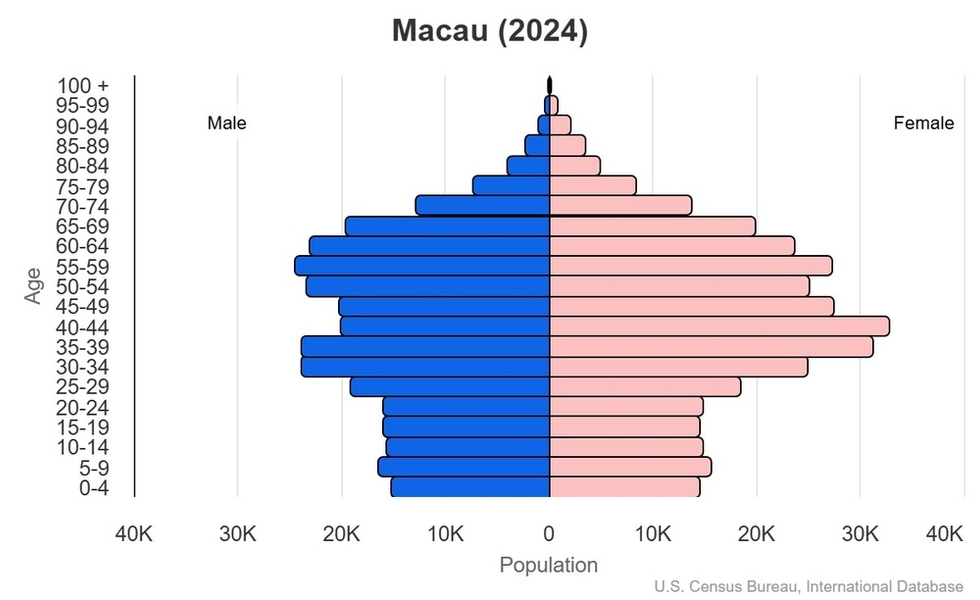
Age structure
0-14 years: 14.4% (male 47,346/female 45,216)
15-64 years: 69.9% (male 210,059/female 240,577)
65 years and over: 15.7% (2024 est.) (male 47,583/female 53,645)
2024 population pyramid:
Dependency ratios
total dependency ratio: 43 (2024 est.)
youth dependency ratio: 20.5 (2024 est.)
elderly dependency ratio: 22.5 (2024 est.)
potential support ratio: 4.5 (2024 est.)
Median age
total: 42.5 years (2024 est.)
male: 41.5 years
female: 43.1 years
comparison ranking: total 43
Population growth rate
0.67% (2024 est.)
comparison ranking: 132
Birth rate
8.6 births/1,000 population (2024 est.)
comparison ranking: 204
Death rate
4.9 deaths/1,000 population (2024 est.)
comparison ranking: 197
Net migration rate
3.1 migrant(s)/1,000 population (2024 est.)
comparison ranking: 35
Population distribution
population fairly equally distributed
Urbanization
urban population: 100% of total population (2023)
rate of urbanization: 1.46% annual rate of change (2020-25 est.)
Major urban areas – population
682,000 Macau (2023)
Sex ratio
at birth: 1.05 male(s)/female
0-14 years: 1.05 male(s)/female
15-64 years: 0.87 male(s)/female
65 years and over: 0.89 male(s)/female
total population: 0.9 male(s)/female (2024 est.)
Infant mortality rate
total: 4.4 deaths/1,000 live births (2024 est.)
male: 4.5 deaths/1,000 live births
female: 4.3 deaths/1,000 live births
comparison ranking: total 183
Life expectancy at birth
total population: 85.3 years (2024 est.)
male: 82.5 years
female: 88.3 years
comparison ranking: total population 3
Total fertility rate
1.24 children born/woman (2024 est.)
comparison ranking: 222
Gross reproduction rate
0.6 (2024 est.)
Contraceptive prevalence rate
NA
Drinking water source
improved:
urban: 100% of population
rural: NA
total: 100% of population
unimproved:
urban: 0% of population
rural: NA
total: 0% of population (2020)
Currently married women (ages 15-49)
53.5% (2023 est.)
Education expenditure
6.3% of GDP (2020 est.)
comparison ranking: Education expenditure (% GDP) 27
Literacy
total population: 97.1%
male: 98.5%
female: 95.9% (2021)
School life expectancy (primary to tertiary education)
total: 18 years
male: 17 years
female: 19 years (2021)
Environment
Environment – current issues
air pollution; coastal water pollution; solid-waste disposal; noise pollution
Climate
subtropical; marine with cool winters, warm summers
Land use
agricultural land: 0% (2022 est.)
forest: 0% (2022 est.)
other: 100% (2022 est.)
Urbanization
urban population: 100% of total population (2023)
rate of urbanization: 1.46% annual rate of change (2020-25 est.)
Air pollutants
carbon dioxide emissions: 2.07 megatons (2016 est.)
Waste and recycling
municipal solid waste generated annually: 377,942 tons (2016 est.)
municipal solid waste recycled annually: 75,588 tons (2014 est.)
percent of municipal solid waste recycled: 20% (2014 est.)
Government
Country name
conventional long form: Macau Special Administrative Region
conventional short form: Macau
official long form: Aomen Tebie Xingzhengqu (Chinese)/ Regiao Administrativa Especial de Macau (Portuguese)
official short form: Aomen (Chinese)/ Macau (Portuguese)
etymology: name derived from the Chinese ama-gao, or “Bay of Ama,” for Ama, the patron goddess of sailors
Government type
executive-led limited democracy; a special administrative region of the People’s Republic of China
Dependency status
special administrative region of the People’s Republic of China
Administrative divisions
none (special administrative region of the People’s Republic of China)
Legal system
civil law system based on the Portuguese model
Constitution
history: previous 1976 (Organic Statute of Macau, under Portuguese authority); latest adopted 31 March 1993, effective 20 December 1999 (Basic Law of the Macau Special Administrative Region of the People’s Republic of China serves as Macau’s constitution)
amendment process: proposed by the Standing Committee of the National People’s Congress (NPC), the People’s Republic of China State Council, and the Macau Special Administrative Region; submittal of proposals to the NPC requires two-thirds majority vote by the Legislative Assembly of Macau, approval by two thirds of Macau’s deputies to the NPC, and consent of the Macau chief executive; final passage requires approval by the NPC
Citizenship
see China
Suffrage
18 years of age in direct elections for some legislative positions, universal for permanent residents living in Macau for the past 7 years; note – indirect elections are limited to organizations registered as “corporate voters” and an election committee for the chief executive drawn from broad regional groupings, municipal organizations, central government bodies, and elected Macau officials
Executive branch
chief of state: President of China XI Jinping (since 14 March 2013)
head of government: Chief Executive Sam Hou FAI (since 20 December 2024)
cabinet: Executive Council appointed by the chief executive
election/appointment process: president indirectly elected by National People’s Congress for a 5-year term (eligible for a second term); chief executive chosen by a 400-member Election Committee for a 5-year term (eligible for a second term)
most recent election date: president: 10 March 2023
chief executive: 13 October 2024
election results:
2024: Sam Hou FAI (unopposed; received 394 out of 400 votes)
2019: HO lat Seng (unopposed; received 392 out of 400 votes)
expected date of next election: president: March 2028
chief executive: 2029
Legislative branch
legislature name: Legislative Assembly (Regiao Administrativa Especial de Macau)
legislative structure: unicameral
number of seats: 33 (14 directly elected, 12 indirectly elected, 7 appointed)
electoral system: mixed
scope of elections: full renewal
term in office: 4 years
most recent election date: 9/12/2021
parties elected and seats per party: United Citizens Association of Macau (ACUM) (3); Union for Development (UPD) (2); Macau-Guangdong Union (UGM) (2); Union for Promoting Progress (UPP) (2); Alliance for a Happy Home (ABL) (2); New Hope (NE) (2); Association of Synergy of Macau (PS) (1)
expected date of next election: September 2025
Judicial branch
highest court(s): Court of Final Appeal of Macau Special Administrative Region (consists of the court president and 2 associate justices)
judge selection and term of office: justices appointed by the Macau chief executive upon the recommendation of an independent commission of judges, lawyers, and “eminent” persons; judge tenure NA
subordinate courts: Court of Second Instance; Court of First instance; Lower Court; Administrative Court
Political parties
Alliance for a Happy Home or ABL
Association of Synergy of Macau (“Synergy Power” or Poder da Singeria) or PS
Macau-Guangdong Union or UGM
New Hope or NE
Union for Development or UPD
Union for Promoting Progress or UPP or UNIPRO
United Citizens Association of Macau or ACUM
note: there is no political party ordinance, so there are no registered political parties; politically active groups register as societies or companies
Diplomatic representation in the US
none (Special Administrative Region of China)
Diplomatic representation from the US
embassy: the US has no offices in Macau; US Consulate General in Hong Kong is accredited to Macau
International organization participation
ICC (national committees), IHO, IMF, IMO (associate), Interpol (subbureau), ISO (correspondent), UNESCO (associate), UNWTO (associate), UPU, WCO, WMO, WTO
Independence
none (special administrative region of China)
National holiday
National Day (anniversary of the Founding of the People’s Republic of China), 1 October (1949); note – 20 December (1999) is celebrated as Macau Special Administrative Region Establishment Day
Flag description
green with a lotus flower above a stylized bridge and water in white, under an arc of five five-pointed gold stars; the lotus is the national floral emblem, and the three petals represent the country’s peninsula and two islands; the five stars echo those on the Chinese flag
National symbol(s)
lotus blossom
National color(s)
green, white, yellow
National anthem
note: as a Special Administrative Region of China, “Yiyongjun Jinxingqu” is the official anthem (see China)
Economy
Economic overview
high-income, Chinese special administrative region economy; known for apparel exports and gambling tourism; currency pegged to Hong Kong dollar; significant recession due to 2015 Chinese anticorruption campaign; COVID-19 further halved economic activity
Real GDP (purchasing power parity)
$71.248 billion (2023 est.)
$40.699 billion (2022 est.)
$50.626 billion (2021 est.)
note: data in 2021 dollars
comparison ranking: 109
Real GDP growth rate
75.06% (2023 est.)
-19.61% (2022 est.)
23.54% (2021 est.)
note: annual GDP % growth based on constant local currency
comparison ranking: 1
Real GDP per capita
$105,000 (2023 est.)
$60,100 (2022 est.)
$74,200 (2021 est.)
note: data in 2021 dollars
comparison ranking: 6
GDP (official exchange rate)
$45.803 billion (2023 est.)
note: data in current dollars at official exchange rate
Inflation rate (consumer prices)
0.5% (2023 est.)
1% (2022 est.)
0% (2021 est.)
note: annual % change based on consumer prices
comparison ranking: 14
GDP – composition, by sector of origin
industry: 5.4% (2023 est.)
services: 91.4% (2023 est.)
note: figures may not total 100% due to non-allocated consumption not captured in sector-reported data
comparison rankings: services 4; industry 212
GDP – composition, by end use
household consumption: 30.1% (2023 est.)
government consumption: 13.8% (2023 est.)
investment in fixed capital: 14.6% (2023 est.)
investment in inventories: 0.9% (2023 est.)
exports of goods and services: 91.4% (2023 est.)
imports of goods and services: -50.7% (2023 est.)
note: figures may not total 100% due to rounding or gaps in data collection
Agricultural products
pork, chicken, beef, eggs, pork offal, pork fat, pepper, beef offal, cattle hides, goose meat (2023)
note: top ten agricultural products based on tonnage
Industries
tourism, gambling, clothing, textiles, electronics, footwear, toys
Industrial production growth rate
6.78% (2023 est.)
note: annual % change in industrial value added based on constant local currency
comparison ranking: 32
Labor force
373,800 (2024 est.)
note: number of people ages 15 or older who are employed or seeking work
comparison ranking: 165
Unemployment rate
2.4% (2024 est.)
2.2% (2023 est.)
2.5% (2022 est.)
note: % of labor force seeking employment
comparison ranking: 26
Youth unemployment rate (ages 15-24)
total: 7.2% (2024 est.)
male: 9.4% (2024 est.)
female: 5.6% (2024 est.)
note: % of labor force ages 15-24 seeking employment
comparison ranking: total 152
Remittances
0.23% of GDP (2023 est.)
0.33% of GDP (2022 est.)
0.24% of GDP (2021 est.)
note: personal transfers and compensation between resident and non-resident individuals/households/entities
Budget
revenues: $5.135 billion (2022 est.)
expenditures: $12.259 billion (2022 est.)
note: central government revenues (excluding grants) and expenses converted to US dollars at average official exchange rate for year indicated
Public debt
0% of GDP (2017 est.)
comparison ranking: 207
Taxes and other revenues
22.8% (of GDP) (2023 est.)
note: central government tax revenue as a % of GDP
comparison ranking: 62
Current account balance
$14.38 billion (2023 est.)
$3.476 billion (2022 est.)
$2.705 billion (2021 est.)
note: balance of payments – net trade and primary/secondary income in current dollars
comparison ranking: 24
Exports
$41.839 billion (2023 est.)
$21.097 billion (2022 est.)
$28.163 billion (2021 est.)
note: balance of payments – exports of goods and services in current dollars
comparison ranking: 71
Exports – partners
Hong Kong 73%, China 6%, USA 6%, Philippines 3%, Singapore 1% (2023)
note: top five export partners based on percentage share of exports
Exports – commodities
jewelry, garments, broadcasting equipment, precious metal watches, video and card games (2023)
note: top five export commodities based on value in dollars
Imports
$23.205 billion (2023 est.)
$20.923 billion (2022 est.)
$23.77 billion (2021 est.)
note: balance of payments – imports of goods and services in current dollars
comparison ranking: 88
Imports – partners
China 36%, Hong Kong 17%, USA 6%, France 6%, Japan 5% (2023)
note: top five import partners based on percentage share of imports
Imports – commodities
jewelry, garments, trunks and cases, broadcasting equipment, electricity (2023)
note: top five import commodities based on value in dollars
Reserves of foreign exchange and gold
$29.392 billion (2024 est.)
$27.771 billion (2023 est.)
$25.971 billion (2022 est.)
note: holdings of gold (year-end prices)/foreign exchange/special drawing rights in current dollars
comparison ranking: 51
Exchange rates
patacas (MOP) per US dollar –
Exchange rates:
8.037 (2024 est.)
8.063 (2023 est.)
8.065 (2022 est.)
8.006 (2021 est.)
7.989 (2020 est.)
Energy
Electricity access
electrification – total population: 100% (2022 est.)
Electricity
installed generating capacity: 427,000 kW (2023 est.)
consumption: 5.659 billion kWh (2023 est.)
imports: 5.327 billion kWh (2023 est.)
transmission/distribution losses: 161.125 million kWh (2023 est.)
comparison rankings: transmission/distribution losses 57; imports 44; consumption 128; installed generating capacity 155
Electricity generation sources
fossil fuels: 58.5% of total installed capacity (2023 est.)
biomass and waste: 41.5% of total installed capacity (2023 est.)
Coal
exports: 600 metric tons (2023 est.)
imports: 7 metric tons (2023 est.)
Petroleum
refined petroleum consumption: 11,000 bbl/day (2023 est.)
Natural gas
consumption: 121.747 million cubic meters (2023 est.)
imports: 121.716 million cubic meters (2023 est.)
Carbon dioxide emissions
1.595 million metric tonnes of CO2 (2023 est.)
from coal and metallurgical coke: -1,239 metric tonnes of CO2 (2023 est.)
from petroleum and other liquids: 1.358 million metric tonnes of CO2 (2023 est.)
from consumed natural gas: 238,000 metric tonnes of CO2 (2023 est.)
comparison ranking: total emissions 164
Energy consumption per capita
64.641 million Btu/person (2023 est.)
comparison ranking: 77
Communications
Telephones – fixed lines
total subscriptions: 87,000 (2023 est.)
subscriptions per 100 inhabitants: 12 (2023 est.)
comparison ranking: total subscriptions 139
Telephones – mobile cellular
total subscriptions: 1.37 million (2023 est.)
subscriptions per 100 inhabitants: 175 (2022 est.)
comparison ranking: total subscriptions 161
Broadcast media
local government dominates broadcast media; 2 TV stations operated by the government, with one broadcasting in Portuguese and the other in Cantonese and Mandarin; 1 cable TV and 4 satellite TV services available; 3 radio stations broadcasting, of which 2 are government-operated (2019)
Internet country code
.mo
Internet users
percent of population: 89% (2023 est.)
Broadband – fixed subscriptions
total: 212,000 (2023 est.)
subscriptions per 100 inhabitants: 30 (2023 est.)
comparison ranking: total 121
Transportation
Civil aircraft registration country code prefix
B-M
Airports
1 (2025)
comparison ranking: 210
Heliports
4 (2025)
comparison ranking: 107
Merchant marine
total: 5 (2023)
by type: other 5
comparison ranking: total 167
Ports
total ports: 1 (2024)
large: 0
medium: 1
small: 0
very small: 0
ports with oil terminals: 1
key ports: Macau
Military and Security
Military and security forces
no regular indigenous military forces; Macau Public Security Police Force
Military – note
defense is the responsibility of China; the Chinese People’s Liberation Army (PLA) maintains a garrison in Macau
Transnational Issues
Trafficking in persons
tier rating: Tier 3 — Macau does not fully meet the minimum standards for the elimination of trafficking and is not making significant efforts to do so, therefore, Macau remained on Tier 3; for more details, go to: https://www.state.gov/reports/2024-trafficking-in-persons-report/macau/
Illicit drugs
Asian organized crime groups involved in drug trafficking and money laundering