Once the center of power for the large Austro-Hungarian Empire, Austria was reduced to a small republic after its defeat in World War I. Nazi Germany annexed Austria in 1938, and the victorious Allies then occupied the country in 1945. As a result, Austria’s status remained unclear for a decade after World War II, until a State Treaty signed in 1955 ended the occupation, recognized Austria’s independence, and forbade unification with Germany. A constitutional law that same year declared the country’s “perpetual neutrality” as a condition for Soviet military withdrawal. Austria joined the EU in 1995, but the obligation to remain neutral kept it from joining NATO, although the country became a member of NATO’s Partnership for Peace program in 1995. Austria entered the EU Economic and Monetary Union in 1999.TipVisit the Definitions and Notes page to view a description of each topic.Definitions and Notes
Geography
Location
Central Europe, north of Italy and Slovenia
Geographic coordinates
47 20 N, 13 20 E
Map references
Europe
Area
total : 83,871 sq km
land: 82,445 sq km
water: 1,426 sq km
comparison ranking: total 114
Area – comparative
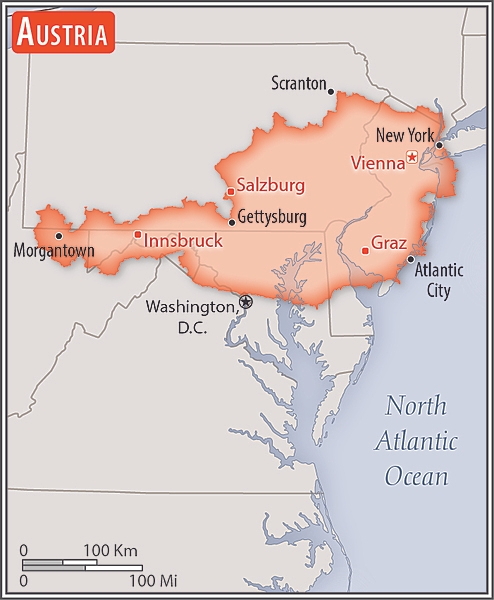
about the size of South Carolina; slightly more than two-thirds the size of Pennsylvania
Area comparison map:
Land boundaries
total: 2,524 km
border countries (8): Czech Republic 402 km; Germany 801 km; Hungary 321 km; Italy 404 km; Liechtenstein 34 km; Slovakia 105 km; Slovenia 299 km; Switzerland 158 km
Coastline
0 km (landlocked)
Maritime claims
none (landlocked)
Climate
temperate; continental, cloudy; cold winters with frequent rain and some snow in lowlands and snow in mountains; moderate summers with occasional showers
Terrain
mostly mountains (Alps) in the west and south; mostly flat or gently sloping along the eastern and northern margins
Elevation
highest point: Grossglockner 3,798 m
lowest point: Neusiedler See 115 m
mean elevation: 910 m
Natural resources
oil, coal, lignite, timber, iron ore, copper, zinc, antimony, magnesite, tungsten, graphite, salt, hydropower
Land use
agricultural land: 31.5% (2022 est.)
arable land: 16% (2022 est.)
permanent crops: 0.8% (2022 est.)
permanent pasture: 14.7% (2022 est.)
forest: 47.2% (2022 est.)
other: 21.3% (2022 est.)
Irrigated land
382 sq km (2016)
Major lakes (area sq km)
fresh water lake(s): Lake Constance (shared with Switzerland and Germany) – 540 sq km
Major rivers (by length in km)
Donau (Danube) (shared with Germany [s], Slovakia, Hungary, Croatia, Serbia, Bulgaria, Ukraine, Moldova, and Romania [m]) – 2,888 km
note: [s] after country name indicates river source; [m] after country name indicates river mouth
Major watersheds (area sq km)
Atlantic Ocean drainage: Rhine-Maas (198,735 sq km), (Black Sea) Danube (795,656 sq km)
Population distribution
the northern and eastern portions of the country are more densely populated; nearly two thirds of the populace lives in urban areas
Natural hazards
landslides; avalanches; earthquakes
Geography – note
note 1: landlocked; strategic location at the crossroads of central Europe with many easily traversable Alpine passes and valleys; major river is the Danube; population is concentrated on eastern lowlands because of steep slopes, poor soils, and low temperatures elsewhere
note 2: the world’s largest and longest ice cave system at 42 km (26 mi) is the Eisriesenwelt (Ice Giants World) inside the Hochkogel mountain near Werfen, about 40 km south of Salzburg; ice caves are bedrock caves that contain year-round ice formations; they differ from glacial caves, which are transient and are formed by melting ice and flowing water within and under glaciers
People and Society
Population
total: 8,967,982 (2024 est.)
male: 4,392,898
female: 4,575,084
comparison rankings: total 100; female 99; male 102
Nationality
noun: Austrian(s)
adjective: Austrian
Ethnic groups
Austrian 80.8%, German 2.6%, Bosnian and Herzegovinian 1.9%, Turkish 1.8%, Serbian 1.6%, Romanian 1.3%, other 10% (2018 est.)
note: data represent population by country of birth
Languages
German (official nationwide) 88.6%, Turkish 2.3%, Serbian 2.2%, Croatian (official in Burgenland) 1.6%, other (includes Slovene, official in southern Carinthia, and Hungarian, official in Burgenland) 5.3% (2001 est.)
major-language sample(s):
Das World Factbook, die unverzichtbare Quelle für grundlegende Informationen. (German)
The World Factbook, the indispensable source for basic information.
German audio sample:
Religions
Roman Catholic 55.2%, Muslim 8.3%, Orthodox 4.9%, Evangelical Christian 3.8%, Jewish 0.1%, other 5.4%, none 22.4% (2021 est.)
note: data on Muslim is a 2016 estimate; data on other/none/unspecified are from 2012-2018 estimates
Age structure
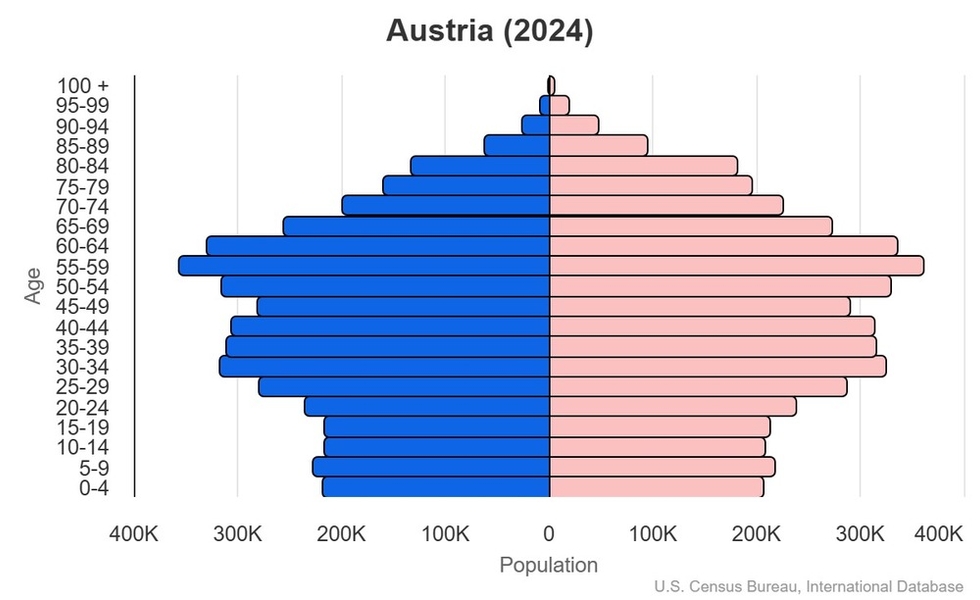
0-14 years: 14.1% (male 648,639/female 616,334)
15-64 years: 64.7% (male 2,904,587/female 2,898,339)
65 years and over: 21.2% (2024 est.) (male 839,672/female 1,060,411)
2024 population pyramid:
Dependency ratios
total dependency ratio: 53.4 (2024 est.)
youth dependency ratio: 21.7 (2024 est.)
elderly dependency ratio: 31.7 (2024 est.)
potential support ratio: 3.2 (2024 est.)
Median age
total: 44.9 years (2024 est.)
male: 43.6 years
female: 46.3 years
comparison ranking: total 24
Population growth rate
0.3% (2024 est.)
comparison ranking: 167
Birth rate
9.3 births/1,000 population (2024 est.)
comparison ranking: 194
Death rate
9.9 deaths/1,000 population (2024 est.)
comparison ranking: 37
Net migration rate
3.5 migrant(s)/1,000 population (2024 est.)
comparison ranking: 32
Population distribution
the northern and eastern portions of the country are more densely populated; nearly two thirds of the populace lives in urban areas
Urbanization
urban population: 59.5% of total population (2023)
rate of urbanization: 0.68% annual rate of change (2020-25 est.)
Major urban areas – population
1.975 million VIENNA (capital) (2023)
Sex ratio
at birth: 1.05 male(s)/female
0-14 years: 1.05 male(s)/female
15-64 years: 1 male(s)/female
65 years and over: 0.79 male(s)/female
total population: 0.96 male(s)/female (2024 est.)
Mother’s mean age at first birth
29.7 years (2020 est.)
Maternal mortality ratio
5 deaths/100,000 live births (2020 est.)
comparison ranking: 168
Infant mortality rate
total: 3.2 deaths/1,000 live births (2024 est.)
male: 3.6 deaths/1,000 live births
female: 2.7 deaths/1,000 live births
comparison ranking: total 201
Life expectancy at birth
total population: 82.7 years (2024 est.)
male: 80.1 years
female: 85.4 years
comparison ranking: total population 24
Total fertility rate
1.52 children born/woman (2024 est.)
comparison ranking: 200
Gross reproduction rate
0.74 (2024 est.)
Contraceptive prevalence rate
79% (2019)
note: percent of women aged 16-49
Drinking water source
improved:
urban: 100% of population
rural: 100% of population
total: 100% of population
unimproved:
urban: 0% of population
rural: 0% of population
total: 0% of population (2020 est.)
Health expenditure
12.1% of GDP (2021)
16.3% of national budget (2022 est.)
Physician density
5.52 physicians/1,000 population (2023)
Hospital bed density
7.1 beds/1,000 population (2020 est.)
Sanitation facility access
improved:
urban: 100% of population
rural: 100% of population
total: 100% of population
unimproved:
urban: 0% of population
rural: 0% of population
total: 0% of population (2020 est.)
Obesity – adult prevalence rate
20.1% (2016)
comparison ranking: 105
Alcohol consumption per capita
total: 11.9 liters of pure alcohol (2019 est.)
beer: 6.3 liters of pure alcohol (2019 est.)
wine: 3.7 liters of pure alcohol (2019 est.)
spirits: 1.9 liters of pure alcohol (2019 est.)
other alcohols: 0 liters of pure alcohol (2019 est.)
comparison ranking: total 5
Tobacco use
total: 19.7% (2025 est.)
male: 21.1% (2025 est.)
female: 18.3% (2025 est.)
comparison ranking: total 72
Currently married women (ages 15-49)
58.7% (2023 est.)
Education expenditure
4.8% of GDP (2022 est.)
9% national budget (2022 est.)
comparison ranking: Education expenditure (% GDP) 74
Literacy
total population: NA
male: NA
female: NA
School life expectancy (primary to tertiary education)
total: 16 years
male: 16 years
female: 16 years (2020)
Environment
Environment – current issues
some forest degradation from air and soil pollution; soil pollution from agricultural chemicals; air pollution from coal- and oil-fired power stations and industrial plants, and from trucks transiting Austria; water pollution
Environment – international agreements
party to: Air Pollution, Air Pollution-Heavy Metals, Air Pollution-Nitrogen Oxides, Air Pollution-Persistent Organic Pollutants, Air Pollution-Sulphur 85, Air Pollution-Sulphur 94, Air Pollution-Volatile Organic Compounds, Antarctic Treaty, Biodiversity, Climate Change, Climate Change-Kyoto Protocol, Climate Change-Paris Agreement, Comprehensive Nuclear Test Ban, Desertification, Endangered Species, Environmental Modification, Hazardous Wastes, Law of the Sea, Nuclear Test Ban, Ozone Layer Protection, Ship Pollution, Tropical Timber 2006, Wetlands, Whaling
signed, but not ratified: Air Pollution-Multi-effect Protocol, Antarctic-Environmental Protection
Climate
temperate; continental, cloudy; cold winters with frequent rain and some snow in lowlands and snow in mountains; moderate summers with occasional showers
Land use
agricultural land: 31.5% (2022 est.)
arable land: 16% (2022 est.)
permanent crops: 0.8% (2022 est.)
permanent pasture: 14.7% (2022 est.)
forest: 47.2% (2022 est.)
other: 21.3% (2022 est.)
Urbanization
urban population: 59.5% of total population (2023)
rate of urbanization: 0.68% annual rate of change (2020-25 est.)
Air pollutants
particulate matter emissions: 11.51 micrograms per cubic meter (2019 est.)
carbon dioxide emissions: 61.45 megatons (2016 est.)
methane emissions: 6.34 megatons (2020 est.)
Waste and recycling
municipal solid waste generated annually: 4.836 million tons (2015 est.)
municipal solid waste recycled annually: 1,240,918 tons (2015 est.)
percent of municipal solid waste recycled: 25.7% (2015 est.)
Major lakes (area sq km)
fresh water lake(s): Lake Constance (shared with Switzerland and Germany) – 540 sq km
Major rivers (by length in km)
Donau (Danube) (shared with Germany [s], Slovakia, Hungary, Croatia, Serbia, Bulgaria, Ukraine, Moldova, and Romania [m]) – 2,888 km
note: [s] after country name indicates river source; [m] after country name indicates river mouth
Major watersheds (area sq km)
Atlantic Ocean drainage: Rhine-Maas (198,735 sq km), (Black Sea) Danube (795,656 sq km)
Total water withdrawal
municipal: 720 million cubic meters (2020 est.)
industrial: 2.7 billion cubic meters (2020 est.)
agricultural: 720 million cubic meters (2020 est.)
Total renewable water resources
77.7 billion cubic meters (2020 est.)
Geoparks
total global geoparks and regional networks: 3
global geoparks and regional networks: Ore of the Alps; Styrian Eisenwurzen; Karawanken/Karavanke (includes Slovenia) (2023)
Government
Country name
conventional long form: Republic of Austria
conventional short form: Austria
local long form: Republik Oesterreich
local short form: Oesterreich
etymology: the name Oesterreich means “eastern realm” and dates to the 10th century; the designation refers to the fact that Austria was the easternmost extension of Bavaria and the German peoples; the word Austria is a Latinization of the German name
Government type
federal parliamentary republic
Capital
name: Vienna
geographic coordinates: 48 12 N, 16 22 E
time difference: UTC+1 (6 hours ahead of Washington, DC, during Standard Time)
daylight saving time: +1hr, begins last Sunday in March; ends last Sunday in October
etymology: the name may have evolved from the Roman name Vindobona, which was taken from the Celtic words vindo (white) and bona (fort)
Administrative divisions
9 states (Bundeslaender, singular – Bundesland); Burgenland, Kaernten (Carinthia), Niederoesterreich (Lower Austria), Oberoesterreich (Upper Austria), Salzburg, Steiermark (Styria), Tirol (Tyrol), Vorarlberg, Wien (Vienna)
Legal system
civil law system; Constitutional Court reviews legislative acts
Constitution
history: several previous; latest adopted 1 October 1920, revised 1929, replaced May 1934, replaced by German Weimar constitution in 1938 following German annexation, reinstated 1 May 1945
amendment process: proposed through laws designated “constitutional laws” or through the constitutional process if the amendment is part of another law; approval required by at least a two-thirds majority vote by the National Assembly and the presence of one-half of the members; a referendum is required only if requested by one-third of the National Council or Federal Council membership; passage by referendum requires absolute majority vote
International law organization participation
accepts compulsory ICJ jurisdiction; accepts ICCt jurisdiction
Citizenship
citizenship by birth: no
citizenship by descent only: at least one parent must be a citizen of Austria
dual citizenship recognized: no
residency requirement for naturalization: 10 years
Suffrage
16 years of age; universal
Executive branch
chief of state: President Alexander VAN DER BELLEN (since 26 January 2017)
head of government: Chancellor Christian STOCKER (since 3 March 2025)
cabinet: Council of Ministers proposed by the chancellor and appointed by the president
election/appointment process: president directly elected by absolute-majority popular vote in 2 rounds, if needed, for a 6-year term (eligible for a second term); chancellor appointed by the president but determined by the majority coalition parties in the Federal Assembly; vice chancellor appointed by the president on the advice of the chancellor
most recent election date: 9 October 2022
election results:
2022: Alexander VAN DER BELLEN reelected in first round; percent of vote – Alexander VAN DER BELLEN (independent) 56.7%, Walter ROSENKRANZ (FPO) 17.7%, Dominik WLAZNY (Beer Party) 8.3%, Tassilo WALLENTIN (independent) 8.1%, Gerald GROSZ (independent) 5.6%
2016: Alexander VAN DER BELLEN elected in second round; percent of vote in first round – Norbert HOFER (FPOe) 35.1%, Alexander VAN DER BELLEN (independent, allied with the Greens) 21.3%, Irmgard GRISS (independent) 18.9%, Rudolf HUNDSTORFER (SPOe) 11.3%, Andreas KHOL (OeVP) 11.1%, Richard LUGNER (independent) 2.3%; percent of vote in second round – Alexander VAN DER BELLEN 53.8%, Norbert HOFER 46.2%
expected date of next election: 2028
Legislative branch
legislature name: Parliament (Parlament)
legislative structure: bicameral
Legislative branch – lower chamber
chamber name: National Council (Nationalrat)
number of seats: 183 (all directly elected)
electoral system: proportional representation
scope of elections: full renewal
term in office: 5 years
most recent election date: 9/29/2024
parties elected and seats per party: Freedom Party (FPÖ) (57); People’s Party (ÖVP) (51); Social Democratic Party (SPÖ) (41); NEOS (“New Austria”) (18); Greens (16)
percentage of women in chamber: 36.1%
expected date of next election: September 2029
Legislative branch – upper chamber
chamber name: Federal Council (Bundesrat)
number of seats: 60 (all indirectly elected)
parties elected and seats per party: People’s Party (OVP) (22); Social Democratic Party (SPO) (18); Freedom Party (16); Greens (3); NEOS (New Austria) (1)
percentage of women in chamber: 46.7%
Judicial branch
highest court(s): Supreme Court of Justice or Oberster Gerichtshof (consists of 85 judges organized into 17 senates or panels of 5 judges each); Constitutional Court or Verfassungsgerichtshof (consists of 20 judges including 6 substitutes; Administrative Court or Verwaltungsgerichtshof – 2 judges plus other members depending on the importance of the case)
judge selection and term of office: Supreme Court judges nominated by executive branch departments and appointed by the president; judges serve for life; Constitutional Court judges nominated by several executive branch departments and approved by the president; judges serve for life; Administrative Court judges recommended by executive branch departments and appointed by the president; terms of judges and members determined by the president
subordinate courts: Courts of Appeal (4); Regional Courts (20); district courts (120); county courts
Political parties
Austrian People’s Party or OeVP
Freedom Party of Austria or FPOe
The Greens – The Green Alternative
NEOS – The New Austria and Liberal Forum
Social Democratic Party of Austria or SPOe
Diplomatic representation in the US
chief of mission: Ambassador Petra SCHNEEBAUER (since 19 APRIL 2023)
chancery: 3524 International Court NW, Washington, DC 20008-3035
telephone: [1] (202) 895-6700
FAX: [1] (202) 895-6750
email address and website:
[email protected]
https://www.austria.org/
consulate(s) general: Los Angeles, New York
consulate(s): Chicago
Diplomatic representation from the US
chief of mission: Ambassador (vacant); Chargé d’Affaires Kami A. WITMER (since 20 January 2025)
embassy: Boltzmanngasse 16, 1090, Vienna
mailing address: 9900 Vienna Place, Washington DC 20521-9900
telephone: [43] (1) 31339 0
FAX: [43] (1) 31339 2017
email address and website:
[email protected]
https://at.usembassy.gov/
International organization participation
ADB (nonregional member), AfDB (nonregional member), Australia Group, BIS, BSEC (observer), CD, CE, CEI, CERN, EAPC, EBRD, ECB, EIB, EMU, ESA, EU, FAO, FATF, G-9, IADB, IAEA, IBRD, ICAO, ICC (national committees), ICCt, ICRM, IDA, IEA, IFAD, IFC, IFRCS, IGAD (partners), ILO, IMF, IMO, Interpol, IOC, IOM, IPU, ISO, ITSO, ITU, ITUC (NGOs), MIGA, MINURSO, NEA, NSG, OAS (observer), OECD, OIF (observer), OPCW, OSCE, Paris Club, PCA, PFP, Schengen Convention, SELEC (observer), UN, UNCTAD, UNESCO, UNFICYP, UNHCR, UNIDO, UNIFIL, UNTSO, UNWTO, UPU, Wassenaar Arrangement, WCO, WFTU (NGOs), WHO, WIPO, WMO, WTO, ZC
Independence
no official date of independence: 976 (Margravate of Austria established); 17 September 1156 (Duchy of Austria founded); 6 January 1453 (Archduchy of Austria acknowledged); 11 August 1804 (Austrian Empire proclaimed); 30 March 1867 (Austro-Hungarian dual monarchy established); 12 November 1918 (First Republic proclaimed); 27 April 1945 (Second Republic proclaimed)
National holiday
National Day (commemorates passage of the law on permanent neutrality), 26 October (1955)
Flag description
three equal horizontal bands of red (top), white, and red; the flag design is one of the oldest national banners in the world; according to tradition, after a fierce battle in the Third Crusade in 1191, Duke Leopold V of Austria’s white tunic became blood-spattered; upon removal of his sash, a white band was revealed, and the red-white-red color combination was adopted as his banner
National symbol(s)
eagle, edelweiss, Alpine gentian
National color(s)
red, white
National anthem
name: “Bundeshymne” (Federal Hymn)
lyrics/music: Paula von PRERADOVIC/Wolfgang Amadeus MOZART or Johann HOLZER (disputed)
note 1: adopted 1947; the anthem is also known as “Land der Berge, Land am Strome” (Land of the Mountains, Land by the River); Austria adopted a new national anthem after World War II to replace the former imperial anthem composed by Franz Josef HAYDN, which had been appropriated by Germany in 1922 and was thereafter associated with the Nazi regime; a gender-neutral version of the lyrics was adopted by the Austrian Federal Assembly in fall 2011 and became effective 1 January 2012
note 2: the beloved waltz “The Blue Danube” (“An der schoenen, blauen Donau”), composed in 1866 by the Austrian composer Johann STRAUSS II, is consistently referred to as Austria’s unofficial national anthem
National heritage
total World Heritage Sites: 12 (11 cultural, 1 natural)
selected World Heritage Site locales: Historic Salzburg (c); Palace and Gardens of Schönbrunn (c); Halstadt–Dachstein/Salzkammergut Cultural Landscape (c); Semmering railway (c); Historic Graz and Schloss Eggenberg (c); Wachau Cultural Landscape (c); Historic Vienna (c); Fertő/Neusiedlersee Cultural Landscape (c); Baden bei Wien (c); Primeval Beech Forests – Dürrenstein, Kalkalpen (n)
Economy
Economic overview
one of the strongest EU and euro economies; diversified trade portfolios and relations; enormous trade economy; Russian energy dependence, but investing in alternative energy; aging labor force but large refugee population; large government debt
Real GDP (purchasing power parity)
$593.703 billion (2023 est.)
$599.427 billion (2022 est.)
$569.376 billion (2021 est.)
note: data in 2021 dollars
comparison ranking: 43
Real GDP growth rate
-0.95% (2023 est.)
5.28% (2022 est.)
4.24% (2021 est.)
note: annual GDP % growth based on constant local currency
comparison ranking: 199
Real GDP per capita
$65,000 (2023 est.)
$66,300 (2022 est.)
$63,600 (2021 est.)
note: data in 2021 dollars
comparison ranking: 22
GDP (official exchange rate)
$511.685 billion (2023 est.)
note: data in current dollars at official exchange rate
Inflation rate (consumer prices)
2.9% (2024 est.)
7.8% (2023 est.)
8.5% (2022 est.)
note: annual % change based on consumer prices
comparison ranking: 94
GDP – composition, by sector of origin
agriculture: 1.3% (2023 est.)
industry: 25.2% (2023 est.)
services: 63.3% (2023 est.)
note: figures may not total 100% due to non-allocated consumption not captured in sector-reported data
comparison rankings: services 67; industry 91; agriculture 175
GDP – composition, by end use
household consumption: 52.2% (2023 est.)
government consumption: 20.5% (2023 est.)
investment in fixed capital: 24.9% (2023 est.)
investment in inventories: 0.5% (2023 est.)
exports of goods and services: 59.5% (2023 est.)
imports of goods and services: -57.3% (2023 est.)
note: figures may not total 100% due to rounding or gaps in data collection
Agricultural products
milk, sugar beets, maize, wheat, barley, potatoes, pork, grapes, triticale, soybeans (2023)
note: top ten agricultural products based on tonnage
Industries
construction, machinery, vehicles and parts, food, metals, chemicals, lumber and paper, electronics, tourism
Industrial production growth rate
-1.99% (2023 est.)
note: annual % change in industrial value added based on constant local currency
comparison ranking: 179
Labor force
4.738 million (2024 est.)
note: number of people ages 15 or older who are employed or seeking work
comparison ranking: 91
Unemployment rate
5.4% (2024 est.)
5.3% (2023 est.)
5% (2022 est.)
note: % of labor force seeking employment
comparison ranking: 102
Youth unemployment rate (ages 15-24)
total: 11.7% (2024 est.)
male: 11.4% (2024 est.)
female: 12% (2024 est.)
note: % of labor force ages 15-24 seeking employment
comparison ranking: total 115
Population below poverty line
14.8% (2021 est.)
note: % of population with income below national poverty line
Gini Index coefficient – distribution of family income
30.7 (2021 est.)
note: index (0-100) of income distribution; higher values represent greater inequality
comparison ranking: 122
Average household expenditures
on food: 10.1% of household expenditures (2023 est.)
on alcohol and tobacco: 3.5% of household expenditures (2023 est.)
Household income or consumption by percentage share
lowest 10%: 2.8% (2021 est.)
highest 10%: 23.8% (2021 est.)
note: % share of income accruing to lowest and highest 10% of population
Remittances
0.64% of GDP (2023 est.)
0.64% of GDP (2022 est.)
0.66% of GDP (2021 est.)
note: personal transfers and compensation between resident and non-resident individuals/households/entities
Budget
revenues: $212.218 billion (2022 est.)
expenditures: $225.52 billion (2022 est.)
note: central government revenues (excluding grants) and expenses converted to US dollars at average official exchange rate for year indicated
Public debt
78.3% of GDP (2023 est.)
note: central government debt as a % of GDP
comparison ranking: 40
Taxes and other revenues
25.9% (of GDP) (2023 est.)
note: central government tax revenue as a % of GDP
comparison ranking: 38
Current account balance
$12.642 billion (2024 est.)
$6.783 billion (2023 est.)
-$3.911 billion (2022 est.)
note: balance of payments – net trade and primary/secondary income in current dollars
comparison ranking: 26
Exports
$299.366 billion (2024 est.)
$303.914 billion (2023 est.)
$291.804 billion (2022 est.)
note: balance of payments – exports of goods and services in current dollars
comparison ranking: 32
Exports – partners
Germany 25%, USA 9%, Italy 7%, Switzerland 5%, Hungary 4% (2023)
note: top five export partners based on percentage share of exports
Exports – commodities
cars, packaged medicine, vaccines, vehicle parts/accessories, nitrogen compounds (2023)
note: top five export commodities based on value in dollars
Imports
$284.467 billion (2024 est.)
$293.692 billion (2023 est.)
$294.324 billion (2022 est.)
note: balance of payments – imports of goods and services in current dollars
comparison ranking: 30
Imports – partners
Germany 34%, China 7%, Italy 7%, Switzerland 5%, Czechia 4% (2023)
note: top five import partners based on percentage share of imports
Imports – commodities
cars, garments, vaccines, vehicle parts/accessories, refined petroleum (2023)
note: top five import commodities based on value in dollars
Reserves of foreign exchange and gold
$11.919 billion (2024 est.)
$31.212 billion (2023 est.)
$33.078 billion (2022 est.)
note: holdings of gold (year-end prices)/foreign exchange/special drawing rights in current dollars
comparison ranking: 72
Exchange rates
euros (EUR) per US dollar –
Exchange rates:
0.924 (2024 est.)
0.925 (2023 est.)
0.95 (2022 est.)
0.845 (2021 est.)
0.876 (2020 est.)
Energy
Electricity access
electrification – total population: 100% (2022 est.)
Electricity
installed generating capacity: 33.371 million kW (2023 est.)
consumption: 64.611 billion kWh (2023 est.)
exports: 21.631 billion kWh (2023 est.)
imports: 21.55 billion kWh (2023 est.)
transmission/distribution losses: 3.095 billion kWh (2023 est.)
comparison rankings: transmission/distribution losses 141; imports 10; exports 12; consumption 45; installed generating capacity 36
Electricity generation sources
fossil fuels: 14.9% of total installed capacity (2023 est.)
solar: 9% of total installed capacity (2023 est.)
wind: 11.9% of total installed capacity (2023 est.)
hydroelectricity: 56.4% of total installed capacity (2023 est.)
biomass and waste: 7.8% of total installed capacity (2023 est.)
Coal
production: 1.288 million metric tons (2023 est.)
consumption: 5.403 million metric tons (2023 est.)
exports: 2,000 metric tons (2022 est.)
imports: 4.179 million metric tons (2023 est.)
Petroleum
total petroleum production: 18,000 bbl/day (2023 est.)
refined petroleum consumption: 244,000 bbl/day (2024 est.)
crude oil estimated reserves: 35.2 million barrels (2021 est.)
Natural gas
production: 548.976 million cubic meters (2023 est.)
consumption: 6.971 billion cubic meters (2023 est.)
imports: 7.084 billion cubic meters (2023 est.)
proven reserves: 5.04 billion cubic meters (2021 est.)
Carbon dioxide emissions
56.959 million metric tonnes of CO2 (2023 est.)
from coal and metallurgical coke: 10.527 million metric tonnes of CO2 (2023 est.)
from petroleum and other liquids: 33.036 million metric tonnes of CO2 (2023 est.)
from consumed natural gas: 13.397 million metric tonnes of CO2 (2023 est.)
comparison ranking: total emissions 55
Energy consumption per capita
120.211 million Btu/person (2023 est.)
comparison ranking: 35
Communications
Telephones – fixed lines
total subscriptions: 3.604 million (2023 est.)
subscriptions per 100 inhabitants: 40 (2023 est.)
comparison ranking: total subscriptions 34
Telephones – mobile cellular
total subscriptions: 11.1 million (2023 est.)
subscriptions per 100 inhabitants: 123 (2022 est.)
comparison ranking: total subscriptions 90
Broadcast media
public broadcaster, Oesterreichischer Rundfunk (ORF), is a major player in the TV and radio markets; private broadcasters, cable, and satellite TV are available in most homes are widely used; some German stations carry programs for Austrian viewers; national and regional newspapers compete fiercely for readers; the print media are owned by a handful of mostly Austrian and German media groups (2023)
Internet country code
.at
Internet users
percent of population: 95% (2024 est.)
Broadband – fixed subscriptions
total: 2.71 million (2023 est.)
subscriptions per 100 inhabitants: 30 (2023 est.)
comparison ranking: total 52
Transportation
Civil aircraft registration country code prefix
OE
Airports
62 (2025)
comparison ranking: 77
Heliports
112 (2025)
comparison ranking: 24
Railways
total: 6,123 km (2022) 3,523 km electrified
Merchant marine
total: 1 (2023)
by type: other 1
comparison ranking: total 181
Military and Security
Military and security forces
Austrian Armed Forces (Bundesheer): Land Forces, Air Force, Cyber Forces, Special Operations Forces, Militia (reserves) (2025)
note 1: the federal police maintain internal security and report to the Ministry of the Interior
note 2: the militia is comprised of men and women who have done their basic military or training service and continue to perform a task in the armed forces; they are integrated into the military but have civilian jobs and only participate in exercises or operations; missions for the militia may include providing disaster relief, assisting security police, and protecting critical infrastructure (energy, water, etc.), as well as deployments on missions abroad
Military expenditures
1% of GDP (2024 est.)
0.9% of GDP (2023 est.)
0.7% of GDP (2022 est.)
0.8% of GDP (2021 est.)
0.7% of GDP (2020 est.)
Military and security service personnel strengths
approximately 22,000 active Armed Forces (includes about 14,000 regular troops and around 8,000 reservists/militia undergoing refresher training) (2025)
Military equipment inventories and acquisitions
the military’s inventory includes a mix of domestically produced and imported weapons systems from European countries and the US; the Austrian defense industry produces a range of equipment and partners with other countries (2024)
Military service age and obligation
registration requirement at age 17, the legal minimum age for voluntary military service; men above the age of 18 are subject to compulsory military service; women may volunteer; compulsory service is for 6 months, or optionally, alternative civil/community service (Zivildienst) for 9 months (2024)
note 1: as of 2023, women made up about 4% of the military’s full-time personnel
note 2: in a January 2013 referendum, a majority of Austrians voted in favor of retaining the system of compulsory military service (with the option of alternative/non-military service) instead of switching to a professional army system
Military deployments
210 Bosnia-Herzegovina (EUFOR stabilization force); 160 Kosovo (NATO/KFOR); 160 Lebanon (UNIFIL) (2025)
Military – note
the military’s primary responsibilities are national defense and protecting Austria’s neutrality; it also has some domestic security and disaster response responsibilities; each of the nine federal states has a military command that provides a link between the military and civil authorities; the main tasks of these commands include providing military assistance during disasters and supporting security police operations
the Austrian military contributes to international peacekeeping and humanitarian missions; Austria has been constitutionally militarily non-aligned since 1955 but is an EU member and actively participates in EU peacekeeping and crisis management operations under the EU Common Security and Defense Policy; Austria is not a member of NATO but joined NATO’s Partnership for Peace framework in 1995 and participates in some NATO-led crisis management and peacekeeping operations; more than 100,000 Austrian military and civilian personnel have taken part in more than 50 international peace support and humanitarian missions since 1960 (2025)
Space
Space agency/agencies
Aerospace Agency (established in 1972 as the Austrian Space Agency) (2024)
Space program overview
has a national space program and is a member of the European Space Agency (ESA); develops, builds, operates, and tracks satellites, including remote sensing (RS) and research/scientific satellites; works closely with member states of ESA, the EU, and the commercial sector to develop a range of space capabilities and technologies, including applications for satellite payloads, space flight, and space research; has also cooperated with other foreign space agencies and industries, including those of China, India, Russia, and the US (2024)
note: further details about the key activities, programs, and milestones of the country’s space program, as well as government spending estimates on the space sector, appear in the Space Programs reference guide
Terrorism
Terrorist group(s)
Terrorist group(s): Islamic State of Iraq and ash-Sham (ISIS)
note: details about the history, aims, leadership, organization, areas of operation, tactics, targets, weapons, size, and sources of support of the group(s) appear(s) in the Terrorism reference guide
Transnational Issues
Refugees and internally displaced persons
refugees (country of origin): 68,700 (Syria), 43,725 (Afghanistan), 10,110 (Iraq), 8,684 (Somalia), 7,294 (Iran), 6,124 (Russia) (mid-year 2022); 84,135 (Ukraine) (as of 11 March 2024)
stateless persons: 3,219 (2022)
Illicit drugs
transshipment point for Southwest Asian heroin and South American cocaine destined for Western Europe; increasing consumption of European-produced synthetic drugs