


After four centuries of Ottoman rule over Bosnia and Herzegovina, Austria-Hungary took control in 1878 and held the region until 1918, when it was incorporated into the newly created Kingdom of Serbs, Croats, and Slovenes. After World War II, Bosnia and Herzegovina joined the Socialist Federal Republic of Yugoslavia (SFRY).
Bosnia and Herzegovina declared sovereignty in October 1991 and independence from the SFRY on 3 March 1992 after a referendum boycotted by ethnic Serbs. Bosnian Serb militias, with the support of Serbia and Croatia, then tried to take control of territories they claimed as their own. From 1992 to 1995, ethnic cleansing campaigns killed thousands and displaced more than two million people. On 21 November 1995, in Dayton, Ohio, the warring parties initialed a peace agreement, and the final agreement was signed in Paris on 14 December 1995.
The Dayton Accords retained Bosnia and Herzegovina’s international boundaries and created a multiethnic and democratic government composed of two entities roughly equal in size: the predominantly Bosniak-Bosnian Croat Federation of Bosnia and Herzegovina and the predominantly Bosnian Serb-led Republika Srpska (RS). The Dayton Accords also established the Office of the High Representative to oversee the agreement’s implementation. In 1996, the NATO-led Stabilization Force (SFOR) took over responsibility for enforcing the peace. In 2004, European Union peacekeeping troops (EUFOR) replaced SFOR. As of 2022, EUFOR deploys around 1,600 troops in Bosnia in a peacekeeping capacity. Bosnia and Herzegovina became an official candidate for EU membership in 2022.TipVisit the Definitions and Notes page to view a description of each topic.Definitions and Notes
Geography
Location
Southeastern Europe, bordering the Adriatic Sea and Croatia
Geographic coordinates
44 00 N, 18 00 E
Map references
Europe
Area
total : 51,197 sq km
land: 51,187 sq km
water: 10 sq km
comparison ranking: total 128
Area – comparative
slightly smaller than West Virginia
Area comparison map:

Land boundaries
total: 1,543 km
border countries (3): Croatia 956 km; Montenegro 242 km; Serbia 345 km
Coastline
20 km
Maritime claims
NA
Climate
hot summers and cold winters; areas of high elevation have short, cool summers and long, severe winters; mild, rainy winters along coast
Terrain
mountains and valleys
Elevation
highest point: Maglic 2,386 m
lowest point: Adriatic Sea 0 m
mean elevation: 500 m
Natural resources
coal, iron ore, antimony, bauxite, copper, lead, zinc, chromite, cobalt, manganese, nickel, clay, gypsum, salt, sand, timber, hydropower
Land use
agricultural land: 44.2% (2022 est.)
arable land: 19.7% (2022 est.)
permanent crops: 2.1% (2022 est.)
permanent pasture: 22.4% (2022 est.)
forest: 42.7% (2022 est.)
other: 13.1% (2022 est.)
Irrigated land
30 sq km (2012)
Major watersheds (area sq km)
Atlantic Ocean drainage: (Black Sea) Danube (795,656 sq km)
Population distribution
the northern and central areas of the country are the most densely populated
Natural hazards
destructive earthquakes
Geography – note
within Bosnia and Herzegovina’s recognized borders, the country is divided into a joint Bosniak/Croat Federation (about 51% of the territory) and the Bosnian Serb-led Republika Srpska or RS (about 49% of the territory); the region called Herzegovina is contiguous to Croatia and Montenegro
People and Society
Population
total: 3,798,671 (2024 est.)
male: 1,852,164
female: 1,946,507
comparison rankings: total 131; female 130; male 132
Nationality
noun: Bosnian(s), Herzegovinian(s)
adjective: Bosnian, Herzegovinian
Ethnic groups
Bosniak 50.1%, Serb 30.8%, Croat 15.4%, other 2.7%, not declared/no answer 1% (2013 est.)
note: Republika Srpska authorities dispute the methodology and refuse to recognize the results; Bosniak has replaced Muslim as an ethnic term in part to avoid confusion with the religious term Muslim – an adherent of Islam
Languages
Bosnian (official) 52.9%, Serbian (official) 30.8%, Croatian (official) 14.6%, other 1.6%, no answer 0.2% (2013 est.)
major-language sample(s):
Knjiga svjetskih činjenica, neophodan izvor osnovnih informacija. (Bosnian)
Knjiga svetskih činjenica, neophodan izvor osnovnih informacija. (Serbian)
Knjiga svjetskih činjenica, nužan izvor osnovnih informacija. (Croatian)
The World Factbook, the indispensable source for basic information.
Bosnian/Montenegrin audio sample:
Serbian audio sample:
Croatian audio sample:
Religions
Muslim 50.7%, Orthodox 30.7%, Roman Catholic 15.2%, atheist 0.8%, agnostic 0.3%, other 1.2%, undeclared/no answer 1.1% (2013 est.)
Age structure
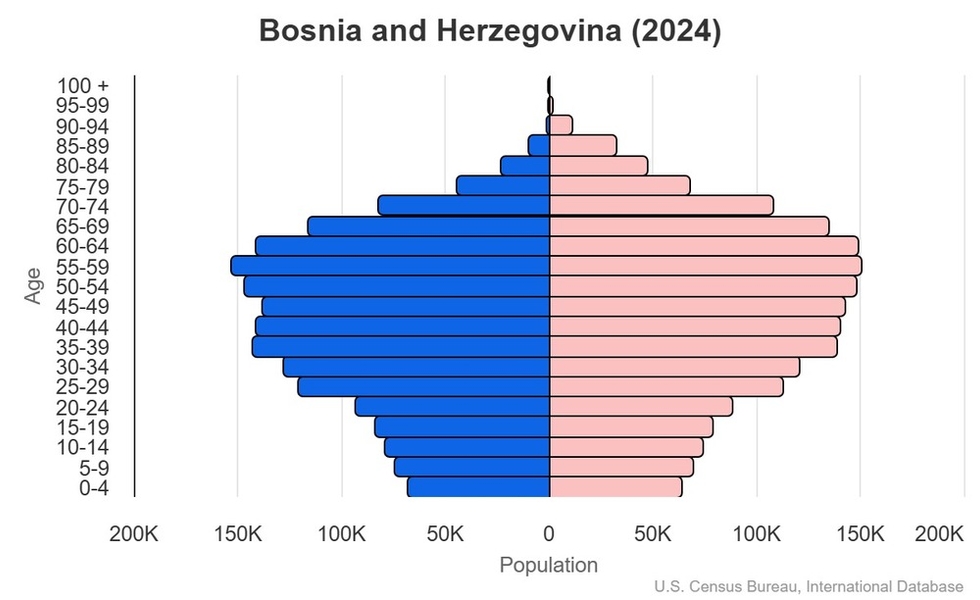
0-14 years: 13.1% (male 257,444/female 240,209)
15-64 years: 68.3% (male 1,305,271/female 1,290,920)
65 years and over: 18.6% (2024 est.) (male 289,449/female 415,378)
2024 population pyramid:
Dependency ratios
total dependency ratio: 43.5 (2024 est.)
youth dependency ratio: 16.8 (2024 est.)
elderly dependency ratio: 26.7 (2024 est.)
potential support ratio: 3.7 (2024 est.)
Median age
total: 44.8 years (2024 est.)
male: 43.1 years
female: 46.5 years
comparison ranking: total 28
Population growth rate
-0.25% (2024 est.)
comparison ranking: 211
Birth rate
8.2 births/1,000 population (2024 est.)
comparison ranking: 213
Death rate
10.3 deaths/1,000 population (2024 est.)
comparison ranking: 32
Net migration rate
-0.4 migrant(s)/1,000 population (2024 est.)
comparison ranking: 118
Population distribution
the northern and central areas of the country are the most densely populated
Urbanization
urban population: 50.3% of total population (2023)
rate of urbanization: 0.61% annual rate of change (2020-25 est.)
Major urban areas – population
346,000 SARAJEVO (capital) (2023)
Sex ratio
at birth: 1.07 male(s)/female
0-14 years: 1.07 male(s)/female
15-64 years: 1.01 male(s)/female
65 years and over: 0.7 male(s)/female
total population: 0.95 male(s)/female (2024 est.)
Mother’s mean age at first birth
27.7 years (2019 est.)
Maternal mortality ratio
6 deaths/100,000 live births (2020 est.)
comparison ranking: 160
Infant mortality rate
total: 5 deaths/1,000 live births (2024 est.)
male: 5.1 deaths/1,000 live births
female: 4.9 deaths/1,000 live births
comparison ranking: total 176
Life expectancy at birth
total population: 78.5 years (2024 est.)
male: 75.5 years
female: 81.6 years
comparison ranking: total population 77
Total fertility rate
1.38 children born/woman (2024 est.)
comparison ranking: 214
Gross reproduction rate
0.67 (2024 est.)
Contraceptive prevalence rate
45.8% (2011/12)
Drinking water source
improved:
urban: 99.9% of population
rural: 100% of population
total: 99.9% of population
unimproved:
urban: 0.1% of population
rural: 0% of population
total: 0.1% of population (2020 est.)
Health expenditure
9.6% of GDP (2021)
14.8% of national budget (2022 est.)
Physician density
2.58 physicians/1,000 population (2019)
Hospital bed density
2.3 beds/1,000 population (2019 est.)
Sanitation facility access
improved:
urban: 99.5% of population
rural: NA
total: NA
unimproved:
urban: 0.5% of population
rural: NA
total: (2020 est.) NA
Obesity – adult prevalence rate
17.9% (2016)
comparison ranking: 118
Alcohol consumption per capita
total: 5.46 liters of pure alcohol (2019 est.)
beer: 4.19 liters of pure alcohol (2019 est.)
wine: 0.47 liters of pure alcohol (2019 est.)
spirits: 0.62 liters of pure alcohol (2019 est.)
other alcohols: 0.17 liters of pure alcohol (2019 est.)
comparison ranking: total 81
Tobacco use
total: 34% (2025 est.)
male: 39.2% (2025 est.)
female: 29% (2025 est.)
comparison ranking: total 11
Currently married women (ages 15-49)
63.8% (2023 est.)
Education expenditure
3% of GDP (2022 est.)
10.4% national budget (2021 est.)
comparison ranking: Education expenditure (% GDP) 153
Literacy
total population: 98.1%
male: 99.4%
female: 98.1% (2021)
School life expectancy (primary to tertiary education)
total: 14 years
male: 14 years
female: 15 years (2014)
Environment
Environment – current issues
air pollution; deforestation and illegal logging; inadequate wastewater treatment and flood management facilities; urban waste disposal; uncleared land mines from the 1990s
Environment – international agreements
party to: Air Pollution, Biodiversity, Climate Change, Climate Change-Kyoto Protocol, Climate Change-Paris Agreement, Comprehensive Nuclear Test Ban, Desertification, Endangered Species, Hazardous Wastes, Law of the Sea, Marine Life Conservation, Nuclear Test Ban, Ozone Layer Protection, Wetlands
signed, but not ratified: none of the selected agreements
Climate
hot summers and cold winters; areas of high elevation have short, cool summers and long, severe winters; mild, rainy winters along coast
Land use
agricultural land: 44.2% (2022 est.)
arable land: 19.7% (2022 est.)
permanent crops: 2.1% (2022 est.)
permanent pasture: 22.4% (2022 est.)
forest: 42.7% (2022 est.)
other: 13.1% (2022 est.)
Urbanization
urban population: 50.3% of total population (2023)
rate of urbanization: 0.61% annual rate of change (2020-25 est.)
Air pollutants
particulate matter emissions: 26.19 micrograms per cubic meter (2019 est.)
carbon dioxide emissions: 21.85 megatons (2016 est.)
methane emissions: 2.92 megatons (2020 est.)
Waste and recycling
municipal solid waste generated annually: 1,248,718 tons (2015 est.)
municipal solid waste recycled annually: 12 tons (2015 est.)
percent of municipal solid waste recycled: 0% (2015 est.)
Major watersheds (area sq km)
Atlantic Ocean drainage: (Black Sea) Danube (795,656 sq km)
Total water withdrawal
municipal: 310 million cubic meters (2020 est.)
industrial: 60 million cubic meters (2020 est.)
Total renewable water resources
37.5 billion cubic meters (2020 est.)
Government
Country name
conventional long form: none
conventional short form: Bosnia and Herzegovina
local long form: none
local short form: Bosna i Hercegovina
former: People’s Republic of Bosnia and Herzegovina, Socialist Republic of Bosnia and Herzegovina
abbreviation: BiH
etymology: the larger northern territory is named for the Bosna River; the smaller southern section takes its name from the Old Serbian word herceg, meaning “duke,” combined with the possessive –ov and the suffix –ina, meaning “country,” to denote “dukedom”
Government type
parliamentary republic
Capital
name: Sarajevo
geographic coordinates: 43 52 N, 18 25 E
time difference: UTC+1 (6 hours ahead of Washington, DC, during Standard Time)
daylight saving time: +1hr, begins last Sunday in March; ends last Sunday in October
etymology: the name derives from the Turkish word saray, meaning “palace” or “mansion”
Administrative divisions
3 first-order administrative divisions – Brcko District (Brcko Distrikt) (ethnically mixed), Federation of Bosnia and Herzegovina (Federacija Bosne i Hercegovine) (predominantly Bosniak-Croat), Republika Srpska (predominantly Serb)
Legal system
civil law system; Constitutional Court review of legislative acts
Constitution
history: 14 December 1995 (constitution included as part of the Dayton Peace Accords)
amendment process: decided by the Parliamentary Assembly, including a two-thirds majority vote of members present in the House of Representatives; the constitutional article on human rights and fundamental freedoms cannot be amended
note: each of the political entities has its own constitution
International law organization participation
has not submitted an ICJ jurisdiction declaration; accepts ICCt jurisdiction
Citizenship
citizenship by birth: no
citizenship by descent only: at least one parent must be a citizen of Bosnia and Herzegovina
dual citizenship recognized: yes, provided there is a bilateral agreement with the other state
residency requirement for naturalization: 8 years
Suffrage
18 years of age, 16 if employed; universal
Executive branch
chief of state: Chairperson of the Presidency Zeljka CVIJANOVIC (chairperson since 16 November 2024; presidency member since 16 November 2022 – Serb seat); Denis BECIROVIC (presidency member since 16 November 2022 – Bosniak seat); Zeljko KOMSIC (presidency member since 20 November 2018 – Croat seat)
head of government: Chairperson of the Council of Ministers Borjana KRISTO (since 25 January 2023)
cabinet: Council of Ministers nominated by the council chairperson, approved by the state-level House of Representatives
election/appointment process: 3-member presidency (1 Bosniak and 1 Croat elected from the Federation of Bosnia and Herzegovina and 1 Serb elected from the Republika Srpska) directly elected by simple-majority popular vote for a 4-year term (eligible for a second term but then ineligible for 4 years); the presidency chairpersonship rotates every 8 months, with the new member of the presidency elected with the highest number of votes starting the new mandate as chair; the chairperson of the Council of Ministers appointed by the presidency and confirmed by the state-level House of Representatives
most recent election date: 2 October 2022
election results:
2022: percent of vote – Denis BECIROVIC – (SDP BiH) 57.4% – Bosniak seat; Zeljko KOMSIC (DF) 55.8% – Croat seat; Zeljka CVIJANOVIC (SNSD) 51.7% – Serb seat
2018: percent of vote – Milorad DODIK (SNSD) 53.9% – Serb seat; Zeljko KOMSIC (DF) 52.6% – Croat seat; Sefik DZAFEROVIC (SDA) 36.6% – Bosniak seat
expected date of next election: October 2026
note: President of the Federation of Bosnia and Herzegovina Lidiia BRADARA (since 28 February 2023)
Legislative branch
legislature name: Parliamentary Assembly (Skupstina)
legislative structure: bicameral
Legislative branch – lower chamber
chamber name: House of Representatives (Predstavnicki dom)
number of seats: 42 (all directly elected)
electoral system: proportional representation
scope of elections: full renewal
term in office: 4 years
most recent election date: 10/2/2022
parties elected and seats per party: Party of Democratic Action (SDA) (9); Alliance of Independent Social Democrats (SNSD) (6); Social Democratic Party of Bosnia and Herzegovina (SDP) (5); HDZ BiH, HSS, HSP BiH, HKDU, HSPAS, HDU, HSPHB, HRAST (4); Democratic Front (DF) – Civic Alliance (GS) (3); People and Justice (NAROD I PRAVDA) (3); Other (12)
percentage of women in chamber: 19%
expected date of next election: October 2026
Legislative branch – upper chamber
chamber name: House of Peoples (Dom Naroda)
number of seats: 15 (all appointed)
scope of elections: full renewal
term in office: 4 years
most recent election date: 2/16/2023
percentage of women in chamber: 6.7%
expected date of next election: February 2027
Judicial branch
highest court(s): Bosnia and Herzegovina (BiH) Constitutional Court (consists of 9 members); Court of BiH (consists of 44 national judges and 7 international judges organized into 3 divisions – Administrative, Appellate, and Criminal, which includes a War Crimes Chamber)
judge selection and term of office: BiH Constitutional Court judges – 4 selected by the Federation of Bosnia and Herzegovina House of Representatives, 2 selected by the Republika Srpska’s National Assembly, and 3 non-Bosnian judges selected by the president of the European Court of Human Rights; Court of BiH president and national judges appointed by the High Judicial and Prosecutorial Council; Court of BiH president appointed for renewable 6-year term; other national judges appointed to serve until age 70; international judges recommended by the president of the Court of BiH and appointed by the High Representative for Bosnia and Herzegovina; international judges appointed to serve until age 70
subordinate courts: the Federation has 10 cantonal courts plus a number of municipal courts; the Republika Srpska has a supreme court, 5 district courts, and a number of municipal courts
Political parties
Alliance of Independent Social Democrats or SNSD
Bosnian-Herzegovinian Initiative or BHI KF
Civic Alliance or GS
Croatian Democratic Union of Bosnia and Herzegovina or HDZ-BiH
Democratic Front or DF
Democratic Union or DEMOS
For Justice and Order
Our Party or NS/HC
Party for Democratic Action or SDA
Party of Democratic Progress or PDP
People and Justice Party or NiP
People’s European Union of Bosnia and Herzegovina or NES
Serb Democratic Party or SDS
Social Democratic Party or SDP
United Srpska or US
Diplomatic representation in the US
chief of mission: Ambassador Sven ALKALAJ (since 30 June 2023)
chancery: 2109 E Street NW, Washington, DC 20037
telephone: [1] (202) 337-1500
FAX: [1] (202) 337-1502
email address and website:
[email protected]
http://www.bhembassy.org/index.html
consulate(s) general: Chicago
Diplomatic representation from the US
chief of mission: Ambassador (vacant); Chargé d’Affaires Daniel KOSKI (since February 2025)
embassy: 1 Robert C. Frasure Street, 71000 Sarajevo
mailing address: 7130 Sarajevo Place, Washington DC 20521-7130
telephone: [387] (33) 704-000
FAX: [387] (33) 659-722
email address and website:
[email protected]
https://ba.usembassy.gov/
branch office(s): Banja Luka, Mostar
International organization participation
BIS, CD, CE, CEI, EAPC, EBRD, FAO, G-77, IAEA, IBRD, ICAO, ICC (NGOs), ICCt, ICRM, IDA, IFAD, IFC, IFRCS, ILO, IMF, IMO, IMSO, Interpol, IOC, IOM, IPU, ISO, ITSO, ITU, ITUC (NGOs), MIGA, MONUSCO, NAM (observer), OAS (observer), OIC (observer), OIF (observer), OPCW, OSCE, PFP, SELEC, UN, UNCTAD, UNESCO, UNIDO, UNWTO, UPU, WCO, WHO, WIPO, WMO, WTO (observer)
note: Bosnia-Herzegovina is an EU candidate country whose satisfactory completion of accession criteria is required before being granted full EU membership
Independence
1 March 1992 (from Yugoslavia)
note: referendum for independence completed on 1 March 1992; independence declared on 3 March 1992
National holiday
Independence Day, 1 March (1992) and Statehood Day, 25 November (1943) – both observed in the Federation of Bosnia and Herzegovina entity; Victory Day, 9 May (1945) and Dayton Agreement Day, 21 November (1995) – both observed in the Republika Srpska entity
note: there is no national-level holiday
Flag description
a wide blue vertical band on the fly side, with a yellow isosceles triangle; the rest of the flag is blue with seven five-pointed white stars and two half-stars along the hypotenuse of the triangle; the triangle approximates the shape of the country, and its three points stand for the Bosniaks, Croats, and Serbs; the stars represent Europe; the colors (white, blue, and yellow) are traditional to Bosnia and are also associated with neutrality and peace
note: one of four national flags that reflect the shape of the country in the flag design; the others are Brazil, Eritrea, and Vanuatu
National symbol(s)
golden lily
National color(s)
blue, yellow, white
National anthem
name: “Drzavna himna Bosne i Hercegovine” (The National Anthem of Bosnia and Herzegovina)
lyrics/music: none officially/Dusan SESTIC
note: music adopted 1999; lyrics proposed in 2008 and others in 2016 were not approved
National heritage
total World Heritage Sites: 5 (3 cultural, 2 natural)
selected World Heritage Site locales: Old Bridge Area of Mostar (c); Mehmed Paša Sokolović Bridge in Višegrad (c); Stećci Medieval Tombstones Graveyards (c); Ancient and Primeval Beech Forests of the Carpathians and Other Regions of Europe – Janj Forest (n); Vjetrenica Cave, Ravno (n)
Economy
Economic overview
import-dominated economy; remains consumption-heavy; lack of private sector investments and diversification; jointly addressing structural economic challenges; Chinese energy infrastructure investments; high unemployment; tourism industry impacted by COVID-19
Real GDP (purchasing power parity)
$64.104 billion (2023 est.)
$62.717 billion (2022 est.)
$60.174 billion (2021 est.)
note: data in 2021 dollars
comparison ranking: 114
Real GDP growth rate
2.21% (2023 est.)
4.23% (2022 est.)
7.39% (2021 est.)
note: annual GDP % growth based on constant local currency
comparison ranking: 135
Real GDP per capita
$20,100 (2023 est.)
$19,600 (2022 est.)
$18,500 (2021 est.)
note: data in 2021 dollars
comparison ranking: 100
GDP (official exchange rate)
$27.515 billion (2023 est.)
note: data in current dollars at official exchange rate
Inflation rate (consumer prices)
1.7% (2024 est.)
6.1% (2023 est.)
14% (2022 est.)
note: annual % change based on consumer prices
comparison ranking: 48
GDP – composition, by sector of origin
agriculture: 4.7% (2023 est.)
industry: 23.8% (2023 est.)
services: 55.8% (2023 est.)
note: figures may not total 100% due to non-allocated consumption not captured in sector-reported data
comparison rankings: services 119; industry 110; agriculture 118
GDP – composition, by end use
household consumption: 68.5% (2023 est.)
government consumption: 19.2% (2023 est.)
investment in fixed capital: 23.1% (2023 est.)
investment in inventories: 3.3% (2023 est.)
exports of goods and services: 44.1% (2023 est.)
imports of goods and services: -55.8% (2023 est.)
note: figures may not total 100% due to rounding or gaps in data collection
Agricultural products
maize, milk, vegetables, potatoes, plums, wheat, apples, barley, chicken, tomatoes (2023)
note: top ten agricultural products based on tonnage
Industries
steel, coal, iron ore, lead, zinc, manganese, bauxite, aluminum, motor vehicle assembly, textiles, tobacco products, wooden furniture, ammunition, domestic appliances, oil refining
Industrial production growth rate
-0.47% (2023 est.)
note: annual % change in industrial value added based on constant local currency
comparison ranking: 155
Labor force
1.356 million (2024 est.)
note: number of people ages 15 or older who are employed or seeking work
comparison ranking: 141
Unemployment rate
10.7% (2024 est.)
10.7% (2023 est.)
12.7% (2022 est.)
note: % of labor force seeking employment
comparison ranking: 162
Youth unemployment rate (ages 15-24)
total: 27.3% (2024 est.)
male: 25.4% (2024 est.)
female: 30.9% (2024 est.)
note: % of labor force ages 15-24 seeking employment
comparison ranking: total 30
Population below poverty line
16.9% (2015 est.)
note: % of population with income below national poverty line
Average household expenditures
on food: 32.1% of household expenditures (2023 est.)
on alcohol and tobacco: 7.1% of household expenditures (2023 est.)
Remittances
10.26% of GDP (2023 est.)
10.52% of GDP (2022 est.)
10.47% of GDP (2021 est.)
note: personal transfers and compensation between resident and non-resident individuals/households/entities
Budget
revenues: $10.195 billion (2023 est.)
expenditures: $9.739 billion (2023 est.)
note: central government revenues (excluding grants) and expenses converted to US dollars at average official exchange rate for year indicated
Public debt
40.4% of GDP (2023 est.)
note: central government debt as a % of GDP
comparison ranking: 130
Taxes and other revenues
19.1% (of GDP) (2023 est.)
note: central government tax revenue as a % of GDP
comparison ranking: 92
Current account balance
-$638.769 million (2023 est.)
-$1.078 billion (2022 est.)
-$349.24 million (2021 est.)
note: balance of payments – net trade and primary/secondary income in current dollars
comparison ranking: 125
Exports
$12.126 billion (2023 est.)
$11.838 billion (2022 est.)
$10.116 billion (2021 est.)
note: balance of payments – exports of goods and services in current dollars
comparison ranking: 107
Exports – partners
Germany 15%, Croatia 14%, Serbia 12%, Austria 10%, Slovenia 9% (2023)
note: top five export partners based on percentage share of exports
Exports – commodities
footwear, electricity, garments, plastic products, insulated wire (2023)
note: top five export commodities based on value in dollars
Imports
$15.37 billion (2023 est.)
$15.166 billion (2022 est.)
$12.739 billion (2021 est.)
note: balance of payments – imports of goods and services in current dollars
comparison ranking: 105
Imports – partners
Italy 13%, Germany 11%, Serbia 11%, China 9%, Croatia 8% (2023)
note: top five import partners based on percentage share of imports
Imports – commodities
refined petroleum, cars, garments, plastic products, packaged medicine (2023)
note: top five import commodities based on value in dollars
Reserves of foreign exchange and gold
$9.127 billion (2024 est.)
$9.205 billion (2023 est.)
$8.762 billion (2022 est.)
note: holdings of gold (year-end prices)/foreign exchange/special drawing rights in current dollars
comparison ranking: 84
Debt – external
$5.359 billion (2023 est.)
note: present value of external debt in current US dollars
comparison ranking: 72
Exchange rates
konvertibilna markas (BAM) per US dollar –
Exchange rates:
1.808 (2024 est.)
1.809 (2023 est.)
1.859 (2022 est.)
1.654 (2021 est.)
1.717 (2020 est.)
Energy
Electricity access
electrification – total population: 100% (2022 est.)
Electricity
installed generating capacity: 4.682 million kW (2023 est.)
consumption: 12.867 billion kWh (2023 est.)
exports: 7.104 billion kWh (2023 est.)
imports: 3.6 billion kWh (2023 est.)
transmission/distribution losses: 1.339 billion kWh (2023 est.)
comparison rankings: transmission/distribution losses 113; imports 55; exports 33; consumption 94; installed generating capacity 93
Electricity generation sources
fossil fuels: 64% of total installed capacity (2023 est.)
solar: 0.9% of total installed capacity (2023 est.)
wind: 2.2% of total installed capacity (2023 est.)
hydroelectricity: 31.1% of total installed capacity (2023 est.)
biomass and waste: 1.8% of total installed capacity (2023 est.)
Coal
production: 12.311 million metric tons (2023 est.)
consumption: 12.304 million metric tons (2023 est.)
exports: 1.254 million metric tons (2023 est.)
imports: 1.327 million metric tons (2023 est.)
proven reserves: 2.264 billion metric tons (2023 est.)
Petroleum
refined petroleum consumption: 34,000 bbl/day (2023 est.)
Natural gas
consumption: 228.855 million cubic meters (2023 est.)
imports: 228.855 million cubic meters (2023 est.)
Carbon dioxide emissions
24.513 million metric tonnes of CO2 (2023 est.)
from coal and metallurgical coke: 19.292 million metric tonnes of CO2 (2023 est.)
from petroleum and other liquids: 4.785 million metric tonnes of CO2 (2023 est.)
from consumed natural gas: 436,000 metric tonnes of CO2 (2023 est.)
comparison ranking: total emissions 78
Energy consumption per capita
91.227 million Btu/person (2023 est.)
comparison ranking: 58
Communications
Telephones – fixed lines
total subscriptions: 614,000 (2023 est.)
subscriptions per 100 inhabitants: 19 (2023 est.)
comparison ranking: total subscriptions 85
Telephones – mobile cellular
total subscriptions: 3.87 million (2023 est.)
subscriptions per 100 inhabitants: 118 (2022 est.)
comparison ranking: total subscriptions 139
Broadcast media
3 public TV broadcasters: Radio and TV of Bosnia and Herzegovina, Federation TV (operating 2 networks), and Republika Srpska Radio-TV; a local commercial network of 5 TV stations; 3 private, near-national TV stations and dozens of small independent TV stations; 3 large public radio broadcasters and many private radio stations (2019)
Internet country code
.ba
Internet users
percent of population: 83% (2023 est.)
Broadband – fixed subscriptions
total: 908,000 (2023 est.)
subscriptions per 100 inhabitants: 29 (2023 est.)
comparison ranking: total 80
Transportation
Civil aircraft registration country code prefix
T9
Airports
20 (2025)
comparison ranking: 139
Heliports
3 (2025)
comparison ranking: 114
Railways
total: 965 km (2014)
standard gauge: 965 km (2014) 1.435-m gauge (565 km electrified)
Ports
total ports: 1 (2024)
large: 0
medium: 0
small: 1
very small: 0
ports with oil terminals: 0
key ports: Neum
Military and Security
Military and security forces
Armed Forces of Bosnia and Herzegovina (AFBiH or Oruzanih Snaga Bosne i Hercegovine, OSBiH): Army, Air, Air Defense forces organized into an Operations Command and a Support Command
Ministry of Security: Border Police (2025)
Military expenditures
0.8% of GDP (2024 est.)
0.8% of GDP (2023 est.)
0.8% of GDP (2022 est.)
0.9% of GDP (2021 est.)
0.9% of GDP (2020 est.)
Military and security service personnel strengths
approximately 10,000 active-duty Armed Forces (2024)
Military equipment inventories and acquisitions
the military’s inventory of weapons and equipment is a combination of material originating from the former Soviet Union/former Yugoslavia and secondhand deliveries from Western suppliers such as the UK and especially the US (2024)
Military service age and obligation
18 years of age for voluntary military service; conscription abolished in 2005 (2024)
note: as of 2024, women made up about 9% of the military’s full-time personnel
Military – note
the Armed Forces of Bosnia and Herzegovina (AFBiH) are responsible for territorial defense, providing assistance to civil authorities during disasters or other emergencies, and participating in collective security and peace support operations; each of the AFBiH’s three combat brigades are headquartered inside of their respective ethnicity territory, while its main headquarters is in Sarajevo; Bosnia and Herzegovina aspires to join NATO; Bosnia and Herzegovina joined NATO’s Partnership for Peace (PfP) program in 2006 and was invited to join NATO’s Membership Action Plan in 2010; the AFBiH is undergoing a 10-year (2017-2027) defense modernization and reform program for preparing to join and integrate with NATO; it has contributed small numbers of troops to EU, NATO, and UN missions
NATO maintains a military headquarters in Sarajevo with the mission of assisting Bosnia and Herzegovina with the PfP program and promoting closer integration with NATO, as well as providing logistics and other support to the EU Force Bosnia and Herzegovina (EUFOR), which has operated in the country to oversee implementation of the Dayton/Paris Agreement since taking over from NATO’s Stabilization Force (SFOR) in 2004 (2025)
Terrorism
Terrorist group(s)
Terrorist group(s): Islamic Revolutionary Guard Corps/Qods Force
note: details about the history, aims, leadership, organization, areas of operation, tactics, targets, weapons, size, and sources of support of the group(s) appear(s) in the Terrorism reference guide
Transnational Issues
Refugees and internally displaced persons
IDPs: 91,000 (Bosnian Croats, Serbs, and Bosniaks displaced by inter-ethnic violence, human rights violations, and armed conflict during the 1992-95 war) (2022)
stateless persons: 48 (2022)
note: 153,304 estimated refugee and migrant arrivals (January 2015-March 2024)
Illicit drugs
drug trafficking groups are major players in the procurement and transportation of large quantities of cocaine destined for European markets