


Originally a Dutch colony in the 17th century, by 1815 Guyana had become a British possession. The abolition of slavery led to former slaves settling urban areas and indentured servants being imported from India to work the sugar plantations. The resulting ethnocultural divide has persisted and has led to turbulent politics. Guyana achieved independence from the UK in 1966, and since then primarily socialist-oriented governments have ruled the country.
In 1992, Cheddi JAGAN was elected president in what is considered the country’s first free and fair election since independence. After his death five years later, his wife, Janet JAGAN, became president but resigned in 1999 due to poor health. Her successor, Bharrat JAGDEO, was elected in 2001 and again in 2006. Donald RAMOTAR won in 2011, but early elections held in 2015 resulted in the first change in governing party, and David GRANGER took office. After a 2018 no-confidence vote against the GRANGER government, the administration ignored a constitutional requirement to hold elections and remained in place until the 2020 elections, when Irfaan ALI became president.
The discovery of massive offshore oil reserves in 2015 has been Guyana’s primary economic and political focus, with many hoping the reserves will transform one of the poorest countries in the region. Guyana is the only English-speaking country in South America and shares cultural and historical bonds with the Anglophone Caribbean.TipVisit the Definitions and Notes page to view a description of each topic.Definitions and Notes
Geography
Location
Northern South America, bordering the North Atlantic Ocean, between Suriname and Venezuela
Geographic coordinates
5 00 N, 59 00 W
Map references
South America
Area
total : 214,969 sq km
land: 196,849 sq km
water: 18,120 sq km
comparison ranking: total 85
Area – comparative
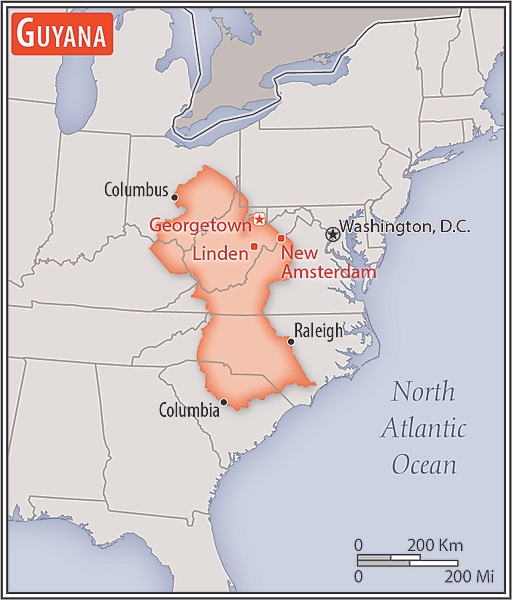
slightly smaller than Idaho; almost twice the size of Tennessee
Area comparison map:
Land boundaries
total: 2,933 km
border countries (3): Brazil 1,308 km; Suriname 836 km; Venezuela 789 km
Coastline
459 km
Maritime claims
territorial sea: 12 nm
exclusive economic zone: 200 nm
continental shelf: 200 nm or to the outer edge of the continental margin
Climate
tropical; hot, humid, moderated by northeast trade winds; two rainy seasons (May to August, November to January)
Terrain
mostly rolling highlands; low coastal plain; savanna in south
Elevation
highest point: Laberintos del Norte on Mount Roraima 2,775 m
lowest point: Atlantic Ocean 0 m
mean elevation: 207 m
Natural resources
bauxite, gold, diamonds, hardwood timber, shrimp, fish
Land use
agricultural land: 5.3% (2022 est.)
arable land: 2.1% (2022 est.)
permanent crops: 0.1% (2022 est.)
permanent pasture: 3% (2022 est.)
forest: 93.5% (2022 est.)
other: 1.2% (2022 est.)
Irrigated land
1,430 sq km (2012)
Major watersheds (area sq km)
Atlantic Ocean drainage: Amazon (6,145,186 sq km), Orinoco (953,675 sq km)
Population distribution
population is heavily concentrated in the northeast in and around Georgetown, with notable concentrations along the Berbice River to the east; the remainder of the country is sparsely populated
Natural hazards
flash flood threat during rainy seasons
Geography – note
the third-smallest country in South America after Suriname and Uruguay; contains some of the largest unspoiled rainforests on the continent
People and Society
Population
total: 794,099 (2024 est.)
male: 405,244
female: 388,855
comparison rankings: total 166; female 166; male 166
Nationality
noun: Guyanese (singular and plural)
adjective: Guyanese
Ethnic groups
East Indian 39.8%, African descent 29.3%, mixed 19.9%, Indigenous 10.5%, other 0.5% (includes Portuguese, Chinese, White) (2012 est.)
Languages
English (official), Guyanese Creole, Amerindian languages (including Caribbean and Arawak languages), Indian languages (including Caribbean Hindustani, a dialect of Hindi), Chinese (2014 est.)
Religions
Protestant 34.8% (Pentecostal 22.8%, Seventh Day Adventist 5.4%, Anglican 5.2%, Methodist 1.4%), Hindu 24.8%, other Christian 20.8%, Roman Catholic 7.1%, Muslim 6.8%, Jehovah’s Witness 1.3%, Rastafarian 0.5%, other 0.9%, none 3.1% (2012 est.)
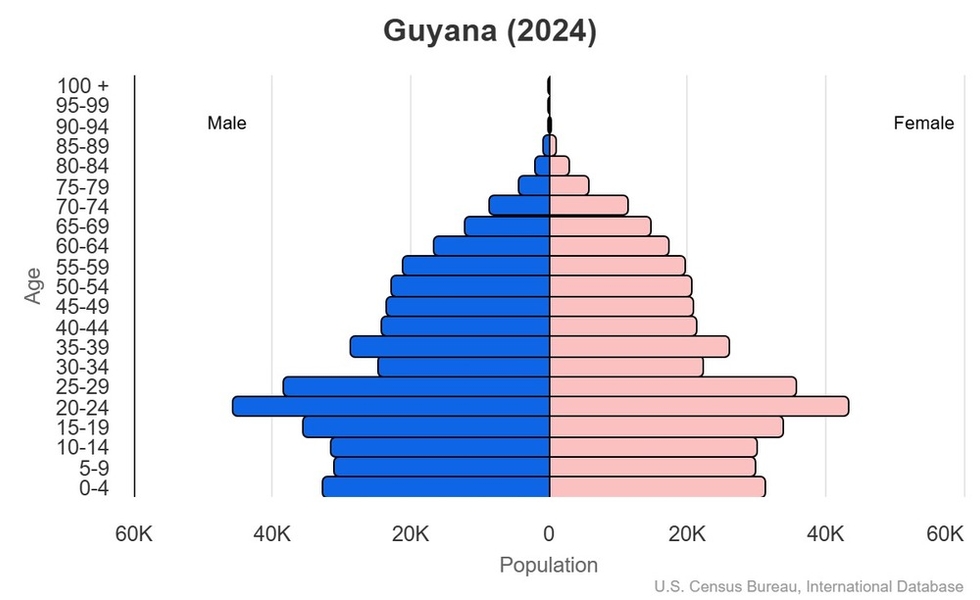
Age structure
0-14 years: 23.5% (male 95,223/female 91,272)
15-64 years: 68.4% (male 281,669/female 261,261)
65 years and over: 8.1% (2024 est.) (male 28,352/female 36,322)
2024 population pyramid:
Dependency ratios
total dependency ratio: 46.3 (2024 est.)
youth dependency ratio: 34.3 (2024 est.)
elderly dependency ratio: 11.9 (2024 est.)
potential support ratio: 8.4 (2024 est.)
Median age
total: 28.3 years (2024 est.)
male: 28.2 years
female: 28.4 years
comparison ranking: total 150
Population growth rate
0.32% (2024 est.)
comparison ranking: 164
Birth rate
16.7 births/1,000 population (2024 est.)
comparison ranking: 95
Death rate
7 deaths/1,000 population (2024 est.)
comparison ranking: 122
Net migration rate
-6.6 migrant(s)/1,000 population (2024 est.)
comparison ranking: 214
Population distribution
population is heavily concentrated in the northeast in and around Georgetown, with notable concentrations along the Berbice River to the east; the remainder of the country is sparsely populated
Urbanization
urban population: 27.2% of total population (2023)
rate of urbanization: 1.01% annual rate of change (2020-25 est.)
Major urban areas – population
110,000 GEORGETOWN (capital) (2018)
Sex ratio
at birth: 1.05 male(s)/female
0-14 years: 1.04 male(s)/female
15-64 years: 1.08 male(s)/female
65 years and over: 0.78 male(s)/female
total population: 1.04 male(s)/female (2024 est.)
Mother’s mean age at first birth
20.8 years (2009 est.)
note: data represents median age at first birth among women 25-29
Maternal mortality ratio
75 deaths/100,000 live births (2023 est.)
comparison ranking: 76
Infant mortality rate
total: 21.1 deaths/1,000 live births (2024 est.)
male: 23.9 deaths/1,000 live births
female: 18.3 deaths/1,000 live births
comparison ranking: total 75
Life expectancy at birth
total population: 72.4 years (2024 est.)
male: 70.6 years
female: 74.3 years
comparison ranking: total population 163
Total fertility rate
2.05 children born/woman (2024 est.)
comparison ranking: 99
Gross reproduction rate
1 (2024 est.)
Drinking water source
improved:
urban: 96% of population (2022 est.)
rural: 95.8% of population (2022 est.)
total: 95.9% of population (2022 est.)
unimproved:
urban: 4% of population (2022 est.)
rural: 4.2% of population (2022 est.)
total: 4.1% of population (2022 est.)
Health expenditure
4.9% of GDP (2021)
10.5% of national budget (2022 est.)
Physician density
1.39 physicians/1,000 population (2020)
Hospital bed density
2.6 beds/1,000 population (2021 est.)
Sanitation facility access
improved:
urban: 98.7% of population (2022 est.)
rural: 99.5% of population (2022 est.)
total: 99.3% of population (2022 est.)
unimproved:
urban: 1.3% of population (2022 est.)
rural: 0.5% of population (2022 est.)
total: 0.7% of population (2022 est.)
Obesity – adult prevalence rate
20.2% (2016)
comparison ranking: 102
Alcohol consumption per capita
total: 5.11 liters of pure alcohol (2019 est.)
beer: 2.75 liters of pure alcohol (2019 est.)
wine: 0.04 liters of pure alcohol (2019 est.)
spirits: 2.3 liters of pure alcohol (2019 est.)
other alcohols: 0.02 liters of pure alcohol (2019 est.)
comparison ranking: total 83
Tobacco use
total: 9.2% (2025 est.)
male: 16.9% (2025 est.)
female: 1.9% (2025 est.)
comparison ranking: total 133
Children under the age of 5 years underweight
9.4% (2019)
comparison ranking: 54
Currently married women (ages 15-49)
62.6% (2023 est.)
Child marriage
women married by age 15: 6.3% (2020)
women married by age 18: 32.3% (2020)
men married by age 18: 11.9% (2020)
Education expenditure
4.5% of GDP (2018 est.)
16.2% national budget (2018 est.)
comparison ranking: Education expenditure (% GDP) 84
Literacy
total population: 85.6% (2020 est.)
male: 84.2% (2020 est.)
female: 86.9% (2020 est.)
Environment
Environmental issues
water pollution from sewage and agricultural/industrial chemicals; deforestation
International environmental agreements
party to: Biodiversity, Climate Change, Climate Change-Kyoto Protocol, Climate Change-Paris Agreement, Comprehensive Nuclear Test Ban, Desertification, Endangered Species, Hazardous Wastes, Law of the Sea, Marine Dumping-London Protocol, Ozone Layer Protection, Ship Pollution, Tropical Timber 2006
signed, but not ratified: none of the selected agreements
Climate
tropical; hot, humid, moderated by northeast trade winds; two rainy seasons (May to August, November to January)
Land use
agricultural land: 5.3% (2022 est.)
arable land: 2.1% (2022 est.)
permanent crops: 0.1% (2022 est.)
permanent pasture: 3% (2022 est.)
forest: 93.5% (2022 est.)
other: 1.2% (2022 est.)
Urbanization
urban population: 27.2% of total population (2023)
rate of urbanization: 1.01% annual rate of change (2020-25 est.)
Carbon dioxide emissions
2.639 million metric tonnes of CO2 (2023 est.)
from petroleum and other liquids: 2.635 million metric tonnes of CO2 (2023 est.)
from consumed natural gas: 4,000 metric tonnes of CO2 (2023 est.)
comparison ranking: total emissions 155
Particulate matter emissions
11.2 micrograms per cubic meter (2019 est.)
Waste and recycling
municipal solid waste generated annually: 179,252 tons (2010 est.)
municipal solid waste recycled annually: 968 tons (2010 est.)
percent of municipal solid waste recycled: 0.5% (2010 est.)
Total water withdrawal
municipal: 60 million cubic meters (2020 est.)
industrial: 20 million cubic meters (2020 est.)
agricultural: 1.36 billion cubic meters (2020 est.)
Total renewable water resources
271 billion cubic meters (2020 est.)
Government
Country name
conventional long form: Cooperative Republic of Guyana
conventional short form: Guyana
former: British Guiana
etymology: the name is derived from Guiana, the original name for the region that included British Guiana, Dutch Guiana, and French Guiana; the name Guiana may be derived from a local term meaning “Land of Water” (referring to the area’s multitude of rivers and streams)
Government type
parliamentary republic
Capital
name: Georgetown
geographic coordinates: 6 48 N, 58 09 W
time difference: UTC-4 (1 hour ahead of Washington, DC, during Standard Time)
etymology: the British founded the town in 1781 and named it in honor of King GEORGE III (1738-1820)
Administrative divisions
10 regions; Barima-Waini, Cuyuni-Mazaruni, Demerara-Mahaica, East Berbice-Corentyne, Essequibo Islands-West Demerara, Mahaica-Berbice, Pomeroon-Supenaam, Potaro-Siparuni, Upper Demerara-Berbice, Upper Takutu-Upper Essequibo
Legal system
common law system, based on the English model, with some Roman-Dutch civil law influence
Constitution
history: several previous; latest promulgated 6 October 1980
amendment process: proposed by the National Assembly; passage of amendments affecting constitutional articles, such as national sovereignty, government structure and powers, and constitutional amendment procedures, requires approval by the Assembly membership, approval in a referendum, and assent of the president; other amendments only require Assembly approval
International law organization participation
has not submitted an ICJ jurisdiction declaration; accepts ICCt jurisdiction
Citizenship
citizenship by birth: yes
citizenship by descent only: yes
dual citizenship recognized: no
residency requirement for naturalization: na
Suffrage
18 years of age; universal
Executive branch
chief of state: President Mohammed Irfaan ALI (since 2 August 2020)
head of government: President Mohammed Irfaan ALI (since 2 August 2020)
cabinet: Cabinet of Ministers appointed by the president, responsible to the National Assembly
election/appointment process: the predesignated candidate of the winning party in the last National Assembly election becomes president for a 5-year term (no term limits); prime minister appointed by the president
most recent election date: 2 March 2020
election results:
2020: Mohammed Irfaan ALI (PPP/C) designated president by the majority party in the National Assembly
2015: David GRANGER (APNU-AFC) designated president by the majority party in the National Assembly
expected date of next election: 1 September 2025
note: the president is both chief of state and head of government
Legislative branch
legislature name: Parliament of the Co-operative Republic of Guyana
legislative structure: unicameral
chamber name: National Assembly
number of seats: 69 (all directly elected)
electoral system: mixed system
scope of elections: full renewal
term in office: 5 years
most recent election date: 3/2/2020
parties elected and seats per party: People’s Progressive Party/Civic (PPP/C) (33); A Partnership for National Unity – Alliance for Change (APNU-AFC) (31); Other (1)
percentage of women in chamber: 39.4%
expected date of next election: September 2025
Judicial branch
highest court(s): Supreme Court of Judicature (consists of the Court of Appeal with a chief justice and 3 justices, and the High Court with a chief justice and 10 justices organized into 3- or 5-judge panels); Caribbean Court of Justice is the final court of appeal in civil and criminal cases
judge selection and term of office: Court of Appeal and High Court chief justices appointed by the president; other judges of both courts appointed by the Judicial Service Commission, a body appointed by the president; judges appointed for life with retirement at age 65
subordinate courts: Land Court; magistrates’ courts
Political parties
A New and United Guyana or ANUG
A Partnership for National Unity or APNU
Alliance for Change or AFC
Justice for All Party
Liberty and Justice Party or LJP
National Independent Party or NIP
People’s Progressive Party/Civic or PPP/C
The New Movement or TNM
The United Force or TUF
United Republican Party or URP
Diplomatic representation in the US
chief of mission: Ambassador Samuel Archibald HINDS (since 7 July 2021)
chancery: 2490 Tracy Place NW, Washington, DC 20008
telephone: [1] (202) 265-6900
FAX: [1] (202) 232-1297
email address and website:
[email protected]
http://www.guyanaembassydc.org/
consulate(s) general: New York
Diplomatic representation from the US
chief of mission: Ambassador Nicole THERIOT (since 14 October 2023)
embassy: 100 Young and Duke Streets, Kingston, Georgetown
mailing address: 3170 Georgetown Place, Washington DC 20521-3170
telephone: [592] 225-4900 through 4909
FAX: [592] 225-8497
email address and website:
[email protected]
https://gy.usembassy.gov/
International organization participation
ACP, ACS, AOSIS, C, Caricom, CD, CDB, CELAC, FAO, G-77, IADB, IBRD, ICAO, ICCt, ICRM, IDA, IFAD, IFC, IFRCS, ILO, IMF, IMO, Interpol, IOC, IOM, ISO (correspondent), ITU, LAES, MIGA, NAM, OAS, OIC, OPANAL, OPCW, PCA, Petrocaribe, PROSUR, UN, UNASUR, UNCTAD, UNESCO, UNIDO, UPU, WCO, WFTU (NGOs), WHO, WIPO, WMO, WTO
Independence
26 May 1966 (from the UK)
National holiday
Republic Day, 23 February (1970)
Flag description
green with a red isosceles triangle (based on the hoist side) on top of a long, yellow arrowhead; a narrow black border sits between the red and yellow, and a narrow white border between the yellow and green; green stands for forest and foliage, yellow for mineral resources and a bright future, white for the rivers, red for zeal and the people’s sacrifice, and black for perseverance
National symbol(s)
Canje pheasant (hoatzin), jaguar, Victoria Regia water lily
National color(s)
red, yellow, green, black, white
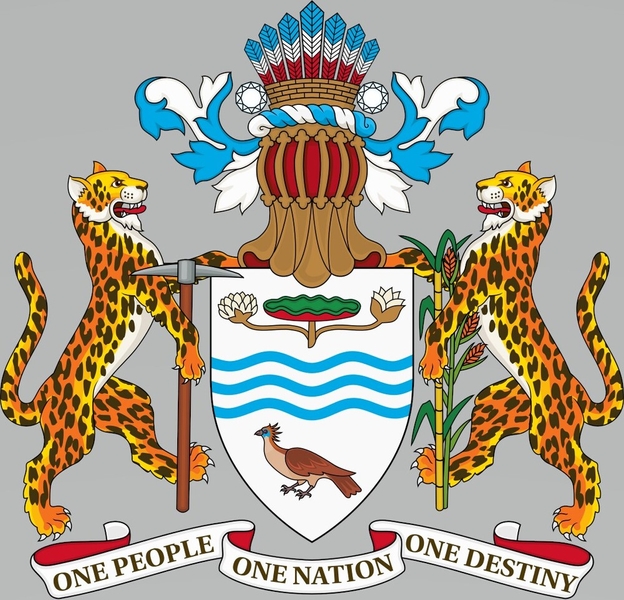
National coat of arms
Guyana’s coat of arms was adopted in 1966, the year of the country’s independence from the United Kingdom; the jaguars signify strength and resilience, with one holding a pickaxe that stands for labor and the other holding stalks of rice and sugarcane for agriculture; two national symbols, the Canje pheasant and the Victorian lily, are on the shield, with the national motto underneath; three wavy blue lines stand for the Essequibo, Demerara, and Berbice rivers, the headdress for the country’s ethnic groups, and the diamonds for the mining industry; the helmet is a symbol of past UK rule in Guyana
National anthem(s)
title: “Dear Land of Guyana, of Rivers and Plains”
lyrics/music: Archibald Leonard LUKERL/Robert Cyril Gladstone POTTER
history: adopted 1966
Economy
Economic overview
small, hydrocarbon-driven South American export economy; major forest coverage being leveraged in carbon credit offsets to encourage preservation; strengthening financial sector; large bauxite and gold resources
Real GDP (purchasing power parity)
$58.423 billion (2024 est.)
$40.749 billion (2023 est.)
$30.457 billion (2022 est.)
note: data in 2021 dollars
comparison ranking: 119
Real GDP growth rate
43.4% (2024 est.)
33.8% (2023 est.)
63.3% (2022 est.)
note: annual GDP % growth based on constant local currency
comparison ranking: 1
Real GDP per capita
$70,300 (2024 est.)
$49,300 (2023 est.)
$37,100 (2022 est.)
note: data in 2021 dollars
comparison ranking: 20
GDP (official exchange rate)
$24.836 billion (2024 est.)
note: data in current dollars at official exchange rate
Inflation rate (consumer prices)
2.9% (2024 est.)
2.8% (2023 est.)
6.1% (2022 est.)
note: annual % change based on consumer prices
comparison ranking: 85
GDP – composition, by sector of origin
agriculture: 8% (2024 est.)
industry: 74.3% (2024 est.)
services: 15.3% (2024 est.)
note: figures may not total 100% due to non-allocated consumption not captured in sector-reported data
comparison rankings: services 207; industry 1; agriculture 86
Agricultural products
rice, sugarcane, plantains, cassava, papayas, pumpkins/squash, chicken, milk, ginger, eggplants (2023)
note: top ten agricultural products based on tonnage
Industries
bauxite, sugar, rice milling, timber, textiles, gold mining
Industrial production growth rate
53.3% (2024 est.)
note: annual % change in industrial value added based on constant local currency
comparison ranking: 1
Labor force
292,200 (2024 est.)
note: number of people ages 15 or older who are employed or seeking work
comparison ranking: 167
Unemployment rate
10.2% (2024 est.)
12.1% (2023 est.)
12.1% (2022 est.)
note: % of labor force seeking employment
comparison ranking: 148
Youth unemployment rate (ages 15-24)
total: 22.3% (2024 est.)
male: 17.4% (2024 est.)
female: 28.1% (2024 est.)
note: % of labor force ages 15-24 seeking employment
comparison ranking: total 46
Remittances
3.2% of GDP (2023 est.)
3.7% of GDP (2022 est.)
6.9% of GDP (2021 est.)
note: personal transfers and compensation between resident and non-resident individuals/households/entities
Budget
revenues: $1.333 billion (2019 est.)
expenditures: $1.467 billion (2019 est.)
Current account balance
$2.352 billion (2023 est.)
$4.242 billion (2022 est.)
-$1.36 billion (2021 est.)
note: balance of payments – net trade and primary/secondary income in current dollars
comparison ranking: 42
Exports
$13.739 billion (2023 est.)
$11.517 billion (2022 est.)
$4.594 billion (2021 est.)
note: balance of payments – exports of goods and services in current dollars
comparison ranking: 102
Exports – partners
USA 20%, Trinidad & Tobago 11%, Netherlands 10%, Singapore 10%, Germany 7% (2023)
note: top five export partners based on percentage share of exports
Exports – commodities
crude petroleum, railway cargo containers, gold, ships, rice (2023)
note: top five export commodities based on value in dollars
Imports
$10.956 billion (2023 est.)
$7.033 billion (2022 est.)
$6.588 billion (2021 est.)
note: balance of payments – imports of goods and services in current dollars
comparison ranking: 116
Imports – partners
USA 28%, China 13%, Trinidad & Tobago 11%, Brazil 5%, Bahamas, The 4% (2023)
note: top five import partners based on percentage share of imports
Imports – commodities
refined petroleum, ships, construction vehicles, excavation machinery, cars (2023)
note: top five import commodities based on value in dollars
Reserves of foreign exchange and gold
$1.01 billion (2024 est.)
$895.275 million (2023 est.)
$917.877 million (2022 est.)
note: holdings of gold (year-end prices)/foreign exchange/special drawing rights in current dollars
comparison ranking: 143
Debt – external
$1.805 billion (2023 est.)
note: present value of external debt in current US dollars
comparison ranking: 97
Exchange rates
Guyanese dollars (GYD) per US dollar –
Exchange rates:
208.5 (2024 est.)
208.5 (2023 est.)
208.5 (2022 est.)
208.5 (2021 est.)
208.5 (2020 est.)
Energy
Electricity access
electrification – total population: 93% (2022 est.)
electrification – urban areas: 98%
electrification – rural areas: 91.6%
Electricity
installed generating capacity: 259,000 kW (2023 est.)
consumption: 1.07 billion kWh (2023 est.)
transmission/distribution losses: 268.803 million kWh (2023 est.)
comparison rankings: transmission/distribution losses 70; consumption 159; installed generating capacity 168
Electricity generation sources
fossil fuels: 92.9% of total installed capacity (2023 est.)
solar: 1.3% of total installed capacity (2023 est.)
hydroelectricity: 0.3% of total installed capacity (2023 est.)
biomass and waste: 5.4% of total installed capacity (2023 est.)
Petroleum
total petroleum production: 391,000 bbl/day (2023 est.)
refined petroleum consumption: 18,000 bbl/day (2023 est.)
Natural gas
consumption: 1.991 million cubic meters (2023 est.)
imports: 1.991 million cubic meters (2023 est.)
Energy consumption per capita
46.045 million Btu/person (2023 est.)
comparison ranking: 97
Communications
Telephones – fixed lines
total subscriptions: 125,000 (2021 est.)
subscriptions per 100 inhabitants: 15 (2022 est.)
comparison ranking: total subscriptions 130
Telephones – mobile cellular
total subscriptions: 856,000 (2021 est.)
subscriptions per 100 inhabitants: 106 (2021 est.)
comparison ranking: total subscriptions 168
Broadcast media
government-dominated broadcast media; the National Communications Network (NCN) TV is state-owned; a few private TV stations relay satellite services; the state owns and operates 2 radio stations broadcasting on multiple frequencies; government limits on licensing of new private radio stations has constrained competition
Internet country code
.gy
Internet users
percent of population: 82% (2023 est.)
Broadband – fixed subscriptions
total: 106,000 (2022 est.)
subscriptions per 100 inhabitants: 13 (2022 est.)
comparison ranking: total 132
Transportation
Civil aircraft registration country code prefix
8R
Airports
55 (2025)
comparison ranking: 82
Merchant marine
total: 80 (2023)
by type: general cargo 45, oil tanker 10, other 25
comparison ranking: total 99
Ports
total ports: 3 (2024)
large: 0
medium: 1
small: 0
very small: 2
ports with oil terminals: 3
key ports: Georgetown, Linden, New Amsterdam
Military and Security
Military and security forces
the Guyana Defense Force (GDF) is a unified force with ground, air, and coast guard components, as well as the Guyana National Reserve (2025)
note: the Guyana Police Force under the Ministry of Home Affairs is responsible for internal security
Military expenditures
0.9% of GDP (2024 est.)
0.6% of GDP (2023 est.)
0.6% of GDP (2022 est.)
1% of GDP (2021 est.)
1.2% of GDP (2020 est.)
Military and security service personnel strengths
approximately 3,500 active-duty Guyana Defense Forces (2025)
Military equipment inventories and acquisitions
the military has a limited inventory comprised mostly of older or second-hand platforms from a variety of foreign suppliers, including Brazil, China, the former Soviet Union, the UK, and the US (2024)
Military service age and obligation
18-25 years of age or older for voluntary military service; no conscription (2024)
Military – note
the Guyana Defense Force (GDF) was established in 1965; its primary missions are territorial defense, maritime security, search and rescue, medical evacuation, aviation and engineering support, disaster relief and humanitarian assistance, peace support operations, and community engagement; key areas of concern include illegal fishing, narcotics trafficking, piracy, porous borders, and threats from Venezuela over disputed territory; the GDF participates in both bilateral and multinational exercises and has relationships with Brazil, China, France, the UK, and the US
Guyana joined the Caribbean Regional Security System (RSS) in 2022; RSS signatories (Antigua and Barbuda, Barbados, Dominica, Grenada, Saint Kitts and Nevis, Saint Lucia, and Saint Vincent and the Grenadines) agreed to prepare contingency plans and assist one another, on request, in national emergencies, prevention of smuggling, search and rescue, immigration control, fishery protection, customs and excise control, maritime policing duties, protection of off-shore installations, pollution control, national and other disasters, and threats to national security (2025)
Transnational Issues
Refugees and internally displaced persons
refugees: 79 (2024 est.)