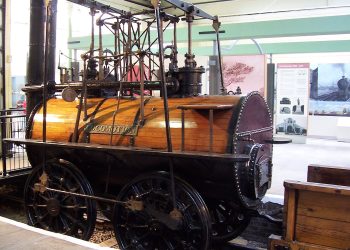
The 0-2-2-0 locomotive is a steam engine wheel arrangement classified under the Whyte notation system as having no leading wheels, four powered but uncoupled driving wheels on two axles, and no trailing wheels. This rare configuration appeared in a few early railway experiments and specialized mountain locomotives, known for their independent axle drive and compact power distribution.
In some references, the layout is denoted as 0-(2-2)-0, emphasizing that the two pairs of driving wheels were not connected by coupling rods. This detail distinguished it from the more common 0-4-0 arrangement, where all four wheels were mechanically linked.
Historical Development
The first recorded use of the 0-2-2-0 locomotive occurred in 1850, when E. B. Wilson and Company built a well tank engine for the York and North Midland Railway in England. This locomotive was later absorbed by the North Eastern Railway in 1854 and eventually rebuilt into a conventional 0-4-0 configuration.
In 1855, R and W Hawthorn constructed another notable series — the G&SWR 99 Class, designed by Patrick Stirling for the Glasgow and South Western Railway. These engines also used the 0-2-2-0 layout but proved unsuccessful in practice due to poor traction and mechanical complexity. The class was withdrawn by 1867, ending early British experimentation with the configuration.
Bavarian ML 2/2 Class
The Royal Bavarian State Railways (Königlich Bayerische Staatsbahn) revived the concept in the early 20th century with the ML 2/2 class, introduced in 1906. Built for light duties, these locomotives were more successful than their British predecessors, benefiting from improved engineering and stronger materials.
The ML 2/2 locomotives used independently driven axles, allowing for better power delivery on steep gradients. Despite limited production, they represented a refinement of the 0-2-2-0 concept, showing its potential in light shunting and industrial applications.
Mount Washington Cog Railway
One of the most famous uses of the 0-2-2-0 arrangement is found on the Mount Washington Cog Railway in New Hampshire, USA. This pioneering mountain railway operates on steep grades using specialized rack-and-pinion locomotives.
The line has eight 0-2-2-0 cog locomotives, though only two remain operational today. Three others are preserved in storage, and the remaining units are on display. These engines were purpose-built for climbing gradients exceeding 37%, where conventional adhesion locomotives could not function.
The Mount Washington examples demonstrate how the 0-2-2-0 design evolved into a specialized configuration suited for rack railways and mountain traction, combining stability, power, and controlled braking on extreme inclines.
Design Characteristics
The 0-2-2-0 locomotive was unique because each axle was driven separately, usually through its own cylinders or gearing system. This independence allowed for better traction control on uneven terrain but also introduced mechanical complexity and maintenance challenges.
Since the driving wheels were uncoupled, synchronization was not guaranteed, making these locomotives unsuitable for high-speed or heavy-haul operations. However, the design’s compactness and adaptability proved valuable for industrial, rack, and narrow-gauge applications.
Legacy
Although the 0-2-2-0 locomotive never achieved widespread use, it occupies an important niche in steam locomotive evolution. It illustrates a transitional period when engineers experimented with various wheel arrangements to balance power, traction, and stability.
Its limited success in early mainline service did not diminish its influence in specialized railway systems, where the concept of independent axles continued to evolve. The configuration remains a point of interest for rail historians and preservation enthusiasts, particularly in connection with the Bavarian ML 2/2 and Mount Washington Cog Railway locomotives.