What Is the USS Gerald R. Ford?
The USS Gerald R. Ford (CVN-78) is the lead ship of the Ford-class aircraft carriers operated by the United States Navy. Named after the 38th President of the United States, Gerald R. Ford, this nuclear-powered supercarrier represents the most technologically advanced aircraft carrier ever built.
Commissioned in 2017, it replaces older Nimitz-class carriers and introduces next-generation systems designed to increase efficiency, survivability, and combat power.
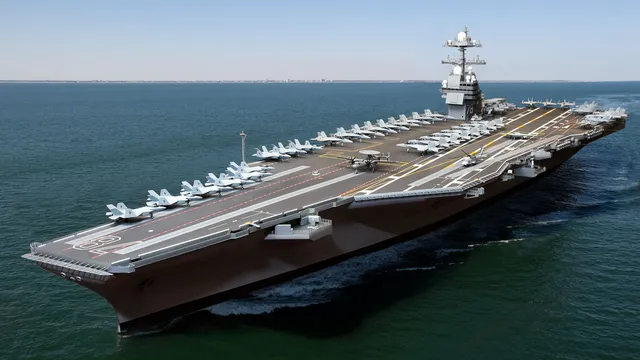
The USS Gerald R. Ford underway during sea trials, showcasing its massive flight deck and advanced design.
Key Specifications
- Length: 1,106 feet (337 meters)
- Displacement: Approximately 100,000 tons
- Propulsion: Two nuclear reactors
- Crew: Around 4,500 personnel
- Aircraft Capacity: More than 75 aircraft
- Estimated Cost: Over $13 billion
According to the U.S. Navy, the Ford-class was designed to deliver greater sortie generation rates while reducing long-term operational costs.
What Makes the USS Gerald R. Ford Different?
The Ford-class introduces several major technological advancements over previous carriers.
Electromagnetic Aircraft Launch System (EMALS)
Unlike older steam catapult systems, the USS Gerald R. Ford uses EMALS to launch aircraft. This electromagnetic system allows smoother acceleration, reduces stress on aircraft frames, and enables the launch of lighter unmanned systems.
Advanced Radar and Defense Systems
The ship features cutting-edge radar systems capable of tracking multiple airborne and surface threats simultaneously. These systems improve early detection and enhance coordinated defense operations.
Higher Aircraft Sortie Rates
The Ford-class can generate up to 33% more flight sorties per day compared to its predecessors. In military operations, this translates into sustained air dominance during prolonged engagements.
Reduced Crew Through Automation
Advanced automation reduces crew requirements while maintaining operational efficiency. Over its lifespan, this is expected to save billions in personnel costs.
Strategic Role in Global Security
Aircraft carriers serve as floating airbases, capable of projecting power anywhere in the world without relying on foreign land bases. The USS Gerald R. Ford plays a central role in U.S. naval deterrence strategy.
When deployed near regions experiencing tension, its presence signals readiness and commitment to allies. It is often accompanied by destroyers, cruisers, and submarines forming a carrier strike group.
Recent deployments in the Mediterranean and Middle East have drawn global attention, particularly amid evolving security dynamics in the Gulf region.
Why the World Is Watching
The movement of a supercarrier like the USS Gerald R. Ford often coincides with heightened geopolitical developments. However, deployment does not automatically mean active war. In many cases, it serves as a deterrent designed to prevent escalation.
Defense analysts note that carrier deployments are strategic signals rather than immediate triggers for combat. Institutions such as the U.S. Department of Defense regularly emphasize deterrence as a primary objective.
Life Onboard the USS Gerald R. Ford
Life aboard a nuclear-powered aircraft carrier is highly structured. Sailors operate in shifts around the clock, managing flight operations, engineering systems, logistics, and security.
The ship includes medical facilities, dining areas, sleeping quarters, and command centers. During extended deployments, it functions as a self-contained city at sea.
Economic and Political Significance
Beyond military power, the USS Gerald R. Ford reflects America’s technological and industrial capacity. Shipbuilding for the Ford-class supports thousands of jobs and represents decades of research and development investment.
Globally, the presence of such a vessel can influence diplomatic negotiations, regional stability discussions, and alliance coordination efforts.
Understanding Military Developments in Context
For readers seeking clarity on global affairs, it is important to analyze military deployments alongside diplomatic and humanitarian developments. For example, migration patterns and refugee flows often rise during regional instability. Those seeking foundational guidance can review this comprehensive resource on the asylum process basics.
Similarly, students considering international education pathways amid geopolitical shifts may find this guide on study in Germany requirements helpful.
While defense developments dominate headlines, global news spans multiple sectors, including sports. Readers following international football updates can explore the latest Liverpool transfer news.
Does Deployment Mean War?
Historically, aircraft carriers are deployed both during peacetime and crises. Their primary function is deterrence. By maintaining visible presence, they reduce the likelihood of miscalculation by adversaries.
Experts at institutions like the Council on Foreign Relations frequently analyze carrier deployments as part of broader strategic balancing rather than immediate combat preparation.
The Future of the Ford-Class
The USS Gerald R. Ford is only the first in a planned series of Ford-class carriers. Future ships will refine these technologies and further modernize naval warfare capabilities.
As unmanned aerial systems and artificial intelligence become more integrated into military operations, the Ford-class is designed to adapt to evolving defense requirements.
Frequently Asked Questions
What does CVN-78 stand for?
CVN stands for “Aircraft Carrier, Nuclear-powered,” and 78 is the hull classification number assigned to the USS Gerald R. Ford.
How long can the USS Gerald R. Ford operate without refueling?
Its nuclear reactors can operate for over 20 years without refueling, allowing extended deployments worldwide.
Is the USS Gerald R. Ford currently in combat?
Deployment does not necessarily indicate active combat. Carriers are frequently positioned as deterrents and rapid-response assets.
How many aircraft can it carry?
The carrier can support more than 75 aircraft, including fighter jets, surveillance planes, and helicopters.
Why is it considered the most advanced aircraft carrier?
Its EMALS launch system, advanced radar technology, automation features, and increased sortie generation rate make it more capable than previous classes.
What role does it play in Middle East security?
When deployed in the region, it serves as a deterrent force and supports allied defense efforts while maintaining readiness.