


Once part of Spain’s vast empire in the New World, Honduras became an independent nation in 1821. After two and a half decades of mostly military rule, a freely elected civilian government came to power in 1982. During the 1980s, Honduras proved a haven for anti-Sandinista contras fighting the Marxist Nicaraguan Government and an ally to Salvadoran Government forces fighting leftist guerrillas. Hurricane Mitch devastated the country in 1998, killing about 5,600 people and causing approximately $2 billion in damage. Since then, the economy has slowly rebounded, despite COVID-19 and severe storm-related setbacks in 2020 and 2021.TipVisit the Definitions and Notes page to view a description of each topic.Definitions and Notes
Geography
Location
Central America, bordering the Caribbean Sea, between Guatemala and Nicaragua and bordering the Gulf of Fonseca (North Pacific Ocean), between El Salvador and Nicaragua
Geographic coordinates
15 00 N, 86 30 W
Map references
Central America and the Caribbean
Area
total : 112,090 sq km
land: 111,890 sq km
water: 200 sq km
comparison ranking: total 103
Area – comparative
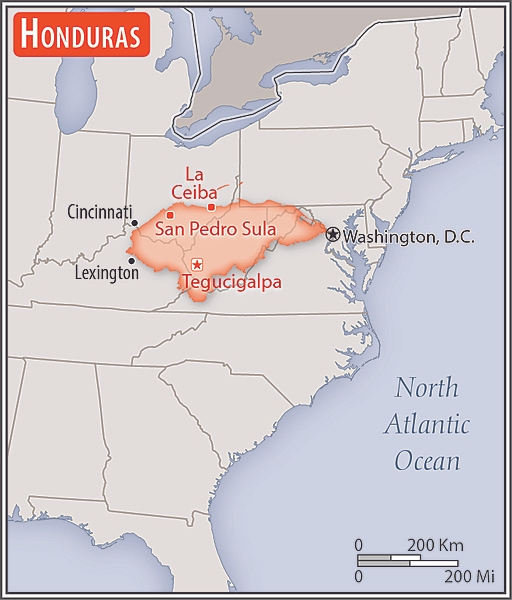
slightly larger than Tennessee
Area comparison map:
Land boundaries
total: 1,575 km
border countries (3): Guatemala 244 km; El Salvador 391 km; Nicaragua 940 km
Coastline
823 km (Caribbean Sea 669 km, Gulf of Fonseca 163 km)
Maritime claims
territorial sea: 12 nm
contiguous zone: 24 nm
exclusive economic zone: 200 nm
continental shelf: natural extension of territory or to 200 nm
Climate
subtropical in lowlands, temperate in mountains
Terrain
mostly mountains in interior, narrow coastal plains
Elevation
highest point: Cerro Las Minas 2,870 m
lowest point: Caribbean Sea 0 m
mean elevation: 684 m
Natural resources
timber, gold, silver, copper, lead, zinc, iron ore, antimony, coal, fish, hydropower
Land use
agricultural land: 32% (2022 est.)
arable land: 9.1% (2022 est.)
permanent crops: 5.4% (2022 est.)
permanent pasture: 17.5% (2022 est.)
forest: 56.5% (2022 est.)
other: 11.6% (2022 est.)
Irrigated land
900 sq km (2012)
Major lakes (area sq km)
salt water lake(s): Laguna de Caratasca – 1,110 sq km
Population distribution
most residents live in the mountainous western half of the country; Honduras is the only Central American nation with an urban population that is distributed between two large centers, the capital of Tegucigalpa and the city of San Pedro Sula; the Rio Ulua valley in the north is the only densely populated lowland area
Natural hazards
frequent, but generally mild, earthquakes; extremely susceptible to damaging hurricanes and floods along the Caribbean coast
Geography – note
has only a short Pacific coast but a long Caribbean shoreline, including the virtually uninhabited eastern Mosquito Coast
People and Society
Population
total: 9,529,188 (2024 est.)
male: 4,591,247
female: 4,937,941
comparison rankings: total 96; female 96; male 97
Nationality
noun: Honduran(s)
adjective: Honduran
Ethnic groups
Mestizo (mixed Indigenous and European) 90%, Indigenous 7%, African descent 2%, White 1%
Languages
Spanish (official), Amerindian dialects
major-language sample(s):
La Libreta Informativa del Mundo, la fuente indispensable de información básica. (Spanish)
The World Factbook, the indispensable source for basic information.
Spanish audio sample:
Religions
Evangelical 55%, Roman Catholic 33.4%, none 10.1%, unspecified 1.5% (2023 est.)
Age structure
0-14 years: 28.7% (male 1,378,026/female 1,353,238)
15-64 years: 65.7% (male 2,980,393/female 3,282,159)
65 years and over: 5.6% (2024 est.) (male 232,828/female 302,544)
2024 population pyramid:

Dependency ratios
total dependency ratio: 52.2 (2024 est.)
youth dependency ratio: 43.6 (2024 est.)
elderly dependency ratio: 8.5 (2024 est.)
potential support ratio: 11.7 (2024 est.)
Median age
total: 25.7 years (2024 est.)
male: 24.8 years
female: 26.6 years
comparison ranking: total 168
Population growth rate
1.29% (2024 est.)
comparison ranking: 74
Birth rate
19.9 births/1,000 population (2024 est.)
comparison ranking: 68
Death rate
5.4 deaths/1,000 population (2024 est.)
comparison ranking: 185
Net migration rate
-1.7 migrant(s)/1,000 population (2024 est.)
comparison ranking: 165
Population distribution
most residents live in the mountainous western half of the country; Honduras is the only Central American nation with an urban population that is distributed between two large centers, the capital of Tegucigalpa and the city of San Pedro Sula; the Rio Ulua valley in the north is the only densely populated lowland area
Urbanization
urban population: 60.2% of total population (2023)
rate of urbanization: 2.48% annual rate of change (2020-25 est.)
Major urban areas – population
1.568 million TEGUCIGALPA (capital), 982,000 San Pedro Sula (2023)
Sex ratio
at birth: 1.03 male(s)/female
0-14 years: 1.02 male(s)/female
15-64 years: 0.91 male(s)/female
65 years and over: 0.77 male(s)/female
total population: 0.93 male(s)/female (2024 est.)
Mother’s mean age at first birth
20.3 years (2011/12 est.)
note: data represents median age a first birth among women 25-49
Maternal mortality ratio
72 deaths/100,000 live births (2020 est.)
comparison ranking: 85
Infant mortality rate
total: 15.4 deaths/1,000 live births (2024 est.)
male: 17.5 deaths/1,000 live births
female: 13.2 deaths/1,000 live births
comparison ranking: total 90
Life expectancy at birth
total population: 73.1 years (2024 est.)
male: 69.6 years
female: 76.8 years
comparison ranking: total population 152
Total fertility rate
2.33 children born/woman (2024 est.)
comparison ranking: 76
Gross reproduction rate
1.15 (2024 est.)
Contraceptive prevalence rate
69.4% (2019)
Drinking water source
improved:
urban: 100% of population
rural: 90.7% of population
total: 96.1% of population
unimproved:
urban: 0% of population
rural: 9.3% of population
total: 3.9% of population (2020 est.)
Health expenditure
9.2% of GDP (2021)
14.2% of national budget (2022 est.)
Physician density
0.49 physicians/1,000 population (2020)
Hospital bed density
0.7 beds/1,000 population (2021 est.)
Sanitation facility access
improved:
urban: 96.7% of population
rural: 87.9% of population
total: 93% of population
unimproved:
urban: 3.3% of population
rural: 12.1% of population
total: 7% of population (2020 est.)
Obesity – adult prevalence rate
21.4% (2016)
comparison ranking: 89
Alcohol consumption per capita
total: 2.73 liters of pure alcohol (2019 est.)
beer: 1.6 liters of pure alcohol (2019 est.)
wine: 0.04 liters of pure alcohol (2019 est.)
spirits: 1.09 liters of pure alcohol (2019 est.)
other alcohols: 0 liters of pure alcohol (2019 est.)
comparison ranking: total 119
Tobacco use
total: 11.9% (2025 est.)
male: 22.2% (2025 est.)
female: 1.6% (2025 est.)
comparison ranking: total 113
Children under the age of 5 years underweight
7.1% (2019)
comparison ranking: 60
Currently married women (ages 15-49)
53.5% (2023 est.)
Child marriage
women married by age 15: 9.2% (2019)
women married by age 18: 34% (2019)
men married by age 18: 10% (2019)
Education expenditure
4% of GDP (2023 est.)
13.3% national budget (2024 est.)
comparison ranking: Education expenditure (% GDP) 110
Literacy
total population: 89% (2019 est.)
male: 88% (2019 est.)
female: 89% (2019 est.)
School life expectancy (primary to tertiary education)
total: 10 years
male: 10 years
female: 11 years (2019)
Environment
Environment – current issues
deforestation from logging and agricultural clearing; land degradation and soil erosion from overdevelopment and improper land use practices; mining activities polluting Lago de Yojoa (the country’s largest source of fresh water) and other rivers and streams
Environment – international agreements
party to: Biodiversity, Climate Change, Climate Change-Kyoto Protocol, Climate Change-Paris Agreement, Comprehensive Nuclear Test Ban, Desertification, Endangered Species, Environmental Modification, Hazardous Wastes, Law of the Sea, Marine Dumping-London Convention, Nuclear Test Ban, Ozone Layer Protection, Ship Pollution, Tropical Timber 2006, Wetlands
signed, but not ratified: none of the selected agreements
Climate
subtropical in lowlands, temperate in mountains
Land use
agricultural land: 32% (2022 est.)
arable land: 9.1% (2022 est.)
permanent crops: 5.4% (2022 est.)
permanent pasture: 17.5% (2022 est.)
forest: 56.5% (2022 est.)
other: 11.6% (2022 est.)
Urbanization
urban population: 60.2% of total population (2023)
rate of urbanization: 2.48% annual rate of change (2020-25 est.)
Air pollutants
particulate matter emissions: 18.93 micrograms per cubic meter (2019 est.)
carbon dioxide emissions: 9.81 megatons (2016 est.)
methane emissions: 7.72 megatons (2020 est.)
Waste and recycling
municipal solid waste generated annually: 2,162,028 tons (2016 est.)
Major lakes (area sq km)
salt water lake(s): Laguna de Caratasca – 1,110 sq km
Total water withdrawal
municipal: 320 million cubic meters (2020 est.)
industrial: 111 million cubic meters (2020 est.)
agricultural: 1.18 billion cubic meters (2020 est.)
Total renewable water resources
92.16 billion cubic meters (2020 est.)
Government
Country name
conventional long form: Republic of Honduras
conventional short form: Honduras
local long form: República de Honduras
local short form: Honduras
etymology: the name means “depths” in Spanish and refers to the deep anchorage in the northern Bay of Trujillo
Government type
presidential republic
Capital
name: Tegucigalpa
geographic coordinates: 14 06 N, 87 13 W
time difference: UTC-6 (1 hour behind Washington, DC during Standard Time)
etymology: the name is a Nahuatl word meaning “silver mountain,” probably referring to nearby silver mines
note: the Honduran constitution states that Tegucigalpa and Comayaguela jointly constitute the capital of Honduras, but virtually all governmental institutions are on the Tegucigalpa side
Administrative divisions
18 departments (departamentos, singular – departamento); Atlántida, Choluteca, Colon, Comayagua, Copan, Cortes, El Paraiso, Francisco Morazán, Gracias a Dios, Intibucá, Islas de la Bahia, La Paz, Lempira, Ocotepeque, Olancho, Santa Barbara, Valle, Yoro
Legal system
civil law system
Constitution
history: several previous; latest approved 11 January 1982, effective 20 January 1982
amendment process: proposed by the National Congress with at least two-thirds majority vote of the membership; passage requires at least two-thirds majority vote of Congress in its next annual session; constitutional articles, such as the form of government, national sovereignty, the presidential term, and the procedure for amending the constitution, cannot be amended
International law organization participation
accepts compulsory ICJ jurisdiction with reservations; accepts ICCt jurisdiction
Citizenship
citizenship by birth: yes
citizenship by descent only: yes
dual citizenship recognized: yes
residency requirement for naturalization: 1 to 3 years
Suffrage
18 years of age; universal and compulsory
Executive branch
chief of state: President Iris Xiomara CASTRO de Zelaya (since 27 January 2022)
head of government: President Iris Xiomara CASTRO de Zelaya (since 27 January 2022)
cabinet: Cabinet appointed by president
election/appointment process: president directly elected by simple-majority popular vote for a 4-year term
most recent election date: 28 November 2021
election results:
2021: Iris Xiomara CASTRO de Zelaya elected president; percent of vote – Iris Xiomara CASTRO de Zelaya (LIBRE) 51.1%, Nasry Juan ASFURA Zablah (PNH) 36.9%, Yani Benjamin ROSENTHAL Hidalgo (PL) 10%, other 2%
2017: Juan Orlando HERNANDEZ Alvarado reelected president; percent of vote – Juan Orlando HERNANDEZ Alvarado (PNH) 43%, Salvador NASRALLA (Alianza de Oposicion contra la Dictadura) 41.4%, Luis Orlando ZELAYA Medrano (PL) 14.7%, other 0.9%
expected date of next election: 30 November 2025
note: the president is both chief of state and head of government
Legislative branch
legislature name: National Congress (Congreso Nacional)
legislative structure: unicameral
number of seats: 128 (all directly elected)
electoral system: proportional representation
scope of elections: full renewal
term in office: 4 years
most recent election date: 11/28/2021
parties elected and seats per party: Liberty and Refoundation Party (LIBRE) (50); National Party (PN) (44); Liberal Party (PL) (22); Salvador de Honduras Party (PSH) (10); Other (2)
percentage of women in chamber: 27.3%
expected date of next election: November 2025
Judicial branch
highest court(s): Supreme Court of Justice or Corte Suprema de Justicia (15 principal judges, including the court president, and 6 alternates; court organized into civil, criminal, constitutional, and labor chambers)
judge selection and term of office: court president elected by his peers; judges elected by the National Congress from candidates proposed by the Nominating Board, a diverse 7-member group of judicial officials and other government and non-government officials nominated by each of their organizations; judges elected by Congress for renewable, 7-year terms
subordinate courts: courts of appeal; courts of first instance; justices of the peace
note: the Supreme Court has both judicial and constitutional jurisdiction
Political parties
Anti-Corruption Party or PAC
Christian Democratic Party or DC
Democratic Liberation of Honduras or Liderh
Democratic Unification Party or UD
The Front or El Frente
Honduran Patriotic Alliance or AP
Innovation and Unity Party or PINU
Liberal Party or PL
Liberty and Refoundation Party or LIBRE
National Party of Honduras or PNH
New Route or NR
Opposition Alliance against the Dictatorship or Alianza de Oposicion contra la Dictadura (electoral coalition)
Savior Party of Honduras or PSH
Vamos or Let’s Go
We Are All Honduras (Todos Somos Honduras) or TSH
Diplomatic representation in the US
chief of mission: Ambassador Javier Efrain BU SOTO (since 12 December 2022)
chancery: 1220 19th Street NW, Suite #320, Washington, DC 20036
telephone: [1] (202) 966-7702
FAX: [1] (202) 966-9751
email address and website:
[email protected]
https://hondurasembusa.org/
consulate(s) general: Atlanta, Boston, Charlotte (NC), Chicago, Dallas, Houston, Los Angeles, McAllen (TX), Miami, New Orleans, New York, San Francisco, Seattle
Diplomatic representation from the US
chief of mission: Ambassador (vacant); Chargé d’Affaires Roy PERRIN (since April 2025)
embassy: Avenida La Paz, Tegucigalpa M.D.C.
mailing address: 3480 Tegucigalpa Place, Washington DC 20521-3480
telephone: [504] 2236-9320,
FAX: [504] 2236-9037
email address and website:
[email protected]
https://hn.usembassy.gov/
International organization participation
ACS, BCIE, CACM, CD, CELAC, EITI (candidate country), FAO, G-11, G-77, IADB, IAEA, IBRD, ICAO, ICCt, ICRM, IDA, IFAD, IFC, IFRCS, ILO, IMF, IMO, Interpol, IOC (suspended), IOM, IPU, ISO (subscriber), ITSO, ITU, ITUC (NGOs), LAES, LAIA (observer), MIGA, MINURSO, MINUSTAH, NAM, OAS, OPANAL, OPCW, Pacific Alliance (observer), PCA, Petrocaribe, SICA, UN, UNCTAD, UNHRC, UNESCO, UNIDO, Union Latina, UNWTO, UPU, WCO (suspended), WFTU (NGOs), WHO, WIPO, WMO, WTO
Independence
15 September 1821 (from Spain)
National holiday
Independence Day, 15 September (1821)
Flag description
three equal horizontal bands of cerulean blue (top), white, and cerulean blue, with five cerulean five-pointed stars arranged in an X pattern and centered in the white band; the stars represent the members of the former Federal Republic of Central America: Costa Rica, El Salvador, Guatemala, Honduras, and Nicaragua; the blue bands stand for the Pacific Ocean and the Caribbean Sea, and the white band for the land and the peace and prosperity of its people
note: similar to the flag of El Salvador, which features a round emblem encircled by the words REPUBLICA DE EL SALVADOR EN LA AMERICA CENTRAL; also similar to the flag of Nicaragua, which features a triangle encircled by the words REPUBLICA DE NICARAGUA on top and AMERICA CENTRAL on the bottom
National symbol(s)
scarlet macaw, white-tailed deer
National color(s)
blue, white
National anthem
name: “Himno Nacional de Honduras” (National Anthem of Honduras)
lyrics/music: Augusto Constancio COELLO/Carlos HARTLING
note: adopted 1915; the anthem’s seven verses chronicle Honduran history; on official occasions, only the chorus and last verse are sung
National heritage
total World Heritage Sites: 2 (1 cultural, 1 natural)
selected World Heritage Site locales: Maya Site of Copan (c); Río Plátano Biosphere Reserve (n)
Economy
Economic overview
second-fastest-growing Central American economy; COVID-19 and two hurricanes crippled activity; high poverty and inequality; declining-but-still-high violent crime disruption; systemic corruption; coffee and banana exporter; enormous remittances
Real GDP (purchasing power parity)
$68.854 billion (2023 est.)
$66.473 billion (2022 est.)
$63.828 billion (2021 est.)
note: data in 2021 dollars
comparison ranking: 111
Real GDP growth rate
3.58% (2023 est.)
4.14% (2022 est.)
12.57% (2021 est.)
note: annual GDP % growth based on constant local currency
comparison ranking: 92
Real GDP per capita
$6,500 (2023 est.)
$6,400 (2022 est.)
$6,200 (2021 est.)
note: data in 2021 dollars
comparison ranking: 163
GDP (official exchange rate)
$34.401 billion (2023 est.)
note: data in current dollars at official exchange rate
Inflation rate (consumer prices)
4.6% (2024 est.)
6.7% (2023 est.)
9.1% (2022 est.)
note: annual % change based on consumer prices
comparison ranking: 142
GDP – composition, by sector of origin
agriculture: 12% (2023 est.)
industry: 26% (2023 est.)
services: 57.4% (2023 est.)
note: figures may not total 100% due to non-allocated consumption not captured in sector-reported data
comparison rankings: services 109; industry 85; agriculture 65
GDP – composition, by end use
household consumption: 86.4% (2023 est.)
government consumption: 14.4% (2023 est.)
investment in fixed capital: 24.2% (2023 est.)
investment in inventories: -1.1% (2023 est.)
exports of goods and services: 37% (2023 est.)
imports of goods and services: -60.9% (2023 est.)
note: figures may not total 100% due to rounding or gaps in data collection
Agricultural products
sugarcane, oil palm fruit, maize, milk, bananas, coffee, cantaloupes/melons, oranges, chicken, beans (2023)
note: top ten agricultural products based on tonnage
Industries
sugar processing, coffee, woven and knit apparel, wood products, cigars
Industrial production growth rate
-2.04% (2023 est.)
note: annual % change in industrial value added based on constant local currency
comparison ranking: 180
Labor force
4.296 million (2024 est.)
note: number of people ages 15 or older who are employed or seeking work
comparison ranking: 95
Unemployment rate
6.1% (2024 est.)
6.1% (2023 est.)
8.8% (2022 est.)
note: % of labor force seeking employment
comparison ranking: 122
Youth unemployment rate (ages 15-24)
total: 10.5% (2024 est.)
male: 7.9% (2024 est.)
female: 15.9% (2024 est.)
note: % of labor force ages 15-24 seeking employment
comparison ranking: total 124
Population below poverty line
64.1% (2023 est.)
note: % of population with income below national poverty line
Gini Index coefficient – distribution of family income
48.2 (2019 est.)
note: index (0-100) of income distribution; higher values represent greater inequality
comparison ranking: 15
Average household expenditures
on food: 31.5% of household expenditures (2023 est.)
on alcohol and tobacco: 4.9% of household expenditures (2023 est.)
Household income or consumption by percentage share
lowest 10%: 1.2% (2019 est.)
highest 10%: 34.6% (2019 est.)
note: % share of income accruing to lowest and highest 10% of population
Remittances
26.07% of GDP (2023 est.)
27% of GDP (2022 est.)
25.59% of GDP (2021 est.)
note: personal transfers and compensation between resident and non-resident individuals/households/entities
Budget
revenues: $5.333 billion (2020 est.)
expenditures: $5.696 billion (2020 est.)
note: central government revenues (excluding grants) and expenses converted to US dollars at average official exchange rate for year indicated
Public debt
39.5% of GDP (2017 est.)
comparison ranking: 133
Taxes and other revenues
15.1% (of GDP) (2020 est.)
note: central government tax revenue as a % of GDP
comparison ranking: 135
Current account balance
-$1.389 billion (2023 est.)
-$2.105 billion (2022 est.)
-$1.538 billion (2021 est.)
note: balance of payments – net trade and primary/secondary income in current dollars
comparison ranking: 147
Exports
$9.646 billion (2023 est.)
$9.403 billion (2022 est.)
$8.052 billion (2021 est.)
note: balance of payments – exports of goods and services in current dollars
comparison ranking: 118
Exports – partners
USA 49%, Nicaragua 8%, El Salvador 7%, Guatemala 5%, Mexico 5% (2023)
note: top five export partners based on percentage share of exports
Exports – commodities
garments, coffee, insulated wire, palm oil, shellfish (2023)
note: top five export commodities based on value in dollars
Imports
$17.789 billion (2023 est.)
$17.943 billion (2022 est.)
$14.869 billion (2021 est.)
note: balance of payments – imports of goods and services in current dollars
comparison ranking: 101
Imports – partners
USA 36%, China 14%, Guatemala 8%, Mexico 6%, El Salvador 6% (2023)
note: top five import partners based on percentage share of imports
Imports – commodities
refined petroleum, cotton yarn, garments, trucks, packaged medicine (2023)
note: top five import commodities based on value in dollars
Reserves of foreign exchange and gold
$7.543 billion (2023 est.)
$8.41 billion (2022 est.)
$8.667 billion (2021 est.)
note: holdings of gold (year-end prices)/foreign exchange/special drawing rights in current dollars
comparison ranking: 86
Debt – external
$7.785 billion (2023 est.)
note: present value of external debt in current US dollars
comparison ranking: 58
Exchange rates
lempiras (HNL) per US dollar –
Exchange rates:
24.799 (2024 est.)
24.602 (2023 est.)
24.486 (2022 est.)
24.017 (2021 est.)
24.582 (2020 est.)
Energy
Electricity access
electrification – total population: 94.4% (2022 est.)
electrification – urban areas: 100%
electrification – rural areas: 86.8%
Electricity
installed generating capacity: 3.334 million kW (2023 est.)
consumption: 8.303 billion kWh (2023 est.)
exports: 4 million kWh (2023 est.)
imports: 214.601 million kWh (2023 est.)
transmission/distribution losses: 3.617 billion kWh (2023 est.)
comparison rankings: transmission/distribution losses 150; imports 106; exports 100; consumption 114; installed generating capacity 106
Electricity generation sources
fossil fuels: 38.4% of total installed capacity (2023 est.)
solar: 8.9% of total installed capacity (2023 est.)
wind: 5.9% of total installed capacity (2023 est.)
hydroelectricity: 33.2% of total installed capacity (2023 est.)
geothermal: 3% of total installed capacity (2023 est.)
biomass and waste: 10.7% of total installed capacity (2023 est.)
Coal
consumption: 144,000 metric tons (2023 est.)
imports: 148,000 metric tons (2023 est.)
Petroleum
total petroleum production: 20 bbl/day (2023 est.)
refined petroleum consumption: 71,000 bbl/day (2023 est.)
Carbon dioxide emissions
10.534 million metric tonnes of CO2 (2023 est.)
from coal and metallurgical coke: 324,000 metric tonnes of CO2 (2023 est.)
from petroleum and other liquids: 10.21 million metric tonnes of CO2 (2023 est.)
comparison ranking: total emissions 107
Energy consumption per capita
16.642 million Btu/person (2023 est.)
comparison ranking: 136
Communications
Telephones – fixed lines
total subscriptions: 444,000 (2023 est.)
subscriptions per 100 inhabitants: 4 (2023 est.)
comparison ranking: total subscriptions 97
Telephones – mobile cellular
total subscriptions: 7.92 million (2023 est.)
subscriptions per 100 inhabitants: 76 (2022 est.)
comparison ranking: total subscriptions 103
Broadcast media
multiple privately owned terrestrial TV networks, supplemented by multiple cable TV networks; Radio Honduras is the state-owned radio network; roughly 300 privately owned radio stations (2019)
Internet country code
.hn
Internet users
percent of population: 58% (2023 est.)
Broadband – fixed subscriptions
total: 476,000 (2023 est.)
subscriptions per 100 inhabitants: 4 (2023 est.)
comparison ranking: total 100
Transportation
Civil aircraft registration country code prefix
HR
Airports
129 (2025)
comparison ranking: 40
Heliports
6 (2025)
comparison ranking: 95
Railways
total: 699 km (2014)
narrow gauge: 164 km (2014) 1.067-m gauge
115 km 1.057-mm gauge
420 km 0.914-mm gauge
Merchant marine
total: 489 (2023)
by type: general cargo 233, oil tanker 82, other 174
comparison ranking: total 43
Ports
total ports: 8 (2024)
large: 0
medium: 0
small: 1
very small: 7
ports with oil terminals: 3
key ports: Coxen Hole, La Ceiba, Puerto Castilla, Puerto Cortes, Puerto de Hencan, Puerto Este, Tela, Trujillo
Military and Security
Military and security forces
Honduran Armed Forces (Fuerzas Armadas de Honduras, FFAA): Army (Ejercito), Honduran Naval Force (Fuerza Naval Hondurena, FNH; includes marines), Honduran Air Force (Fuerza Aerea Hondurena, FAH), Honduran Military Police of Public Order (Policía Militar del Orden Público or PMOP) (2025)
note 1: the National Police of Honduras (Policía Nacional de Honduras, PNH) are under the Secretariat of Security and responsible for internal security; some larger cities have police forces that operate independently of the national police and report to municipal authorities
note 2: the PMOP supports the PNH against narcotics trafficking and organized crime; it is subordinate to the Secretariat of Defense/FFAA, but conducts operations sanctioned by civilian security officials as well as by military leaders
note 3: the National Interinstitutional Security Force is an interagency command that coordinates the overlapping responsibilities of the HNP, PMOP, and other security organizations such as the National Intelligence Directorate and the Public Ministry (public prosecutor), but exercises coordination, command, and control responsibilities only during interagency operations involving those forces
Military expenditures
1.5% of GDP (2024 est.)
1.5% of GDP (2023 est.)
1.4% of GDP (2022 est.)
1.5% of GDP (2021 est.)
1.6% of GDP (2020 est.)
Military and security service personnel strengths
approximately 15,000 active Honduran Armed Forces (2025)
Military equipment inventories and acquisitions
the FFAA’s inventory is comprised of a mix of older or secondhand and limited amounts of more equipment from a wide mix of suppliers, including Colombia, Germany, Israel, the Netherlands, South Korea, the UK, and the US (2024)
Military service age and obligation
18-22 years of age for voluntary military service for men and women; 24-36 month service obligation; no conscription (2024)
note: as of 2023, women made up about 9% of the active duty military
Military – note
the Honduran Armed Forces (FFAA) are responsible for maintaining the country’s territory, defending its sovereignty, providing emergency/humanitarian assistance, and supporting the National Police (PNH); the FFAA’s primary focus is internal and border security, and since 2011 a considerable portion of it has been deployed to support the PNH in combating narcotics trafficking and organized crime; military support to domestic security included the creation of the Military Police of Public Order (PMOP) in 2013 to provide security in areas controlled by street gangs to combat crime and make arrests; the FFAA, including the PMOP, cooperates with the militaries of El Salvador, Guatemala, and Nicaragua on border security
the FFAA has received military equipment, training, humanitarian, and technical assistance from the US military; the US military maintains a joint service task force co-located with the FFAA at Soto Cano Air Base (2025)
Transnational Issues
Refugees and internally displaced persons
IDPs: 247,000 (violence, extortion, threats, forced recruitment by urban gangs between 2004 and 2018) (2023)
Illicit drugs
transshipment point for cocaine destined for the United States and precursor chemicals used to produce illicit drugs; some small-scale coca cultivation