In 1783, the Sunni AL-KHALIFA family took power in Bahrain. In order to secure these holdings, it entered into a series of treaties with the UK during the 19th century that made Bahrain a British protectorate. The archipelago attained its independence in 1971. A steady decline in oil production and reserves since 1970 prompted Bahrain to take steps to diversify its economy, in the process developing petroleum processing and refining, aluminum production, and hospitality and retail sectors. It has also endeavored to become a leading regional banking center, especially with respect to Islamic finance. Bahrain’s small size, central location among Gulf countries, economic dependence on Saudi Arabia, and proximity to Iran require it to play a delicate balancing act in foreign affairs among its larger neighbors. Its foreign policy activities usually fall in line with Saudi Arabia and the UAE. In 2022, the United States designated Bahrain as a major non-NATO ally.
The Sunni royal family has long struggled to manage relations with its Shia-majority population. In 2011, amid Arab uprisings elsewhere in the region, the Bahraini Government responded to similar pro-democracy and reform protests at home with police and military action, including deploying Gulf Cooperation Council security forces. Ongoing dissatisfaction with the political status quo continues to factor into sporadic clashes between demonstrators and security forces. In 2020, Bahrain and the United Arab Emirates signed the US-brokered Abraham Accords with Israel. In 2023, Bahrain and the United States signed the Comprehensive Security Integration and Prosperity Agreement to enhance cooperation across a wide range of areas, from defense and security to emerging technology, trade, and investment.TipVisit the Definitions and Notes page to view a description of each topic.Definitions and Notes
Geography
Location
Middle East, archipelago in the Persian Gulf, east of Saudi Arabia
Geographic coordinates
26 00 N, 50 33 E
Map references
Middle East
Area
total : 760 sq km
land: 760 sq km
water: 0 sq km
comparison ranking: total 187
Area – comparative
3.5 times the size of Washington, D.C.
Area comparison map:

Land boundaries
total: 0 km
Coastline
161 km
Maritime claims
territorial sea: 12 nm
contiguous zone: 24 nm
continental shelf: extending to boundaries to be determined
Climate
arid; mild, pleasant winters; very hot, humid summers
Terrain
mostly low desert plain rising gently to low central escarpment
Elevation
highest point: Jabal ad Dukhan 135 m
lowest point: Persian Gulf 0 m
Natural resources
oil, associated and nonassociated natural gas, fish, pearls
Land use
agricultural land: 10.3% (2022 est.)
arable land: 2.7% (2022 est.)
permanent crops: 2.5% (2022 est.)
permanent pasture: 5.1% (2022 est.)
forest: 0.9% (2022 est.)
other: 88.8% (2022 est.)
Irrigated land
40 sq km (2012)
Major aquifers
Arabian Aquifer System
Population distribution
smallest population of the Gulf States, but urbanization rate exceeds 90%; largest settlement concentration is found on the far northern end of the island in and around Manamah and Al Muharraq
Natural hazards
periodic droughts; dust storms
Geography – note
close to primary Middle Eastern petroleum sources; strategic location in Persian Gulf, through which much of the Western world’s petroleum must transit to reach open ocean
People and Society
Population
total: 1,566,888 (2024 est.)
male: 940,022
female: 626,866
comparison rankings: total 155; female 159; male 154
Nationality
noun: Bahraini(s)
adjective: Bahraini
Ethnic groups
Bahraini 47.4%, Asian 43.4%, other Arab 4.9%, African 1.4%, North American 1.1%, Gulf Co-operative countries 0.9%, European 0.8%, other 0.1% (2020 est.)
Languages
Arabic (official), English, Farsi, Urdu
major-language sample(s):
كتاب حقائق العالم، المصدر الذي لا يمكن الاستغناء عنه للمعلومات الأساسية (Arabic)
The World Factbook, the indispensable source for basic information.
Arabic audio sample:
Religions
Muslim 74.2%, other (includes Christian, Jewish, Hindu, Baha’i) 25.8% (2020 est.)
Age structure
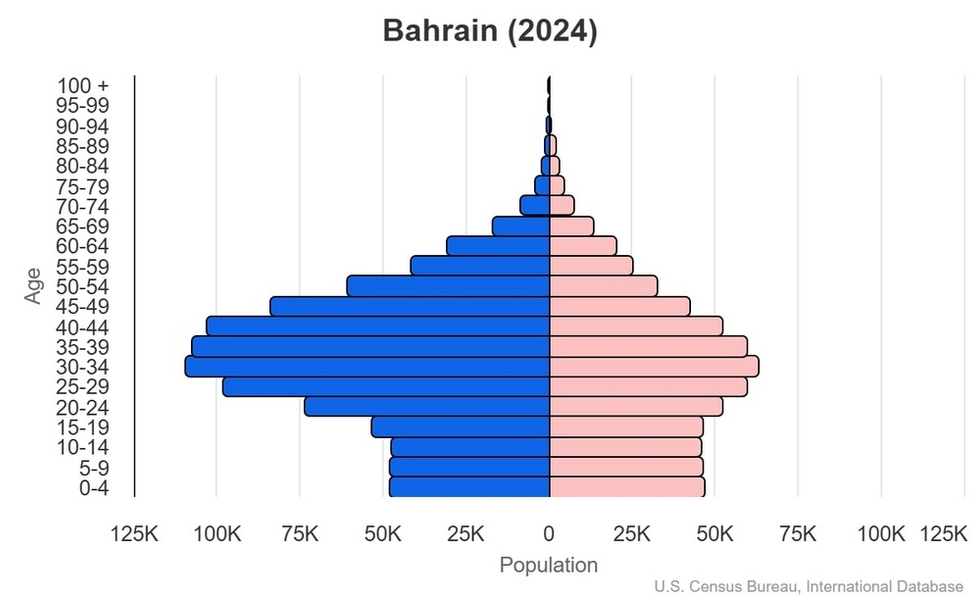
0-14 years: 18.1% (male 143,399/female 139,667)
15-64 years: 77.7% (male 762,190/female 454,616)
65 years and over: 4.3% (2024 est.) (male 34,433/female 32,583)
2024 population pyramid:
Dependency ratios
total dependency ratio: 28.8 (2024 est.)
youth dependency ratio: 23.3 (2024 est.)
elderly dependency ratio: 5.5 (2024 est.)
potential support ratio: 18.2 (2024 est.)
Median age
total: 33.4 years (2024 est.)
male: 34.6 years
female: 31.2 years
comparison ranking: total 111
Population growth rate
0.82% (2024 est.)
comparison ranking: 109
Birth rate
12.2 births/1,000 population (2024 est.)
comparison ranking: 146
Death rate
2.8 deaths/1,000 population (2024 est.)
comparison ranking: 226
Net migration rate
-1.2 migrant(s)/1,000 population (2024 est.)
comparison ranking: 151
Population distribution
smallest population of the Gulf States, but urbanization rate exceeds 90%; largest settlement concentration is found on the far northern end of the island in and around Manamah and Al Muharraq
Urbanization
urban population: 89.9% of total population (2023)
rate of urbanization: 1.99% annual rate of change (2020-25 est.)
Major urban areas – population
709,000 MANAMA (capital) (2023)
Sex ratio
at birth: 1.03 male(s)/female
0-14 years: 1.03 male(s)/female
15-64 years: 1.68 male(s)/female
65 years and over: 1.06 male(s)/female
total population: 1.5 male(s)/female (2024 est.)
Maternal mortality ratio
17 deaths/100,000 live births (2023 est.)
comparison ranking: 129
Infant mortality rate
total: 9.7 deaths/1,000 live births (2024 est.)
male: 11.3 deaths/1,000 live births
female: 8 deaths/1,000 live births
comparison ranking: total 135
Life expectancy at birth
total population: 80.4 years (2024 est.)
male: 78.1 years
female: 82.7 years
comparison ranking: total population 52
Total fertility rate
1.65 children born/woman (2024 est.)
comparison ranking: 171
Gross reproduction rate
0.81 (2024 est.)
Drinking water source
improved:
total: 99.9% of population (2022 est.)
unimproved:
total: 0.1% of population (2022 est.)
Health expenditure
4.3% of GDP (2021)
8.6% of national budget (2022 est.)
Physician density
0.74 physicians/1,000 population (2020)
Hospital bed density
1.7 beds/1,000 population (2019 est.)
Sanitation facility access
improved:
total: 100% of population (2022 est.)
unimproved:
total: 0% of population (2022 est.)
Obesity – adult prevalence rate
29.8% (2016)
comparison ranking: 25
Alcohol consumption per capita
total: 1.18 liters of pure alcohol (2019 est.)
beer: 0.4 liters of pure alcohol (2019 est.)
wine: 0.11 liters of pure alcohol (2019 est.)
spirits: 0.66 liters of pure alcohol (2019 est.)
other alcohols: 0.01 liters of pure alcohol (2019 est.)
comparison ranking: total 148
Tobacco use
total: 17.3% (2025 est.)
male: 24.3% (2025 est.)
female: 4.8% (2025 est.)
comparison ranking: total 89
Currently married women (ages 15-49)
43.8% (2023 est.)
Education expenditure
2% of GDP (2022 est.)
7.7% national budget (2022 est.)
comparison ranking: Education expenditure (% GDP) 183
Literacy
total population: 98% (2023 est.)
male: 99% (2023 est.)
female: 96% (2023 est.)
School life expectancy (primary to tertiary education)
total: 16 years (2023 est.)
male: 15 years (2023 est.)
female: 17 years (2023 est.)
Environment
Environmental issues
desertification; drought; coastal degradation from oil spills and other discharges from large tankers, oil refineries, and distribution stations; lack of freshwater resources; saline contamination from lowered water table
International environmental agreements
party to: Biodiversity, Climate Change, Climate Change-Kyoto Protocol, Climate Change-Paris Agreement, Comprehensive Nuclear Test Ban, Desertification, Endangered Species, Hazardous Wastes, Law of the Sea, Ozone Layer Protection, Ship Pollution, Wetlands
signed, but not ratified: none of the selected agreements
Climate
arid; mild, pleasant winters; very hot, humid summers
Land use
agricultural land: 10.3% (2022 est.)
arable land: 2.7% (2022 est.)
permanent crops: 2.5% (2022 est.)
permanent pasture: 5.1% (2022 est.)
forest: 0.9% (2022 est.)
other: 88.8% (2022 est.)
Urbanization
urban population: 89.9% of total population (2023)
rate of urbanization: 1.99% annual rate of change (2020-25 est.)
Carbon dioxide emissions
47.818 million metric tonnes of CO2 (2023 est.)
from coal and metallurgical coke: -1,401 metric tonnes of CO2 (2023 est.)
from petroleum and other liquids: 8.825 million metric tonnes of CO2 (2023 est.)
from consumed natural gas: 38.995 million metric tonnes of CO2 (2023 est.)
comparison ranking: total emissions 57
Particulate matter emissions
51.8 micrograms per cubic meter (2019 est.)
Waste and recycling
municipal solid waste generated annually: 951,943 tons (2016 est.)
municipal solid waste recycled annually: 76,155 tons (2012 est.)
percent of municipal solid waste recycled: 8% (2012 est.)
Total water withdrawal
municipal: 280 million cubic meters (2020 est.)
industrial: 10 million cubic meters (2020 est.)
agricultural: 140 million cubic meters (2020 est.)
Total renewable water resources
120 million cubic meters (2020 est.)
Government
Country name
conventional long form: Kingdom of Bahrain
conventional short form: Bahrain
local long form: Mamlakat al Bahrayn
local short form: Al Bahrayn
former: Dilmun, Tylos, Awal, Mishmahig, Bahrayn, State of Bahrain
etymology: the name means “the two seas” in Arabic and refers to the water bodies on each side of the archipelago
Government type
constitutional monarchy
Capital
name: Manama
geographic coordinates: 26 14 N, 50 34 E
time difference: UTC+3 (8 hours ahead of Washington, DC, during Standard Time)
etymology: name derives from the Arabic word al-manama, meaning “place of rest” or “place of dreams”
Administrative divisions
4 governorates (muhafazat, singular – muhafazah); Asimah (Capital), Janubiyah (Southern), Muharraq, Shamaliyah (Northern)
note: each governorate administered by an appointed governor
Legal system
mixed legal system of Islamic (sharia) law, English common law, Egyptian civil, criminal, and commercial codes; customary law
Constitution
history: previous 1973; latest adopted 14 February 2002, entry into force 14 February 2002
amendment process: proposed by the king or by at least 15 members of either chamber of the National Assembly followed by submission to an Assembly committee for review and, if approved, submitted to the government for restatement as drafts; passage requires a two-thirds majority vote by the membership of both chambers and validation by the king; constitutional articles on the state religion (Islam), state language (Arabic), and the monarchy and “inherited rule” cannot be amended
International law organization participation
has not submitted an ICJ jurisdiction declaration; non-party state to the ICCt
Citizenship
citizenship by birth: no
citizenship by descent only: the father must be a citizen of Bahrain
dual citizenship recognized: no
residency requirement for naturalization: 25 years; 15 years for Arab nationals
Suffrage
20 years of age; universal
Executive branch
chief of state: King HAMAD bin Isa Al-Khalifa (since 6 March 1999)
head of government: Prime Minister Crown Prince SALMAN bin Hamad Al-Khalifa (since 11 November 2020)
cabinet: Cabinet appointed by the monarch
election/appointment process: the monarchy is hereditary; prime minister appointed by the monarch
Legislative branch
legislature name: National Assembly (Al-Majlis Al-Watani)
legislative structure: bicameral
Legislative branch – lower chamber
chamber name: Council of Representatives (Majlis Al-Nuwab)
number of seats: 40 (all directly elected)
electoral system: plurality/majority
scope of elections: full renewal
term in office: 4 years
most recent election date: 11/12/2022 to 11/19/2022
percentage of women in chamber: 20%
expected date of next election: November 2026
Legislative branch – upper chamber
chamber name: Shura Council (Majlis Al-Shura)
number of seats: 40 (all appointed)
scope of elections: full renewal
term in office: 4 years
most recent election date: 11/27/2022
percentage of women in chamber: 25%
expected date of next election: November 2026
Judicial branch
highest court(s): Court of Cassation (consists of the chairman and 3 judges); Supreme Court of Appeal (consists of the chairman and 3 judges); Constitutional Court (consists of the president and 6 members); High Sharia Court of Appeal (court sittings include the president and at least one judge)
judge selection and term of office: Court of Cassation judges appointed by royal decree and serve for a specified tenure; Constitutional Court president and members appointed by the Higher Judicial Council, a body chaired by the monarch and includes judges from the Court of Cassation, sharia law courts, and Civil High Courts of Appeal; members serve 9-year terms; High Sharia Court of Appeal member appointments by royal decree for a specified tenure
subordinate courts: Civil High Courts of Appeal; middle and lower civil courts; High Sharia Court of Appeal; Senior Sharia Court; Administrative Courts of Appeal; military courts
note: the judiciary of Bahrain is divided into civil law courts and sharia law courts; sharia courts (involving personal status and family law) are further divided into Sunni Muslim and Shia Muslim; the Courts are supervised by the Supreme Judicial Council.
Political parties
note: political parties are prohibited, but political societies were legalized under a July 2005 law
Diplomatic representation in the US
chief of mission: Ambassador Abdulla bin Rashed AL KHALIFA (since 21 July 2017)
chancery: 3502 International Drive NW, Washington, DC 20008
telephone: [1] (202) 342-1111
FAX: [1] (202) 362-2192
email address and website:
[email protected]
https://www.mofa.gov.bh/Default.aspx?language=en-US&tabid=7702
consulate(s) general: New York
Diplomatic representation from the US
chief of mission: Ambassador Steven C. BONDY (since 9 February 2022)
embassy: Building 979, Road 3119, Block 331, Zinj District, P.O. Box 26431, Manama
mailing address: 6210 Manama Place, Washington DC 20521-6210
telephone: [973] 17-242700
FAX: [973] 17-272594
email address and website:
[email protected]
https://bh.usembassy.gov/
International organization participation
ABEDA, AFESD, AMF, CAEU, CICA, FAO, G-77, GCC, IAEA, IBRD, ICAO, ICC (national committees), ICRM, IDA, IDB, IFC, IFRCS, IHO, ILO, IMF, IMO, IMSO, Interpol, IOC, IOM (observer), IPU, ISO, ITSO, ITU, ITUC (NGOs), LAS, MIGA, NAM, OAPEC, OIC, OPCW, PCA, UN, UNCTAD, UNESCO, UNIDO, UNOOSA, UNWTO, UPU, WCO, WFTU (NGOs), WHO, WIPO, WMO, WTO
Independence
15 August 1971 (from the UK)
National holiday
National Day, 16 December (1971)
note: 15 August 1971 was the date of independence from the UK, 16 December 1971 was the date of independence from British protection
Flag description
red, the traditional color for flags of Persian Gulf states, with a white serrated band of five white points on the hoist side; the five points represent the five pillars of Islam
note: until 2002, the flag had eight white points, but this was reduced to five to avoid confusion with the Qatari flag
National symbol(s)
a white serrated band with five white points on top of a red field
National color(s)
red, white
National anthem(s)
title: “Bahrainona” (Our Bahrain)
lyrics/music: unknown
history: adopted 1971; Mohamed Sudqi AYYASH wrote the original lyrics, but they were changed in 2002 after Bahrain became a kingdom
National heritage
total World Heritage Sites: 3 (all cultural)
selected World Heritage Site locales: Dilmun Burial Mounds; Qal’at al-Bahrain – Ancient Harbor and Capital of Dilmun; Bahrain Pearling Path
Economy
Economic overview
high-income, growing Middle Eastern island economy; oil and aluminum exporter with diversification led by services, construction and manufacturing; regional finance and tourism hub; high public debt linked to oil revenue dependence and limited tax base; vulnerable to water reservoir depletion
Real GDP (purchasing power parity)
$93.937 billion (2024 est.)
$91.185 billion (2023 est.)
$87.781 billion (2022 est.)
note: data in 2021 dollars
comparison ranking: 99
Real GDP growth rate
3% (2024 est.)
3.9% (2023 est.)
6.2% (2022 est.)
note: annual GDP % growth based on constant local currency
comparison ranking: 118
Real GDP per capita
$59,100 (2024 est.)
$57,800 (2023 est.)
$57,600 (2022 est.)
note: data in 2021 dollars
comparison ranking: 32
GDP (official exchange rate)
$47.737 billion (2024 est.)
note: data in current dollars at official exchange rate
Inflation rate (consumer prices)
0.9% (2024 est.)
0.1% (2023 est.)
3.6% (2022 est.)
note: annual % change based on consumer prices
comparison ranking: 18
GDP – composition, by sector of origin
agriculture: 0.3% (2023 est.)
industry: 43.4% (2023 est.)
services: 51.9% (2023 est.)
note: figures may not total 100% due to non-allocated consumption not captured in sector-reported data
comparison rankings: services 135; industry 15; agriculture 195
GDP – composition, by end use
household consumption: 38.9% (2023 est.)
government consumption: 14.6% (2023 est.)
investment in fixed capital: 27.5% (2023 est.)
investment in inventories: 1.8% (2023 est.)
exports of goods and services: 87.4% (2023 est.)
imports of goods and services: -70.1% (2023 est.)
note: figures may not total 100% due to rounding or gaps in data collection
Agricultural products
lamb/mutton, dates, milk, tomatoes, chicken, eggs, sheep offal, sheepskins, eggplants, chillies/peppers (2023)
note: top ten agricultural products based on tonnage
Industries
petroleum processing and refining, aluminum smelting, iron pelletization, fertilizers, Islamic and offshore banking, insurance, ship repairing, tourism
Industrial production growth rate
0.1% (2023 est.)
note: annual % change in industrial value added based on constant local currency
comparison ranking: 133
Labor force
913,300 (2024 est.)
note: number of people ages 15 or older who are employed or seeking work
comparison ranking: 147
Unemployment rate
1.2% (2024 est.)
1.2% (2023 est.)
1.4% (2022 est.)
note: % of labor force seeking employment
comparison ranking: 7
Youth unemployment rate (ages 15-24)
total: 5.2% (2024 est.)
male: 2.5% (2024 est.)
female: 12.4% (2024 est.)
note: % of labor force ages 15-24 seeking employment
comparison ranking: total 162
Average household expenditures
on food: 13.6% of household expenditures (2023 est.)
on alcohol and tobacco: 0.4% of household expenditures (2023 est.)
Remittances
0% of GDP (2023 est.)
0% of GDP (2022 est.)
0% of GDP (2021 est.)
note: personal transfers and compensation between resident and non-resident individuals/households/entities
Budget
revenues: $5.538 billion (2020 est.)
expenditures: $9.357 billion (2020 est.)
note: central government revenues and expenses (excluding grants/extrabudgetary units/social security funds) converted to US dollars at average official exchange rate for year indicated
Public debt
111.6% of GDP (2020 est.)
note: central government debt as a % of GDP
comparison ranking: 13
Taxes and other revenues
2.8% (of GDP) (2020 est.)
note: central government tax revenue as a % of GDP
comparison ranking: 150
Current account balance
$2.282 billion (2024 est.)
$2.699 billion (2023 est.)
$6.839 billion (2022 est.)
note: balance of payments – net trade and primary/secondary income in current dollars
comparison ranking: 44
Exports
$41.303 billion (2024 est.)
$40.344 billion (2023 est.)
$44.58 billion (2022 est.)
note: balance of payments – exports of goods and services in current dollars
comparison ranking: 72
Exports – partners
UAE 16%, Saudi Arabia 15%, South Africa 8%, USA 6%, India 4% (2023)
note: top five export partners based on percentage share of exports
Exports – commodities
refined petroleum, aluminum, iron ore, aluminum wire, jewelry (2023)
note: top five export commodities based on value in dollars
Imports
$33.044 billion (2024 est.)
$32.374 billion (2023 est.)
$33.066 billion (2022 est.)
note: balance of payments – imports of goods and services in current dollars
comparison ranking: 79
Imports – partners
China 13%, Saudi Arabia 12%, UAE 11%, Brazil 8%, Australia 7% (2023)
note: top five import partners based on percentage share of imports
Imports – commodities
iron ore, aluminum oxide, ships, cars, gold (2023)
note: top five import commodities based on value in dollars
Reserves of foreign exchange and gold
$4.949 billion (2024 est.)
$5.118 billion (2023 est.)
$4.775 billion (2022 est.)
note: holdings of gold (year-end prices)/foreign exchange/special drawing rights in current dollars
comparison ranking: 101
Exchange rates
Bahraini dinars (BHD) per US dollar –
Exchange rates:
0.376 (2024 est.)
0.376 (2023 est.)
0.376 (2022 est.)
0.376 (2021 est.)
0.376 (2020 est.)
Energy
Electricity access
electrification – total population: 100% (2022 est.)
Electricity
installed generating capacity: 7.031 million kW (2023 est.)
consumption: 35.09 billion kWh (2023 est.)
exports: 467.898 million kWh (2023 est.)
imports: 480.883 million kWh (2023 est.)
transmission/distribution losses: 1.093 billion kWh (2023 est.)
comparison rankings: transmission/distribution losses 102; imports 94; exports 76; consumption 63; installed generating capacity 77
Electricity generation sources
fossil fuels: 99.7% of total installed capacity (2023 est.)
solar: 0.2% of total installed capacity (2023 est.)
Coal
exports: 600 metric tons (2023 est.)
imports: 300 metric tons (2023 est.)
Petroleum
total petroleum production: 190,000 bbl/day (2023 est.)
refined petroleum consumption: 72,000 bbl/day (2023 est.)
crude oil estimated reserves: 186.5 million barrels (2021 est.)
Natural gas
production: 19.55 billion cubic meters (2023 est.)
consumption: 19.878 billion cubic meters (2023 est.)
imports: 81.98 million cubic meters (2020 est.)
proven reserves: 81.383 billion cubic meters (2021 est.)
Energy consumption per capita
554.202 million Btu/person (2023 est.)
comparison ranking: 3
Communications
Telephones – fixed lines
total subscriptions: 246,000 (2023 est.)
subscriptions per 100 inhabitants: 16 (2023 est.)
comparison ranking: total subscriptions 113
Telephones – mobile cellular
total subscriptions: 2.42 million (2023 est.)
subscriptions per 100 inhabitants: 145 (2022 est.)
comparison ranking: total subscriptions 147
Broadcast media
state-run Bahrain Radio and Television Corporation (BRTC) operates 6 terrestrial TV networks and several radio stations; satellite TV systems provide access to international broadcasts; 1 private FM station has broadcasts for Indian listeners; radio and TV broadcasts from countries in the region are available (2023)
Internet country code
.bh
Internet users
percent of population: 100% (2023 est.)
Broadband – fixed subscriptions
total: 268,000 (2023 est.)
subscriptions per 100 inhabitants: 17 (2023 est.)
comparison ranking: total 117
Transportation
Civil aircraft registration country code prefix
A9C
Airports
3 (2025)
comparison ranking: 189
Heliports
8 (2025)
comparison ranking: 85
Merchant marine
total: 184 (2023)
by type: general cargo 12, oil tanker 3, other 169
comparison ranking: total 71
Ports
total ports: 4 (2024)
large: 0
medium: 3
small: 1
very small: 0
ports with oil terminals: 1
key ports: Al Manamah, Khalifa Bin Salman, Mina Salman, Sitrah
Military and Security
Military and security forces
Bahrain Defense Force (BDF): Royal Bahraini Army (includes the Royal Guard), Royal Bahraini Navy, Royal Bahraini Air Force
Ministry of Interior: National Guard, Special Security Forces Command (SSFC), Coast Guard
(2025)
note 1: the Royal Guard is officially under the command of the Army, but exercises considerable autonomy
note 2: the Ministry of Interior is responsible for internal security and oversees police and specialized security units responsible for maintaining internal order; the National Guard’s primary mission is to guard critical infrastructure such as the airport and oil fields and is a back-up to the police; the Guard is under the Ministry of Interior but reports directly to the king
Military expenditures
3% of GDP (2024 est.)
3.2% of GDP (2023 est.)
3.2% of GDP (2022 est.)
3.6% of GDP (2021 est.)
4.2% of GDP (2020 est.)
Military and security service personnel strengths
information varies; approximately 10,000 active Bahrain Defense Force; approximately 3,000 National Guard (2025)
Military equipment inventories and acquisitions
the military’s inventory consists of a mix of equipment acquired from a wide variety of suppliers; in recent years, the US has been the leading supplier of arms to Bahrain (2024)
Military service age and obligation
18 years of age for voluntary military service; 18-55 to voluntarily join the reserves; no compulsory service (2024)
Military – note
the BDF (established 1968) is responsible for territorial defense and support to internal security; its primary concern is Iran, both the conventional military threat and Tehran’s support to regional terrorist groups; the BDF participates in multinational exercises and has conducted small deployments outside of the country; in 2015, for example, Bahrain joined the Saudi Arabia-led military intervention in Yemen, supplying a few hundred troops and combat aircraftBahrain’s closest security partners are Saudi Arabia and the US; Bahraini leaders have said that the security ties of Bahrain and Saudi Arabia are “indivisible”; Saudi Arabia sent forces to Bahrain to assist with internal security following the 2011 uprising; Bahrain hosts the US Naval Forces Central Command (USNAVCENT; established 1983), which includes the US 5th Fleet and the Combined Maritime Forces (established 2002), a coalition of more than 30 nations providing maritime security for regional shipping lanes; in 2003, the US granted Bahrain Major Non-NATO Ally status, a designation under US law that provides foreign partners with certain benefits in the areas of defense trade and security cooperation; Bahrain also has close security ties with the UK, which maintains a naval support facility there
Bahrain hosts the Gulf Cooperation Council’s (GCC) Unified Maritime Operations Center and is a member of the Peninsula Shield Forces, a joint military force established by the GCC countries with the aim of maintaining security and stability in the region (2025)
Space
Space agency/agencies
Bahrain Space Agency (BSA; established 2014) (2025)
Space program overview
has a national space program with a focus on promoting space research and science, applying space-related technologies, and building capacity in the fields of satellite manufacturing, tracking, control, data processing and analysis, and remote sensing; cooperates with a variety of foreign agencies and commercial entities, including those of India, Italy, Japan, Oman, Saudi Arabia, the UK, the UAE, and the US; also a member of the Arab Space Coordination Group (2025)
note: further details about the key activities, programs, and milestones of the country’s space program, as well as government spending estimates on the space sector, appear in the Space Programs reference guide
Terrorism
Terrorist group(s)
Terrorist group(s): al-Ashtar Brigades; Islamic Revolutionary Guard Corps/Qods Force
note 1: details about the history, aims, leadership, organization, areas of operation, tactics, targets, weapons, size, and sources of support of the group(s) appear(s) in the Terrorism reference guide
note 2: in addition to the al-Ashtar Brigades and the IRGC/Qods Force, Saraya al-Mukhtar (aka The Mukhtar Brigade) is an Iran-backed terrorist organization based in Bahrain, reportedly receiving financial and logistic support from the IRGC; Saraya al-Mukhtar’s self-described goal is to depose the Bahraini Government with the intention of paving the way for Iran to exert greater influence in Bahrain; the group was designated by the US as a Specially Designated Global Terrorist in Dec 2020
Transnational Issues
Refugees and internally displaced persons
refugees: 371 (2024 est.)