The Gaza Strip has been under the de facto governing authority of the Islamic Resistance Movement (HAMAS) since 2007 and has faced years of conflict, poverty, and humanitarian crises. Inhabited since at least the 15th century B.C., the Gaza Strip area has been dominated by many different peoples and empires throughout its history; it was incorporated into the Ottoman Empire in the early 16th century. The Gaza Strip fell to British forces during World War I, becoming a part of the British Mandate of Palestine. Following the 1948 Arab-Israeli War, Egypt administered the newly formed Gaza Strip; Israel captured it in the Six-Day War in 1967. Under a series of agreements known as the Oslo Accords signed between 1993 and 1999, Israel transferred to the newly-created Palestinian Authority (PA) security and civilian responsibility for many Palestinian-populated areas of the Gaza Strip, as well as the West Bank.
In 2000, a violent intifada or uprising began in response to perceived Israeli provocations, and in 2001, negotiations to determine the permanent status of the West Bank, East Jerusalem, and Gaza Strip stalled. Subsequent attempts to re-start negotiations have not resulted in progress toward determining final status and resolving the Israeli-Palestinian conflict. Israel in 2005 unilaterally withdrew all of its settlers and soldiers and dismantled its military facilities in the Gaza Strip, but it continues to control the Gaza Strip’s land borders, maritime territorial waters, cyberspace, telecommunications, and airspace. In 2006, HAMAS won a majority in the Palestinian Legislative Council election. Fatah, the dominant Palestinian political faction in the West Bank, and HAMAS failed to maintain a unity government, leading to violent clashes between their respective supporters and HAMAS’s violent seizure of all PA military and governmental institutions in the Gaza Strip in 2007. Since HAMAS’s takeover, Israel and Egypt have enforced tight restrictions on movement and access of goods and individuals into and out of the territory. Fatah and HAMAS have since negotiated a series of agreements aimed at restoring political unity between the Gaza Strip and the West Bank but have struggled to enact them.Palestinian militants in the Gaza Strip and the Israel Defense Forces periodically exchange projectiles and air strikes, respectively, threatening broader conflict. In 2021, HAMAS launched rockets into Israel, sparking an 11-day conflict that also involved other Gaza-based militant groups. Egypt, Qatar, and the UN Special Coordinator for the Middle East Peace Process negotiated ceasefires, averting a broader conflict. Since 2018, HAMAS has coordinated demonstrations along the Gaza-Israel security fence. HAMAS has also stood by while other militant groups, such as Palestinian Islamic Jihad, fought brief conflicts with Israel, most recently in August 2022 and May 2023.
On 7 October 2023, HAMAS militants inside the Gaza Strip launched a combined unguided rocket and ground attack into Israel. The attack began with a barrage of more than 3,000 rockets fired toward Israel from Gaza, and included thousands of terrorists infiltrating Israel by land, sea, and air via paragliders. Militants attacked military bases, clashed with security forces mostly in southern Israel, and simultaneously infiltrated civilian communities. During the attack, terrorists carried out massacres and murdered civilians, including torture, acts of abuse and rape, a massacre at the Supernova music festival near Kibbutz Re’im, as well as kidnapping approximately 240 civilians, including men, women, children, and soldiers. These attacks were followed soon after by Israeli Defense Forces (IDF) air strikes inside Gaza. The next day, Israeli Prime Minister NETANYAHU formally declared war on Gaza. The IDF on 28 October launched a large-scale ground assault inside Gaza that is ongoing as of April 2024.TipVisit the Definitions and Notes page to view a description of each topic.Definitions and Notes
Geography
Location
Middle East, bordering the Mediterranean Sea, between Egypt and Israel
Geographic coordinates
31 25 N, 34 20 E
Map references
Middle East
Area
total : 360 sq km
land: 360 sq km
water: 0 sq km
comparison ranking: total 206
Area – comparative
slightly more than twice the size of Washington, D.C.
Land boundaries
total: 72 km
border countries (2): Egypt 13 km; Israel 59 km
Coastline
40 km
Maritime claims
see entry for Israel
Climate
temperate, mild winters, dry and warm to hot summers
Terrain
flat to rolling, sand- and dune-covered coastal plain
Elevation
highest point: Abu ‘Awdah (Joz Abu ‘Awdah) 105 m
lowest point: Mediterranean Sea 0 m
Natural resources
arable land, natural gas
Land use
agricultural land: 64.9% (2022 est.)
arable land: 7% (2022 est.)
permanent crops: 11.8% (2022 est.)
permanent pasture: 46.1% (2022 est.)
forest: 1.7% (2022 est.)
other: 33.4% (2022 est.)
Irrigated land
(2013) 151 sq km; note – includes the West Bank
Population distribution
population concentrated in major cities, particularly Gaza City in the north
Natural hazards
droughts
Geography – note
once a strategic strip of land along Mideast-North African trade routes
People and Society
Population
total: 2,141,643 (2024 est.)
male: 1,086,340
female: 1,055,303
comparison rankings: total 148; female 149; male 148
Ethnic groups
Palestinian Arab
Languages
Arabic, Hebrew (spoken by many Palestinians), English (widely understood)
major-language sample(s):
كتاب حقائق العالم، المصدر الذي لا يمكن الاستغناء عنه للمعلومات الأساسية (Arabic)
The World Factbook, the indispensable source for basic information.
Arabic audio sample:
Religions
Muslim 98.0 – 99.0% (predominantly Sunni), Christian <1.0%, other, unaffiliated, unspecified <1.0% (2012 est.)
note: Israel dismantled its settlements in September 2005; Gaza has had no Jewish population since then
Age structure
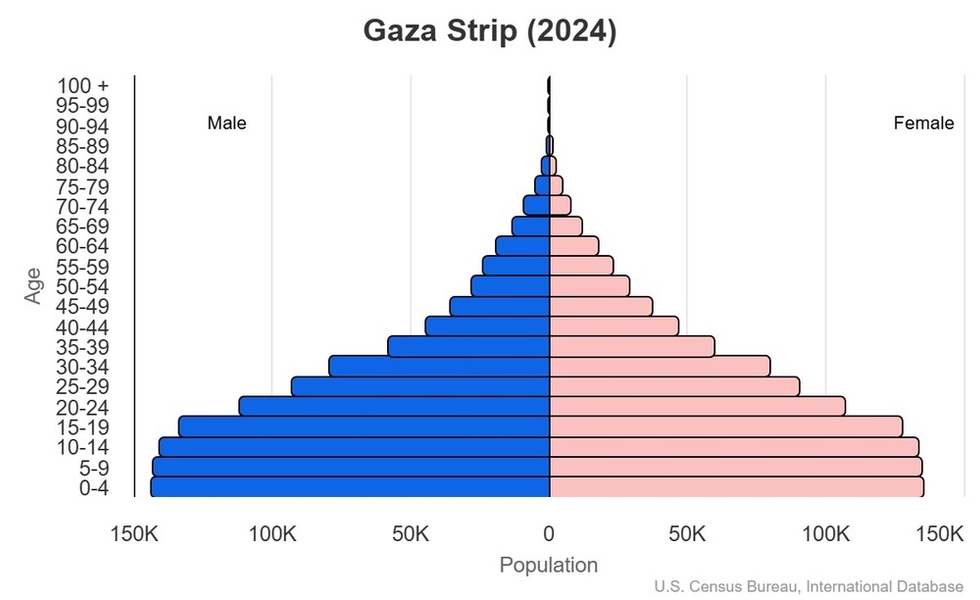
0-14 years: 38.8% (male 427,450/female 404,288)
15-64 years: 58.3% (male 627,235/female 620,903)
65 years and over: 2.9% (2024 est.) (male 31,655/female 30,112)
2024 population pyramid:
Dependency ratios
total dependency ratio: 71.6 (2024 est.)
youth dependency ratio: 66.6 (2024 est.)
elderly dependency ratio: 4.9 (2024 est.)
potential support ratio: 20.2 (2024 est.)
Median age
total: 19.5 years (2024 est.)
male: 19.3 years
female: 19.8 years
comparison ranking: total 208
Population growth rate
2.02% (2024 est.)
comparison ranking: 40
Birth rate
26.8 births/1,000 population (2024 est.)
comparison ranking: 38
Death rate
2.9 deaths/1,000 population (2024 est.)
comparison ranking: 225
Net migration rate
-3.7 migrant(s)/1,000 population (2024 est.)
comparison ranking: 190
Population distribution
population concentrated in major cities, particularly Gaza City in the north
Urbanization
urban population: 77.6% of total population (2023)
rate of urbanization: 2.85% annual rate of change (2020-25 est.)
note: data represent Gaza Strip and the West Bank
Major urban areas – population
778,000 Gaza (2023)
Sex ratio
at birth: 1.06 male(s)/female
0-14 years: 1.06 male(s)/female
15-64 years: 1.01 male(s)/female
65 years and over: 1.05 male(s)/female
total population: 1.03 male(s)/female (2024 est.)
Maternal mortality ratio
16 deaths/100,000 live births (2023 est.)
note: data represent Gaza Strip and the West Bank
comparison ranking: 133
Infant mortality rate
total: 15.1 deaths/1,000 live births (2024 est.)
male: 16.3 deaths/1,000 live births
female: 13.8 deaths/1,000 live births
comparison ranking: total 91
Life expectancy at birth
total population: 75.5 years (2024 est.)
male: 73.7 years
female: 77.4 years
comparison ranking: total population 126
Total fertility rate
3.26 children born/woman (2024 est.)
comparison ranking: 42
Gross reproduction rate
1.58 (2024 est.)
Contraceptive prevalence rate
note: includes Gaza Strip and West Bank
Drinking water source
improved:
total: 98.9% of population
unimproved:
total: 1.1% of population (2022 est.)
note: includes Gaza Strip and the West Bank
Health expenditure
13.5% of national budget (2022 est.)
note: includes Gaza Strip and the West Bank
Physician density
2.17 physicians/1,000 population (2020)
Hospital bed density
1.3 beds/1,000 population (2019 est.)
Sanitation facility access
improved:
urban: 100% of population (2022 est.)
rural: 99% of population (2022 est.)
total: 99.8% of population
unimproved:
urban: 0% of population (2022 est.)
rural: 1% of population (2022 est.)
total: 0.2% of population (2022 est.)
note: includes Gaza Strip and the West Bank
Children under the age of 5 years underweight
2.1% (2019/20)
note: estimate is for Gaza Strip and the West Bank
comparison ranking: 94
Currently married women (ages 15-49)
62.4% (2023 est.)
note: data includes Gaza and the West Bank
Child marriage
women married by age 15: 0.7% (2020)
women married by age 18: 13.4% (2020)
note: includes both the Gaza Strip and the West Bank
Education expenditure
5.4% of GDP (2021 est.)
note: includes Gaza Strip and the West Bank
comparison ranking: Education expenditure (% GDP) 47
Literacy
total population: 98% (2022 est.)
male: 99% (2022 est.)
female: 97% (2022 est.)
note: estimates are for Gaza Strip and the West Bank
School life expectancy (primary to tertiary education)
total: 13 years (2023 est.)
male: 12 years (2023 est.)
female: 14 years (2023 est.)
note: data represent Gaza Strip and the West Bank
Environment
Environmental issues
soil degradation; desertification; water pollution from chemicals and pesticides; salination of fresh water; improper sewage treatment; depletion and contamination of underground water resources
Climate
temperate, mild winters, dry and warm to hot summers
Land use
agricultural land: 64.9% (2022 est.)
arable land: 7% (2022 est.)
permanent crops: 11.8% (2022 est.)
permanent pasture: 46.1% (2022 est.)
forest: 1.7% (2022 est.)
other: 33.4% (2022 est.)
Urbanization
urban population: 77.6% of total population (2023)
rate of urbanization: 2.85% annual rate of change (2020-25 est.)
note: data represent Gaza Strip and the West Bank
Carbon dioxide emissions
3.913 million metric tonnes of CO2 (2023 est.)
from petroleum and other liquids: 3.913 million metric tonnes of CO2 (2023 est.)
note: includes the West Bank and the Gaza Strip
comparison ranking: total emissions 142
Particulate matter emissions
31.3 micrograms per cubic meter (2019 est.)
Waste and recycling
municipal solid waste generated annually: 1.387 million tons (2016 est.)
municipal solid waste recycled annually: 6,935 tons (2013 est.)
percent of municipal solid waste recycled: 0.5% (2013 est.)
note: data represent combined total from the Gaza Strip and the West Bank.
Total water withdrawal
municipal: 181.2 million cubic meters (2017 est.)
industrial: 32 million cubic meters (2017 est.)
agricultural: 162 million cubic meters (2017 est.)
note: data represent combined total from the Gaza Strip and the West Bank.
Total renewable water resources
840 million cubic meters (2020 est.)
note: data represent combined total from the Gaza Strip and the West Bank.
Government
Country name
conventional long form: none
conventional short form: Gaza, Gaza Strip
local long form: none
local short form: Qita’ Ghazzah
etymology: named for the largest city in the enclave, Gaza, whose settlement can be traced back to at least the 15th century B.C. (as “Ghazzat”); “Strip” refers to its elongated shape along the Mediterranean
Economy
Real GDP (purchasing power parity)
$20.339 billion (2024 est.)
$27.694 billion (2023 est.)
$29.016 billion (2022 est.)
note: data in 2021 dollars; entry includes West Bank and Gaza Strip
comparison ranking: 155
Real GDP growth rate
-26.6% (2024 est.)
-4.6% (2023 est.)
4.1% (2022 est.)
note: annual GDP % growth based on constant local currency; entry includes West Bank and Gaza Strip
comparison ranking: 217
Real GDP per capita
$3,800 (2024 est.)
$5,400 (2023 est.)
$5,800 (2022 est.)
note: data in 2021 dollars; entry includes West Bank and Gaza Strip
comparison ranking: 184
GDP (official exchange rate)
$13.711 billion (2024 est.)
note: data in current dollars at official exchange rate; entry includes West Bank and Gaza Strip
Inflation rate (consumer prices)
53.7% (2024 est.)
5.9% (2023 est.)
3.7% (2022 est.)
note: annual % change based on consumer prices; entry includes West Bank and Gaza Strip
comparison ranking: 205
GDP – composition, by sector of origin
agriculture: 5.7% (2022 est.)
industry: 17.4% (2022 est.)
services: 58.3% (2022 est.)
note: figures may not total 100% due to non-allocated consumption not captured in sector-reported data
comparison rankings: services 100; industry 150; agriculture 103
GDP – composition, by end use
household consumption: 95.5% (2024 est.)
government consumption: 20.7% (2024 est.)
investment in fixed capital: 21.8% (2024 est.)
investment in inventories: 1.7% (2024 est.)
exports of goods and services: 21% (2024 est.)
imports of goods and services: -60.3% (2024 est.)
note: figures may not total 100% due to rounding or gaps in data collection
Agricultural products
tomatoes, milk, cucumbers/gherkins, olives, potatoes, sheep milk, eggplants, pumpkins/squash, grapes, goat milk (2023)
note: top ten agricultural products based on tonnage
Industries
textiles, food processing, furniture
Industrial production growth rate
-32.2% (2024 est.)
note: annual % change in industrial value added based on constant local currency; entry includes West Bank and Gaza Strip
comparison ranking: 195
Labor force
1.391 million (2022 est.)
note: number of people ages 15 or older who are employed or seeking work; entry includes West Bank and Gaza Strip
comparison ranking: 136
Unemployment rate
24.5% (2022 est.)
26.4% (2021 est.)
25.9% (2020 est.)
note: % of labor force seeking employment; entry includes West Bank and Gaza Strip
comparison ranking: 187
Youth unemployment rate (ages 15-24)
total: 36.1% (2022 est.)
male: 31.6% (2022 est.)
female: 56.6% (2022 est.)
note: % of labor force ages 15-24 seeking employment
comparison ranking: total 14
Population below poverty line
29.2% (2016 est.)
note: % of population with income below national poverty line; entry includes West Bank and Gaza Strip
Gini Index coefficient – distribution of family income
36.4 (2023 est.)
note: index (0-100) of income distribution; higher values represent greater inequality; entry includes West Bank and Gaza Strip
comparison ranking: 68
Household income or consumption by percentage share
lowest 10%: 2.5% (2023 est.)
highest 10%: 27.1% (2023 est.)
note: % share of income accruing to lowest and highest 10% of population; entry includes West Bank and Gaza Strip
Remittances
5.4% of GDP (2024 est.)
18.2% of GDP (2023 est.)
24% of GDP (2022 est.)
note: personal transfers and compensation between resident and non-resident individuals/households/entities; entry includes West Bank and Gaza Strip
Budget
revenues: $3.803 billion (2020 est.)
expenditures: $5.002 billion (2020 est.)
see entry for the West Bank
Taxes and other revenues
21.5% (of GDP) (2021 est.)
note: central government tax revenue as a % of GDP; entry includes West Bank and Gaza Strip
comparison ranking: 38
Current account balance
-$2.899 billion (2024 est.)
-$2.895 billion (2023 est.)
-$2.037 billion (2022 est.)
note: balance of payments – net trade and primary/secondary income in current dollars; entry includes West Bank and Gaza Strip
comparison ranking: 156
Exports
$2.885 billion (2024 est.)
$3.413 billion (2023 est.)
$3.533 billion (2022 est.)
note: balance of payments – exports of goods and services in current dollars; entry includes West Bank and Gaza Strip
comparison ranking: 157
Exports – partners
Jordan 51%, Turkey 12%, UAE 8%, Saudi Arabia 5%, UK 4% (2023)
note: top five export partners based on percentage share of exports; entry includes the West Bank and the Gaza Strip
Exports – commodities
scrap iron, tropical fruits, olive oil, building stone, prepared meat (2023)
note: top five export commodities based on value in dollars; entry includes the West Bank and the Gaza Strip
Imports
$8.264 billion (2024 est.)
$11.637 billion (2023 est.)
$12.257 billion (2022 est.)
note: balance of payments – imports of goods and services in current dollars; entry includes West Bank and Gaza Strip
comparison ranking: 130
Imports – partners
Egypt 25%, Jordan 17%, China 8%, Germany 7%, UAE 7% (2023)
note: top five import partners based on percentage share of imports; entry includes the West Bank and the Gaza Strip
Imports – commodities
cement, raw sugar, cars, baked goods, perfumes (2023)
note: top five import commodities based on value in dollars; entry includes the West Bank and the Gaza Strip
Reserves of foreign exchange and gold
$1.328 billion (2024 est.)
$1.323 billion (2023 est.)
$896.9 million (2022 est.)
note: holdings of gold (year-end prices)/foreign exchange/special drawing rights in current dollars; entry includes West Bank and Gaza Strip
comparison ranking: 139
Exchange rates
see entry for the West Bank
Energy
Electricity access
electrification – total population: 100% (2022 est.)
note: includes the West Bank and the Gaza Strip
Electricity
installed generating capacity: 352,000 kW (2023 est.)
consumption: 6.956 billion kWh (2023 est.)
imports: 6.925 billion kWh (2023 est.)
transmission/distribution losses: 988 million kWh (2023 est.)
note: includes the West Bank and the Gaza Strip
comparison rankings: transmission/distribution losses 98; imports 38; consumption 119; installed generating capacity 158
Electricity generation sources
fossil fuels: 66.5% of total installed capacity (2023 est.)
solar: 33.5% of total installed capacity (2023 est.)
note: includes the West Bank and the Gaza Strip
Coal
exports: 1 metric tons (2023 est.)
note: includes the West Bank and the Gaza Strip
Petroleum
refined petroleum consumption: 29,000 bbl/day (2023 est.)
note: includes the West Bank and the Gaza Strip
Energy consumption per capita
14.991 million Btu/person (2023 est.)
note: includes the West Bank and the Gaza Strip
comparison ranking: 139
Communications
Telephones – fixed lines
total subscriptions: 384,000 (2023 est.)
subscriptions per 100 inhabitants: 7 (2023 est.)
note: entry includes the West Bank and the Gaza Strip
comparison ranking: total subscriptions 101
Telephones – mobile cellular
total subscriptions: 4.15 million (2023 est.)
subscriptions per 100 inhabitants: 78 (2021 est.)
note: entry includes the West Bank and the Gaza Strip
comparison ranking: total subscriptions 134
Broadcast media
1 TV station and about 10 radio stations; satellite TV accessible
Internet country code
.ps
note: IANA has designated .ps for the Gaza Strip, same as the West Bank
Internet users
percent of population: 87% (2023 est.)
note: includes the West Bank
Broadband – fixed subscriptions
total: 431,000 (2023 est.)
subscriptions per 100 inhabitants: 8 (2023 est.)
note: includes the West Bank
comparison ranking: total 103
Military and Security
Military and security forces
HAMAS maintains security forces inside Gaza in addition to its military wing, the ‘Izz al-Din al-Qassam Brigades; the military wing ostensibly reports to the HAMAS Political Bureau but operates with considerable autonomy; there are several other militant groups operating in the Gaza Strip, most notably the Al-Quds Brigades of Palestinian Islamic Jihad, which are usually but not always beholden to HAMAS’s authority (2024)
Military expenditures
not available
Military and security service personnel strengths
prior to the start of the 2023-2025 conflict with Israel, the military wing of HAMAS was estimated to have 20-30,000 fighters (2024)
Military equipment inventories and acquisitions
the military wing is armed with light weapons, including an inventory of rocket, anti-tank, anti-aircraft, indirect fire (typically mortars), and armed UAV capabilities; HAMAS acquires its weapons through smuggling or local construction and receives significant military support from Iran (2024)
Terrorism
Terrorist group(s)
Terrorist group(s): Army of Islam; Abdallah Azzam Brigades; al-Aqsa Martyrs Brigade; HAMAS; Islamic Revolutionary Guard Corps/Qods Force; Palestine Islamic Jihad (PIJ); Palestine Liberation Front; Popular Front for the Liberation of Palestine (PFLP); PFLP-General Command
note: details about the history, aims, leadership, organization, areas of operation, tactics, targets, weapons, size, and sources of support of the group(s) appear(s) in the Terrorism reference guide
Transnational Issues
Refugees and internally displaced persons
IDPs: 2,032,011 (2024 est.)