


One of the most important questions every trader must answer is how much to risk on each trade. The answer preferred by most professionals is the 1% rule. This simple guideline keeps losses small enough that a normal string of losing trades cannot destroy an account.
This article explains exactly how the 1% rule works, how to calculate position size, and why so many successful traders treat it as non-negotiable.
What the 1% Rule Actually Means
The 1% rule states that you should never risk more than 1% of your total account equity on any single trade. If your account is $5,000, the maximum loss you allow on one trade is $50.
Some conservative traders use 0.5%. A few experienced traders with proven systems go up to 2%. For the majority of people, especially beginners, 1% remains the practical standard.
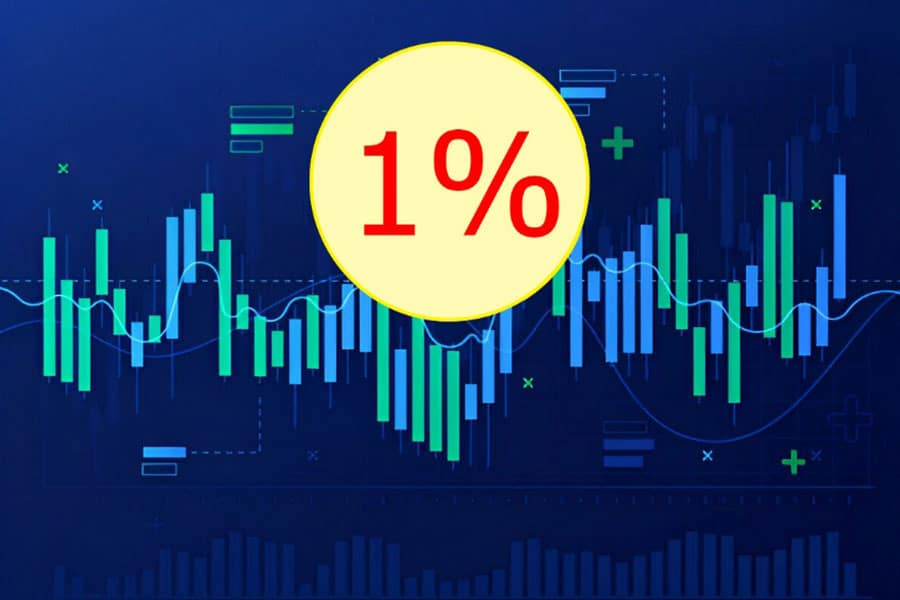
The 1% rule keeps individual losses small and survivable.
Why the 1% Rule Works So Well
Markets are unpredictable in the short term. Even strong strategies experience losing streaks. When risk is limited to 1%, ten consecutive losses reduce the account by only about 10%. Recovery remains realistic.
Did you know that many accounts are wiped out not by one bad trade but by a series of oversized losses? The 1% rule directly prevents that outcome.
The shocking truth is that most retail traders risk far more than 1% and then struggle to understand why their equity curve is so volatile.
How to Calculate Position Size Using the 1% Rule
Follow these steps for every trade:
- Determine your account equity
- Calculate 1% of that equity (this is your maximum risk in dollars)
- Measure the distance from your entry to your stop loss in pips
- Use a position size calculator or simple formula to find the lot size that matches the allowed risk
Example: Account = $10,000 1% risk = $100 Stop loss = 25 pips The position size is adjusted so that 25 pips equals $100 of risk.
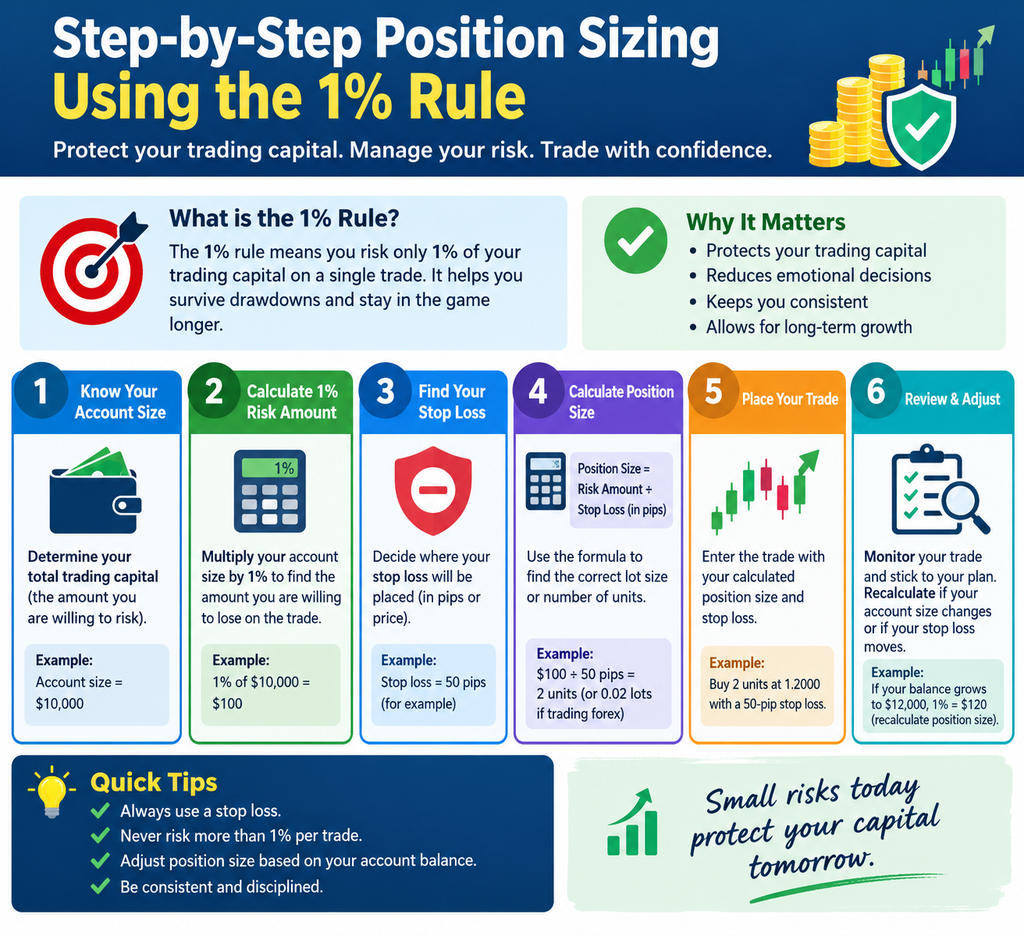
Correct position sizing turns the 1% rule into practical protection.
What Happens When Traders Ignore the Rule
Common results of risking too much include:
- Large drawdowns that take months to recover
- Emotional pressure that leads to further rule-breaking
- Account blow-ups after a normal series of losses
- Inability to stay in the market long enough for an edge to appear
The hidden cost is not only the money lost but the confidence and consistency that disappear with it.
Adjusting the Rule for Different Situations
While 1% is the standard, small adjustments can make sense:
- Reduce to 0.5% during highly volatile news periods
- Reduce size when trading a new or untested strategy
- Keep risk consistent even after a winning streak — never increase percentage just because recent trades went well
The key is that the percentage stays small and controlled at all times.

Lower risk during high volatility adds an extra layer of protection.
Combining the 1% Rule with Other Risk Controls
The 1% rule works best when paired with additional safeguards:
- A daily loss limit (for example 2–3% of the account)
- A maximum number of trades per day
- Hard stop losses that are never moved farther away
- A positive risk-reward ratio on every setup
Together these rules form a complete capital protection system.
Practical Habits That Make the Rule Stick
- Calculate position size before entering every trade
- Write the risk amount in your trading journal
- Review weekly whether you stayed at or below 1%
- Treat any violation as a serious process error, not a minor slip
Consistency with this single rule often produces better results than searching for new strategies.
Final Thoughts and Next Steps
The 1% rule is simple, powerful, and proven. It answers the question of how much you should risk per trade with clarity and discipline. Traders who follow it give themselves the best chance of surviving the learning curve and reaching consistent profitability.
Start applying it today. Calculate the correct position size for your next setup using 1% of your current equity and commit to the rule for the next 20 trades.
Ready to protect your capital? Open your account balance, work out 1% of that amount, and use it as the maximum risk on every trade from this point forward.
Frequently Asked Questions
Is the 1% rule suitable for beginners?
Yes. It is especially important for beginners because it prevents large early losses while skills are still developing.
Can I risk more than 1% if I feel very confident?
No. Confidence is not a reason to increase risk. The rule exists to protect you from overconfidence as much as from fear.
What if my account is very small?
Use micro lots or cent accounts so that the 1% rule can still be applied. Never abandon the percentage just because the account is small.
Should I change the percentage after a big win?
No. Keep the same percentage. Increasing risk after wins is a common path to giving back profits.
Does the 1% rule guarantee profits?
No. It guarantees that losses stay controlled. Profits still require a valid edge and consistent execution.
How do I calculate 1% quickly?
Multiply your account equity by 0.01. Most trading platforms and free online calculators can then convert that dollar risk into the correct lot size.
For further study of position sizing and risk principles, review educational resources from BabyPips and detailed guides on Investopedia.