



China probes US semiconductor sector as tensions between Washington and Beijing intensify over technology, security, and trade. The investigation marks another escalation in the long-running chip war, where both sides are battling for dominance in the high-tech industry that powers everything from smartphones to advanced defense systems.
This move reflects Beijing’s determination to push back against US restrictions on Chinese access to critical chip technology. It also raises concerns for global markets already facing supply chain disruptions. With semiconductors being the backbone of the digital economy, the probe could shape the future of international trade and technological competition.
China Probes US Semiconductor Sector: Rising Tensions in Global Tech War
China probes US semiconductor sector in a move that has sent ripples through global markets and the high-tech industry. The investigation, announced by Beijing, signals yet another escalation in the ongoing tech rivalry between the world’s two largest economies.
The Background: A Battle Over Chips
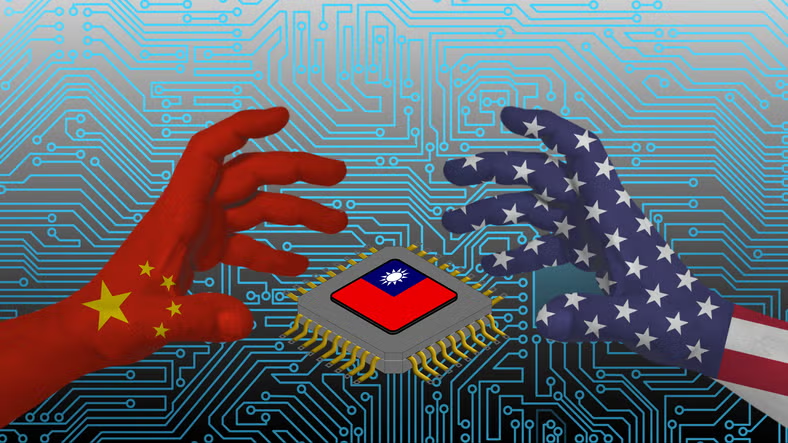
The United States and China have been locked in a struggle over semiconductors for years. Semiconductors, also known as microchips, are essential for modern life. They power smartphones, computers, cars, artificial intelligence systems, and military equipment. Whoever leads in this industry controls the future of global technology.
The US has imposed export controls that restrict China’s access to advanced chips and the tools needed to manufacture them. Washington argues that the measures are necessary to protect national security, as high-end semiconductors are critical for artificial intelligence and defense technologies.
Beijing views these restrictions as an attempt to contain its growth and slow down its technological rise. The latest probe into the US semiconductor sector appears to be China’s way of responding to what it sees as unfair barriers.
What the Probe Means
Details of the probe remain limited, but analysts believe Beijing may target US chipmakers operating in China or suppliers linked to American companies. This could include demands for compliance reviews, antitrust investigations, or tighter regulations on imports.
By probing the US semiconductor sector, China sends a clear signal: it will not stand by quietly while the US tightens its grip on technology. Instead, Beijing is willing to use its massive domestic market and regulatory power as leverage in the ongoing standoff.
Global Supply Chains at Risk
The semiconductor industry is already under pressure from disruptions caused by the pandemic, geopolitical tensions, and natural disasters. A Chinese investigation into US chipmakers could further complicate supply chains, driving up costs and creating uncertainty for businesses worldwide.
Many global companies rely on semiconductors produced in the US, Taiwan, South Korea, and China. If China imposes new restrictions or penalties on US firms, the ripple effects could reach industries from consumer electronics to automotive manufacturing.
The Bigger Picture: The Chip War
The probe cannot be seen in isolation. It is part of a much larger “chip war” between the US and China. Washington has taken steps to block Chinese access to cutting-edge chips, while also investing billions in domestic chip production through the CHIPS and Science Act.
China, on the other hand, has poured resources into its own semiconductor sector, hoping to achieve self-sufficiency. Although it has made progress in areas like memory chips, China still lags behind in advanced processors. That gap explains why access to US technology remains so important.
By probing the US semiconductor sector, China is signaling its willingness to fight back and potentially force concessions.
Industry Reaction
Chipmakers and investors are watching the developments closely. US companies with strong ties to China, such as Intel, Qualcomm, and Micron, could face increased scrutiny. Micron, in fact, has already been the target of past investigations by Chinese regulators.
Industry groups warn that escalating tensions could harm innovation and slow down global progress in areas like artificial intelligence and 5G networks. Collaboration between the US and China has historically fueled technological growth. The breakdown of that cooperation threatens to fragment the industry into competing blocs.
Impact on Global Economy
Semiconductors are not just another product. They are a strategic resource that powers the global economy. Any disruption in their supply can have far-reaching consequences.
For instance, the global car industry has already experienced production delays due to chip shortages. If the China-US tech war further restricts supply, consumers could face higher prices for electronics, cars, and other essential goods. Stock markets, sensitive to semiconductor news, could also experience volatility.
National Security Dimensions
Both the US and China frame the semiconductor conflict in terms of national security. Washington fears that advanced chips could strengthen China’s military and intelligence capabilities. Beijing, in turn, views US restrictions as attempts to weaken its sovereignty and deny it the tools to compete globally.
By probing the US semiconductor sector, China is likely trying to show strength both domestically and internationally. For Beijing, this move demonstrates to its citizens that it will defend national interests in the face of foreign pressure.
What’s Next?
The coming months will reveal how far China plans to take its probe into the US semiconductor sector. If the investigation leads to penalties or restrictions on US firms, the tech rivalry could escalate into a full-scale trade war with global consequences.
Some experts believe that the two powers may eventually reach limited agreements to prevent the worst-case scenarios. Others warn that the rivalry is structural and will only deepen as both countries compete for technological dominance.
Conclusion
China probes US semiconductor sector at a moment when the global tech war is already reshaping the world economy. The move underscores how critical microchips have become—not just as economic tools, but as strategic assets tied to national security and global power.
For now, businesses, governments, and consumers around the world will watch closely as the US-China rivalry continues to unfold. The future of technology, trade, and innovation may very well depend on the outcome of this battle over semiconductors.