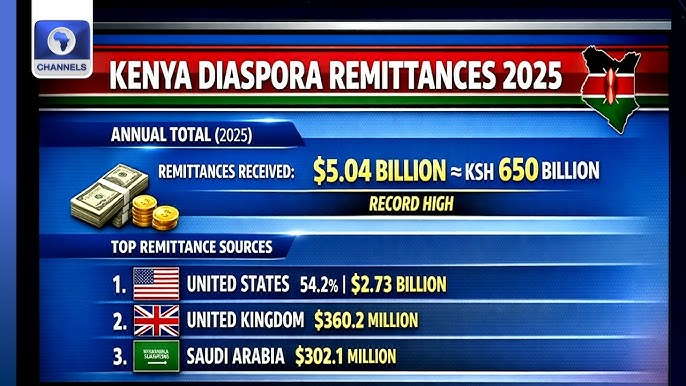
Diaspora remittances Kenya have emerged as one of the most reliable pillars of the national economy, delivering essential support to households while creating pathways for long-term wealth building. In 2025 alone, Kenyans abroad sent a record $5.04 billion (approximately KSh 650 billion), marking the first time inflows crossed the $5 billion threshold and accounting for roughly 4% of GDP. This guide provides authoritative, step-by-step insights into maximizing these funds through smart investments, efficient transfer methods, and government-backed initiatives.
By shifting from consumption-focused spending to productive assets, the Kenyan diaspora can secure family futures, generate passive income, and contribute to national development. Whether you are in the United States, United Kingdom, or the Gulf, understanding current trends and practical strategies will empower you to build generational wealth while strengthening Kenya’s economy.
Monthly diaspora remittances to Kenya (US$) from January 2024 to February 2026, showing consistent growth and the 2026 rebound (Source: Central Bank of Kenya data).
Understanding Diaspora Remittances
Diaspora remittances refer to money sent by Kenyans living and working abroad to their families or for investment back home. These transfers are private, voluntary, and typically recurrent, channeled through formal systems such as banks, mobile money platforms like M-Pesa, or international money transfer operators.
Unlike foreign aid or loans, remittances provide direct, flexible support with minimal bureaucracy. They reduce poverty, improve access to education and healthcare, and stabilize the Kenyan shilling by supplying consistent foreign exchange. However, data consistently shows that approximately 80% of remittances are used for daily consumption, leaving only 20% for savings or investment — a gap this guide aims to close.
Latest Statistics and Trends in Diaspora Remittances Kenya
Kenya’s diaspora remittances reached $5.04 billion in 2025, a 1.9% increase from $4.95 billion in 2024. The Central Bank of Kenya projects a further 4% rise in 2026 to $5.24 billion (approximately KSh 676 billion). Monthly inflows regularly exceed $400 million, with February 2026 recording $412.7 million — an 8% year-on-year increase.
The United States remains the largest source (over 50% of total inflows), followed by the United Kingdom, Saudi Arabia, and other Gulf nations. Formal channels now dominate, thanks to mobile money integration and licensed operators, reducing reliance on informal hawala systems.
How to Send Remittances to Kenya Efficiently and Cost-Effectively
Choosing the right transfer method minimizes fees and maximizes the amount received. Aim for costs below 3% to align with UN Sustainable Development Goals.
- Wise (formerly TransferWise): Transparent mid-market exchange rates, low fees, and direct bank or M-Pesa deposits.
- WorldRemit and Taptap Send: Fast mobile money transfers and cash pickup options.
- Sendwave and Nala: Competitive rates from the US, UK, and EU with instant M-Pesa crediting.
- Equity Bank and KCB diaspora services: Direct account-to-account transfers with dedicated support.
Step-by-step process: 1. Compare fees and exchange rates on the provider’s app or website. 2. Verify recipient details (phone number for M-Pesa or bank account). 3. Complete the transfer with ID verification. 4. Track in real time and confirm receipt.
Opening a Kenyan bank account from abroad (via diaspora banking units at Equity, KCB, or Co-operative Bank) allows recipients to access funds instantly and earn interest on savings.

Seamless M-Pesa integration makes diaspora remittances Kenya faster and more accessible than ever before.
Economic Impact of Remittances on Kenya
Remittances surpass traditional exports like tea and horticulture in foreign exchange earnings. They support household consumption, fund education and healthcare, and stimulate local businesses. In rural areas, they finance small enterprises and agricultural improvements.
At the macro level, they bolster Kenya’s current account, stabilize the currency during global shocks, and reduce reliance on external borrowing. The government recognizes this contribution through the State Department for Diaspora Affairs and targeted policies.
Wealth Building Strategies: Turning Remittances into Assets
The key to sustainable wealth lies in directing 20–30% of incoming remittances toward productive investments. Here are proven avenues.
Real Estate Investment — The Most Popular Choice
Diaspora remittances Kenya drive strong demand for residential and mixed-use properties in Nairobi, Kitengela, Ruiru, and emerging satellite towns. Rental yields average 6–8%, with capital appreciation of 8–12% annually in high-growth areas.
Step-by-step guide for diaspora investors: 1. Research locations using reputable agents or platforms like Property24 or BuyRentKenya. 2. Engage a lawyer for due diligence and title verification. 3. Use a power of attorney or trusted family member for site visits. 4. Finance through diaspora mortgage products offered by Kenyan banks. 5. Aim for off-plan developments or ready-to-rent units for quicker returns.
Real-world example: A Kenyan professional in Texas sends $1,500 monthly via Wise. After two years, the accumulated funds purchase a two-bedroom apartment in Ruiru that generates KSh 45,000 in monthly rent — covering the mortgage and creating positive cash flow.

Contemporary homes in Nairobi suburbs funded by diaspora remittances Kenya continue to deliver strong rental income and appreciation.
Capital Markets and Stock Investments
The Nairobi Securities Exchange (NSE) offers accessible entry for diaspora investors through licensed online brokers such as SBG Securities, Dyer & Blair, or Genghis Capital. You can trade shares, bonds, and exchange-traded funds remotely.
How to start: 1. Open a CDS (Central Depository System) account via a CMA-licensed broker. 2. Fund the account through your Kenyan bank or international transfer. 3. Choose diversified portfolios in banking, telecommunications, or consumer goods sectors. 4. Consider government infrastructure bonds for fixed returns with lower risk.
Dividends and capital gains provide passive income while supporting Kenya’s growth sectors.

The Nairobi Securities Exchange enables Kenyan diaspora to invest directly in the country’s leading companies from anywhere in the world.
Business and Agribusiness Ventures
Many diaspora members launch SMEs in agriculture, technology, or services. The Kenya Diaspora Investment Strategy 2025–2030 promotes pooled investment funds, diaspora bonds, and matching grants for priority sectors including renewable energy, healthcare, and creative industries.
Chamas (investment groups) allow collective purchasing of land or starting businesses, spreading risk and building community networks.
The Kenya Diaspora Investment Strategy 2025–2030
Launched by the State Department for Diaspora Affairs, this landmark framework shifts focus from consumption to productive investment. It introduces diaspora bonds, digital investment platforms, tax incentives, and streamlined business registration for non-residents.
Priority actions include building trust through transparent reporting, expanding online investment portals, and protecting diaspora assets. Kenyans abroad are encouraged to engage via the official diaspora.go.ke portal for updates and opportunities.
Best Practices and Risks to Avoid
Always use formal channels to avoid scams. Conduct thorough due diligence on investments and work with licensed professionals. Diversify across asset classes to mitigate currency, political, or market risks. Monitor exchange rates and inflation. Consult tax advisors regarding double taxation agreements.
Regular financial literacy updates from the Capital Markets Authority and Central Bank of Kenya help diaspora investors stay informed.
Diaspora remittances Kenya are far more than family support — they represent a powerful engine for personal wealth creation and national progress. By adopting disciplined sending habits and strategic investment approaches in real estate, capital markets, and business, Kenyans abroad can build lasting legacies while accelerating Kenya’s development agenda.
Start today: review your current remittance flows, open a diaspora-friendly bank or investment account, and explore opportunities aligned with the 2025–2030 strategy. The tools, data, and pathways are readily available — the choice to build wealth rests with you.
Frequently Asked Questions
What are the main sources of diaspora remittances Kenya?
The United States contributes over 50% of inflows, followed by the United Kingdom, Saudi Arabia, and other Gulf countries. North America and Europe dominate formal transfers.
How can I reduce the cost of sending remittances to Kenya?
Compare apps like Wise, WorldRemit, and Taptap Send for the lowest fees and best exchange rates. Direct M-Pesa transfers and diaspora bank accounts often cost under 2%.
Is real estate the best investment for Kenyan diaspora?
Real estate remains popular due to tangible ownership, rental income, and appreciation. However, combining it with stocks and bonds creates better diversification and risk management.
How does the Kenya Diaspora Investment Strategy help investors?
The strategy offers incentives, diaspora bonds, and digital platforms to channel remittances into productive sectors while providing legal protections and streamlined processes.
Can I invest in the Nairobi Securities Exchange from abroad?
Yes. Licensed brokers provide fully online trading platforms. You need a CDS account and can fund it via international transfers or local diaspora banking services.
What percentage of remittances is typically invested rather than spent?
Currently around 20%. Government and private initiatives aim to increase this through education, incentives, and accessible investment products.