

Interest rate decisions currency pairs feel the impact faster than almost any other asset class. A single announcement from the Federal Reserve, European Central Bank or Bank of England can send the dollar, euro or yen surging or plunging within seconds. The truth is that these moves are not random — they follow clear economic logic driven by capital flows and yield differentials.
Did you know that the largest one-day swings in major currency pairs often occur on the day of a central bank rate decision? Traders who understand the mechanics gain a decisive edge. This guide breaks down exactly how interest rate decisions currency pairs react, why expectations matter more than the decision itself, and what the longer-term consequences can be.
The Core Mechanism Revealed
At its heart, a currency’s value reflects the demand to hold it. Higher interest rates increase that demand because investors can earn more on deposits, government bonds and other interest-bearing assets denominated in that currency.
When a central bank raises rates:
- Foreign capital flows in seeking higher returns
- Demand for the currency rises
- The currency appreciates against others
When rates are cut:
- Holding the currency becomes less attractive
- Capital tends to leave
- The currency depreciates
The real driver is the interest rate differential between two countries. Interest rate decisions currency pairs move most powerfully when one central bank diverges from another.
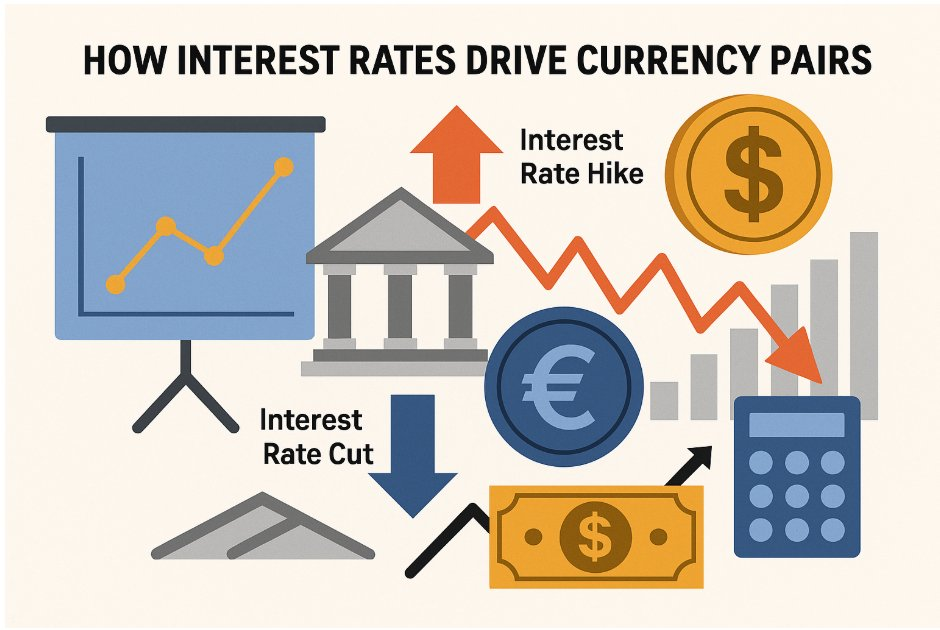
Major currency pairs often react within seconds of an interest rate announcement.
How Expectations Shape the Move
Markets are forward-looking. By the time the central bank announces its decision, traders have already positioned themselves based on forecasts and previous guidance.
Three scenarios dominate:
- Decision matches expectations — The currency may move only modestly or even reverse as traders take profits (“buy the rumour, sell the fact”).
- Surprise hike — A stronger-than-expected increase usually produces an immediate and sharp appreciation.
- Surprise cut — An unexpected reduction typically triggers rapid depreciation.
Forward guidance often outweighs the actual rate change. Language such as “higher for longer,” “data-dependent,” or signals of future cuts can move interest rate decisions currency pairs more than the headline number itself.
Major Currency Pairs and Typical Reactions
Different pairs respond with different intensity depending on which central banks are involved.
- EUR/USD — Highly sensitive to the gap between Federal Reserve and European Central Bank policy. A more hawkish Fed usually pushes the pair lower.
- USD/JPY — One of the purest interest-rate differential trades. When US rates rise relative to Japan’s near-zero rates, the dollar strengthens and the yen weakens.
- GBP/USD — Reacts strongly to Bank of England decisions relative to the Fed.
- AUD/USD and NZD/USD — Commodity currencies that also respond to domestic rate decisions by the Reserve Bank of Australia and Reserve Bank of New Zealand.
- USD/CAD — Influenced by both the Fed–Bank of Canada differential and oil prices.
The shocking reality is that even a 25-basis-point difference, sustained over time, can drive multi-year trends in these pairs.
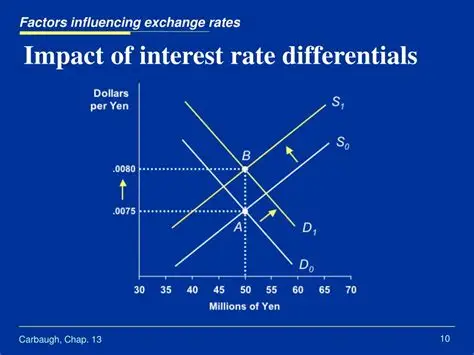
Interest rate differentials often explain the majority of medium-term trends in major currency pairs.
The Carry Trade and Hidden Flows
One of the most powerful long-term effects of interest rate decisions currency pairs is the carry trade. Investors borrow in a low-yielding currency (historically the Japanese yen or Swiss franc) and invest in higher-yielding currencies.
When rate differentials widen, carry trades expand and reinforce the trend. When differentials narrow or risk sentiment turns negative, these trades unwind rapidly, producing sharp reversals. The untold truth is that many of the largest moves in USD/JPY over the past two decades have been driven by the build-up and sudden collapse of carry positions.
Short-Term Volatility vs Longer-Term Trends
Interest rate decisions create two distinct phases of price action:
- Immediate reaction (seconds to hours) — Dominated by algorithmic trading, stop-loss cascades and speculative flows. Volatility can be extreme.
- Medium-term adjustment (days to weeks) — Institutional funds reallocate portfolios based on the new expected rate path.
- Longer-term structural shift (months) — Higher rates eventually slow economic growth and inflation, which can later reverse the currency’s strength.
Did you know that a currency that strengthens sharply after a rate hike can later weaken if the higher rates push the economy into recession? This is why experienced traders watch both the decision and the economic consequences that follow.

Caption: Volatility in major pairs frequently spikes around central bank announcements.
Real Interest Rates Matter More Than Nominal Rates
Sophisticated market participants focus on real interest rates — nominal rates minus expected inflation. A country offering high nominal rates but even higher inflation may still see its currency weaken because the real return remains unattractive.
This is why central bank communications about inflation outlooks often move interest rate decisions currency pairs as much as the rate decision itself.
Other Factors That Can Override Rate Decisions
Interest rates do not operate in isolation. Risk sentiment, geopolitical events, trade balances and unexpected economic data can temporarily overwhelm rate differentials. During global risk-off episodes, safe-haven currencies such as the US dollar, Japanese yen and Swiss franc can strengthen even if their interest rates are relatively low.
For authoritative data on current policy rates and historical decisions, traders regularly consult the Federal Reserve and the European Central Bank websites.

Caption: Central bank decisions remain the single most reliable catalyst for major currency moves.
Practical Takeaways for Market Watchers
To interpret interest rate decisions currency pairs effectively:
- Always compare the decision against market expectations, not just the previous rate.
- Read the accompanying statement and press conference for clues about the future path.
- Monitor the interest rate differential between the two currencies in the pair.
- Watch positioning data and risk sentiment for signs of overcrowded trades.
- Remember that the biggest opportunities often appear when the market’s reaction differs from the fundamental logic.
The secret that professional traders understand is that the decision itself is only the starting point. The real money is made by correctly anticipating how the new rate path will reshape capital flows over the following weeks and months.
Interest rate decisions currency pairs will continue to dominate forex market headlines for as long as central banks remain the primary architects of monetary conditions. Mastering this relationship remains one of the highest-value skills in global macro analysis.
Stay informed: Bookmark this page and return after the next major central bank meeting to test these principles in real time. Understanding how interest rate decisions currency pairs move is the foundation of informed currency analysis.
Frequently Asked Questions
Why do interest rate decisions move currency pairs so quickly?
Because higher rates attract capital flows seeking better yields, while lower rates reduce demand for the currency. These flows begin within seconds of the announcement.
What is an interest rate differential?
It is the gap between the policy rates of two countries. Wider differentials in favour of one currency typically strengthen that currency against the other.
Do all currency pairs react the same way to rate decisions?
No. Pairs involving the US dollar, euro, yen and pound tend to show the strongest and most consistent reactions because their central banks are the most closely watched.
Can a currency weaken after a rate hike?
Yes. If the hike is already fully priced in, or if markets fear the higher rates will damage economic growth, the currency can fall after the announcement.
What matters more — the rate decision or the forward guidance?
In many cases the guidance about future policy matters more. Markets trade the expected path of rates, not just the current level.
How can ordinary investors track these moves?
Follow official central bank calendars, watch the major pairs around announcement times, and pay attention to the interest rate differential between the two currencies involved.