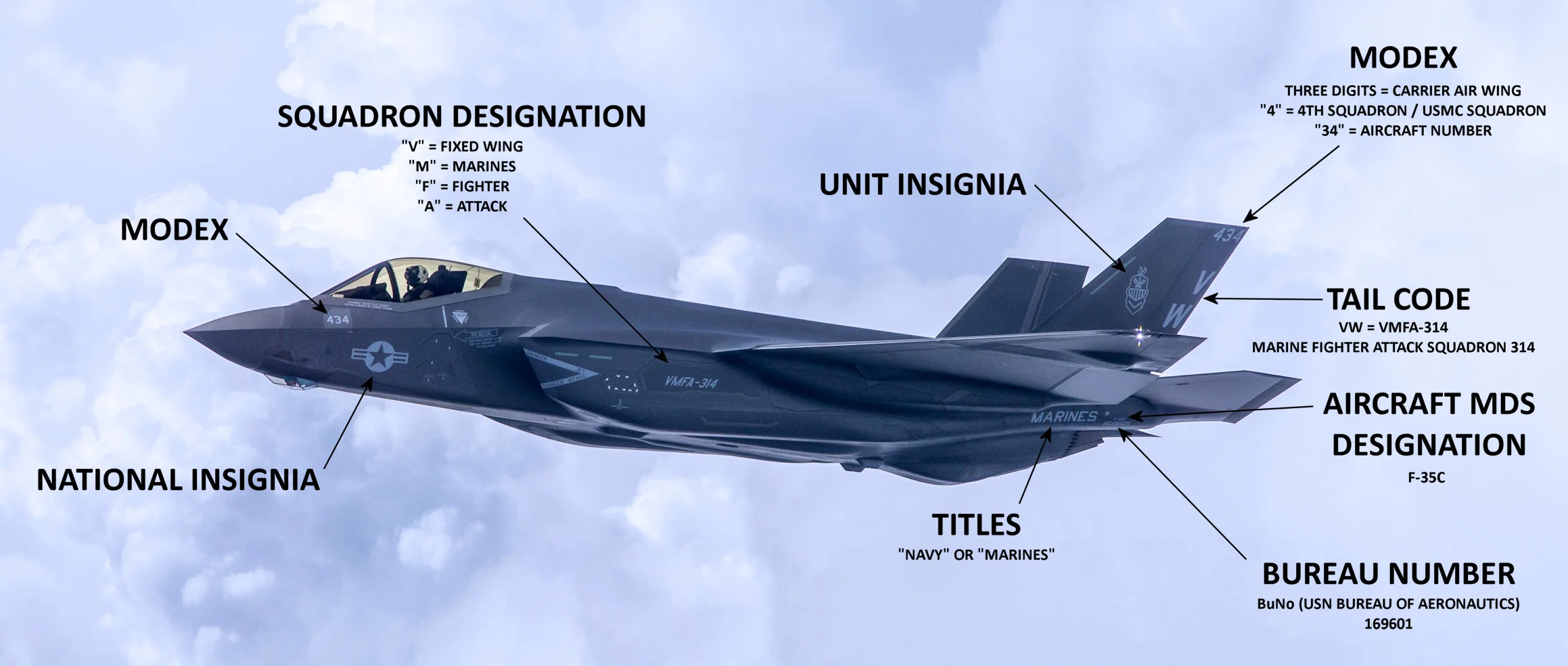
Decode US military aircraft designations with this guide. Learn to interpret type, mission, design numbers, and more to understand aircraft purposes.
Introduction
The United States military employs a detailed system for designating its aircraft, known as the Mission Design Series (MDS). Introduced in 1962 by the Department of Defense, this system standardized aircraft naming conventions across all branches of the military, replacing earlier systems unique to the Air Force, Navy, Marine Corps, Army, and Coast Guard.
Understanding this system not only offers insights into the aircraft’s purpose and capabilities but also allows enthusiasts and professionals alike to identify specific models and their roles in the US defense infrastructure. By decoding these designations, you can learn about the aircraft’s type, mission, modifications, design number, and even its operational status.
In this guide, we’ll break down the MDS designation format step by step, helping you read and understand the designations used for US military aircraft. Whether you’re a budding aviation enthusiast or preparing for professional purposes, mastering these designations is both engaging and practical.
Step-by-Step Guide to US Military Aircraft Designations
Step 1: Understand What the Designation Reveals
The Mission Design Series (MDS) designation provides six critical pieces of information about an aircraft:
- Type of aircraft (e.g., airplane, helicopter, drone).
- Basic mission (primary purpose, such as fighter or reconnaissance).
- Modified mission (special adaptations for other roles).
- Design number (model within the mission category).
- Series letter (version or variant of the model).
- Status prefix (if the aircraft is not in standard operational service).
Each part of the designation conveys specific details that distinguish one aircraft from another.
Step 2: Familiarize Yourself with the Format
The MDS designation follows the format:
(6)(3)(2)(1) – (4)(5)
- Symbols to the left of the hyphen identify the aircraft type, mission, and status.
- Numbers and letters to the right of the hyphen indicate the design number and series.
Step 3: Read from the Hyphen Outward
To decode the designation:
- Start from the hyphen and work outward to the left.
- Then, read everything to the right of the hyphen for details on the model and series.
Decoding the Designation Components
Step 4: Identify the Aircraft Type
If the designation includes a type symbol, it will appear immediately to the left of the hyphen. This indicates the general category of the aircraft. Common type symbols include:
- D – UAS Control Segment (e.g., aircraft directing drones).
- G – Glider (motorized or unpowered).
- H – Helicopter (rotary-wing aircraft).
- Q – UAS Vehicle (the drone itself).
- S – Spaceplane (operates both in and out of the atmosphere).
- V – VTOL/STOL (Vertical or Short Takeoff and Landing).
- Z – Lighter-than-air (e.g., balloons, dirigibles).
If there’s no type symbol, it’s assumed to be a fixed-wing airplane.
Step 5: Determine the Basic Mission
The letter immediately to the left of the hyphen denotes the aircraft’s basic mission—its primary intended use:
- A – Ground Attack (e.g., A-10 Thunderbolt II).
- B – Bomber (e.g., B-52 Stratofortress).
- C – Cargo/Transport (e.g., C-130 Hercules).
- E – Electronic Warfare (e.g., E-3 Sentry).
- F – Fighter (e.g., F-22 Raptor).
- H – Search and Rescue (e.g., HH-60 Pave Hawk).
- K – Tanker (e.g., KC-135 Stratotanker).
- L – Laser-equipped aircraft (newer designations).
- M – Multi-mission (versatile use).
- O – Observation (e.g., OV-10 Bronco).
- P – Patrol (often maritime).
- R – Reconnaissance (e.g., SR-71 Blackbird).
- S – Anti-Submarine (e.g., S-3 Viking).
- T – Trainer (e.g., T-38 Talon).
- U – Utility aircraft (general support).
- X – Experimental (e.g., X-37B Spaceplane).
Step 6: Identify Modified Missions
A modified mission letter (if present) appears immediately to the left of the basic mission letter. This indicates that the aircraft has been adapted for an additional or alternate purpose. Common modifiers include:
- A – Attack modification.
- C – Cargo/transport modification.
- D – Drone controller.
- F – Fighter modification.
- L – Arctic/Antarctic operations.
- M – Multi-mission adaptation.
- Q – UAV/drone designation.
- R – Reconnaissance.
- S – Anti-submarine.
- T – Trainer adaptation.
- V – VIP transport.
- W – Weather reconnaissance.
Step 7: Check for a Status Prefix
A status prefix (if present) appears farthest to the left in the designation. It provides details about the aircraft’s current operational state:
- C – Captive (non-launchable missile or rocket).
- D – Dummy (used for ground training).
- G – Permanently grounded (for training purposes).
- J – Temporary testing.
- N – Permanent testing configuration.
- X – Experimental aircraft.
- Y – Prototype (pre-production model).
- Z – Planning phase (concept only).
Step 8: Look for the Design Number
The first number after the hyphen identifies the aircraft’s design within its mission category. For instance:
- F-16: The 16th fighter design since 1962.
- B-2: The 2nd bomber design since 1962.
- SR-71: The 71st reconnaissance aircraft.
However, exceptions exist (e.g., X-35 became F-35, skipping ahead in the fighter sequence).
Step 9: Understand the Series Letter
A suffix letter following the design number indicates the aircraft variant:
- The initial version is labeled A.
- Subsequent versions proceed alphabetically, skipping I and O to avoid confusion with numbers.
For example, F-16A is the original model, while F-16C is a later, upgraded version.
Step 10: Additional Elements
Some aircraft include optional symbols for further distinction:
- Assigned Name: A popular name like “Eagle” (F-15) or “Raptor” (F-22).
- Block Number: Identifies minor sub-variants (e.g., F-15E-51).
- Manufacturer Code: Indicates the production plant (e.g., “GR” for Grumman).
Practice Examples
- AH-64:
- A: Attack.
- H: Helicopter.
- 64: 64th design.
- F-22A:
- F: Fighter.
- 22: 22nd design.
- A: Initial variant.
- MQ-9A:
- M: Multi-mission.
- Q: UAV.
- 9: 9th design.
- A: Initial variant.
Tips for Decoding
- Start from the hyphen and move outward for clarity.
- Remember type and mission symbols for common aircraft.
- Familiarize yourself with status prefixes and series letters to identify operational states and variants.
Conclusion
Understanding US military aircraft designations requires recognizing the structured format of the Mission Design Series (MDS). By decoding the type, mission, design number, and other components, you can easily interpret the purpose and capabilities of any US military aircraft. Whether for professional use or personal interest, this knowledge offers a fascinating glimpse into the world of aviation and defense technology.